


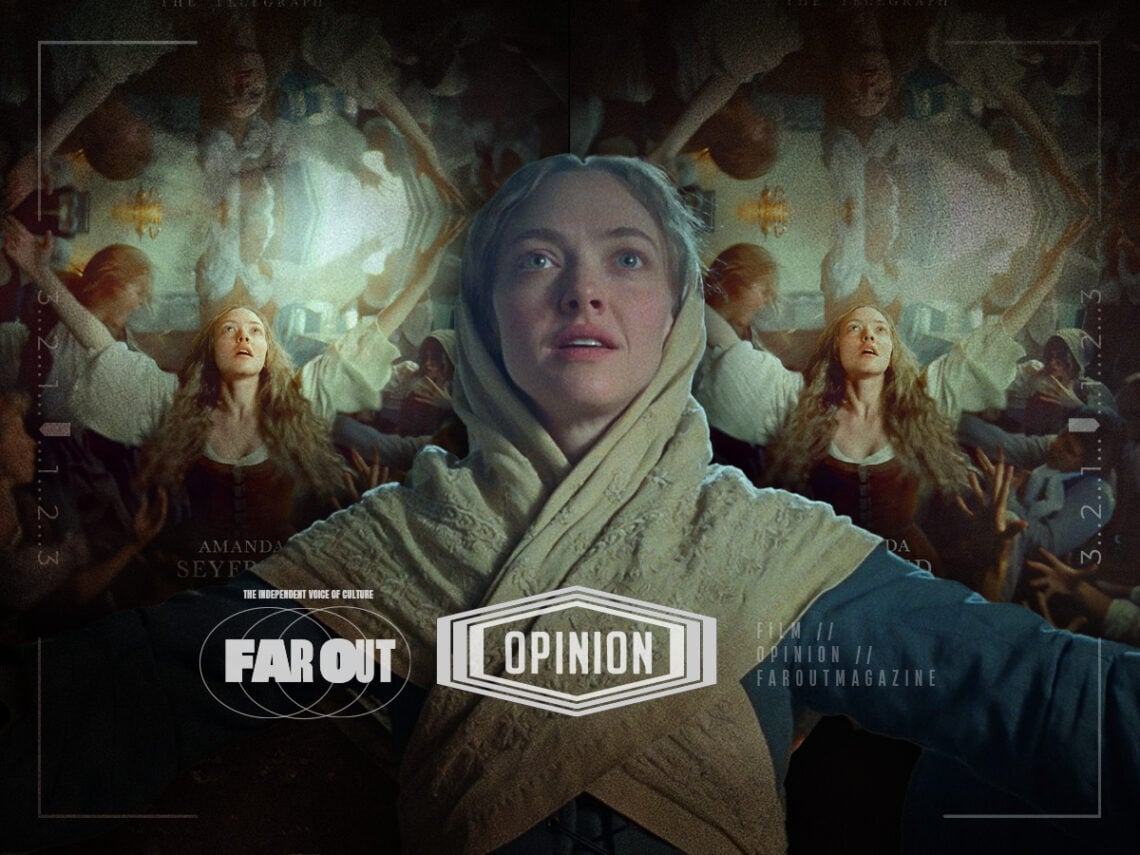
‘The Testament of Ann Lee’: Amanda Seyfried proves that a great performance can get lost in a cinematic mess

Recently feeling sorry for myself, I decided to stay in and mope until my friend suggested going to the cinema, but what would I like to go and see?
Knowing little about The Testament of Ann Lee besides it being a ‘career-defining’ performance for Amanda Seyfried, we settled on that, but then I wondered if it was the right decision.
I don’t believe that any film is ever really a waste of time, because even if you hate it or you’re bored out of your mind, you still come away with something to think about, but in this case, my main thought centred around confusion. What did I just watch? The Testament of Ann Lee was penned by The Brutalist’s Mona Fastvold and Brady Corbet, and while the latter directed last year’s Oscars hype machine, this religious epic saw Fastvold sit in the directorial chair. She clearly knows how to make a beautiful film; rather, it was the screenplay that felt like a complete and utter mess.
As soon as the film begins, we’re met with stunning cinematography and some animalistic dancing. It looks great, but you know what they (well, John Waters) say, “I believe if you come out of a movie and the first thing you say is ‘The cinematography was beautiful’, it’s a bad movie”. Certainly, the film has the makings of an epic religious period piece, with lighting inspired by masters like Caravaggio and Rembrandt and fluid camera movements, but it’s the actual meat of the story that feels, well, a bit raw and undercooked.
I hate to say it, but The Testament of Ann Lee was boring.
It wasn’t even an incredibly slow-paced film, even though it had musical numbers and everything, but there was something so flat about the narrative that left me, if I’m honest, fighting to keep my eyes open. And I’m not one to fall asleep during a film that easily, because I watched and enjoyed every minute of Chantal Akerman’s three-hour-and-20-minute-long Jeanne Dielman, 23 quai du Commerce, 1080 Bruxelles.
The Testament of Ann Lee is an hour shorter than that, but I couldn’t figure out what the movie was trying to say, and if we are meant to sympathise with Ann Lee. Her whole life was a tragedy founded upon sexual repression and grief following the deaths of all four of her babies, and this trauma emerges in a form of religious psychosis involving singing, wailing, and dancing, but the movie never goes far enough. I kept waiting for something to happen, anything to have me jolting awake and feeling something, yet that moment never came.
Much of the movie is narrated by Thomasin McKenzie’s Mary, and it feels like Fastvold and Corbet simply picked the quickest way to get as much information to the audience as possible, a cheat code, if you will. Watching it feels like witnessing a group of people trying to make something really profound and deeply cinematic, but like with Hamnet, it all felt a little trite, which also makes it surprising that The Testament of Ann Lee wasn’t nominated for any Oscars, because it’s exactly this kind of overwrought, dramatic biopic that the Academy usually eats up.
Among this mess of cringe-inducing musical numbers and terrible Manchester accents from much of the supporting cast is a really solid performance from Seyfried, who really is the heart of the film. She might be considerably more beautiful than the real Ann Lee, but she brings a desperation and uneasy sense of grief to the role that feels totally believable, and yet The Testament of Ann Lee just doesn’t do enough to leave you moved, even when she dies. The tone is bizarre, and you never know exactly how serious the film is trying to be. Where was the cohesion?
It didn’t feel like I could get close enough to Ann Lee, always slightly out of reach, so when the lights came on, I looked at my friends with a confounded expression. Was that good? Should I have liked that more than I did? What was the film actually trying to say? When those are the questions on your mind, it’s usually OK to admit to yourself that the film probably just wasn’t that noteworthy.
