


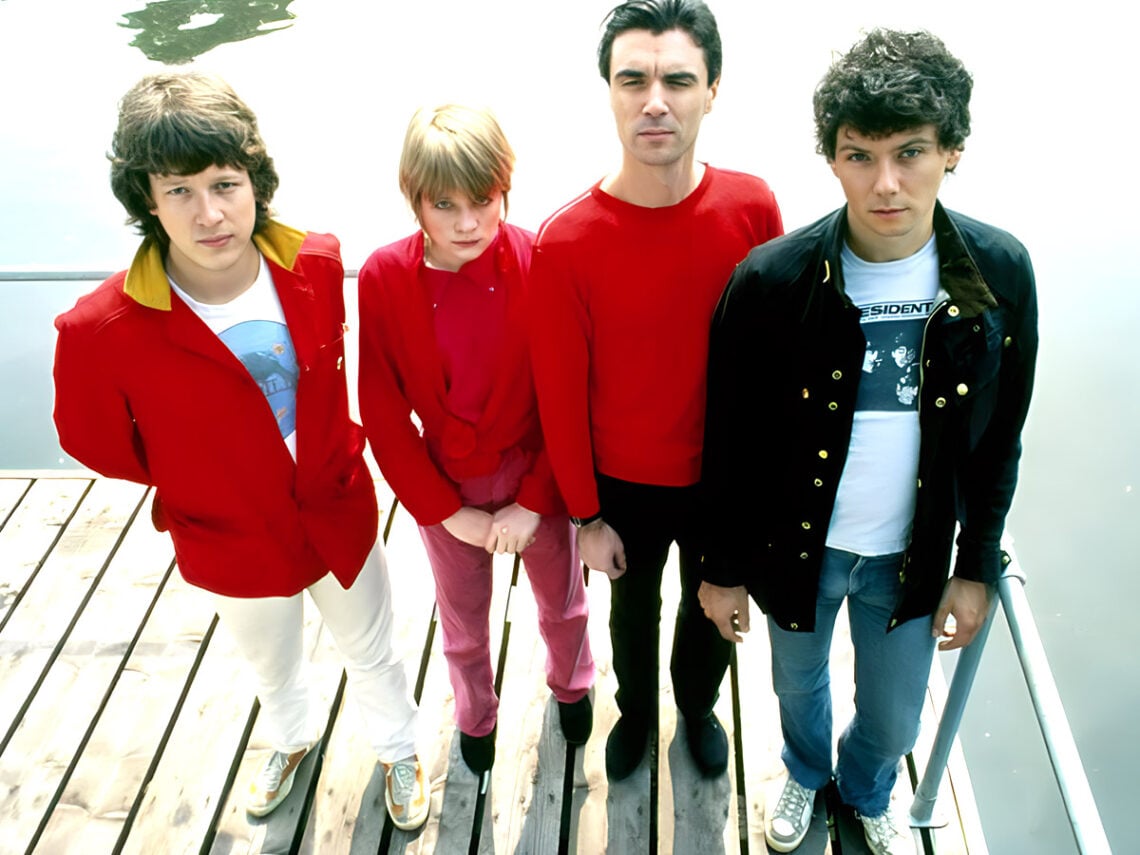
The Talking Heads song that inspired ‘American Psycho’

Given the surface-level utopian themes and positive worldbeat sound of Talking Heads’ 1988 hit ‘(Nothing But) Flowers’, it’s hard to imagine its lyrics acting as an inspiration for one of the most violently nihilistic works of fiction of the 20th century. However, despite its portrayal of the world returning to simpler times where capitalism no longer plagues our everyday lives, Byrne’s depiction of a beautiful green world with no smoke-belching factories and fast food outlets isn’t exactly an entirely positive one.
Tying this into Bret Easton Ellis’ 1991 novel American Psycho suddenly becomes a lot easier given how its protagonist, the vain and psychologically deranged Wall Street investment banker Patrick Bateman, is so obsessed with consumerism and is absorbed by the shallowness of following societal trends. The New York City that Bateman inhabits is so dependent on technological advancements and capitalism that it would collapse if it were suddenly stripped of these elements, and this is exactly the point that Byrne is attempting to make in the song.
The band’s bassist, Tina Weymouth, described the song as being a “complete phantasm of what would happen if the predictions of Nostradamus are true and in the year 2000 it’s all over.” While Ellis’ work doesn’t exactly follow this same post-apocalyptic stance, it does focus on a character who is struggling to cope with the pressures of society to the point that he’s beginning to crumble under its demands.
In Byrne’s eyes, people are so wrapped up in their own ambitions to save the world from the evils of capitalism that they don’t realise just how important some of its facets are to their own existence, and by totally ridding society of the simple commodities such as motorways and convenience stores, the world that we have built for ourselves suddenly begins to cease functioning.
In a sense, the song is almost an inverse of Joni Mitchell’s ‘Big Yellow Taxi’, which has the line “don’t it always seem to go that you don’t know what you’ve got ‘til it’s gone? They paved paradise, put up a parking lot.” Byrne directly responds to this line in ‘(Nothing But) Flowers’, saying, “Once there were parking lots, now it’s a peaceful oasis,” making the argument that hindsight is important in this context and that a balance needs to be struck in order for both this world of peaceful green pastures and technological advance can live in harmony.
Where skyscrapers previously stood, there are now fields of daisies, but how will society fare without the infrastructure it has built for itself to survive in the modern world? This question is what Byrne asks in ‘(Nothing But) Flowers’, and this question of accelerated urban decay is brought up in the line “and as things fell apart, nobody paid much attention” towards the end of the song. It’s this line that was a direct influence on Ellis when writing American Psycho and was used as an epigraph at the start of the novel.
While not the most obvious song to tie into the ultra-violent setting of American Psycho, it’s one that asks many of the same questions as Ellis’ masterwork. Sure, it would have been easier to tie in ‘Psycho Killer’ to the themes of the book, but it wouldn’t have posed quite the same level of philosophical debate that having the more existential horror of the seemingly joyous ‘(Nothing But) Flowers’ provided for the book.
