


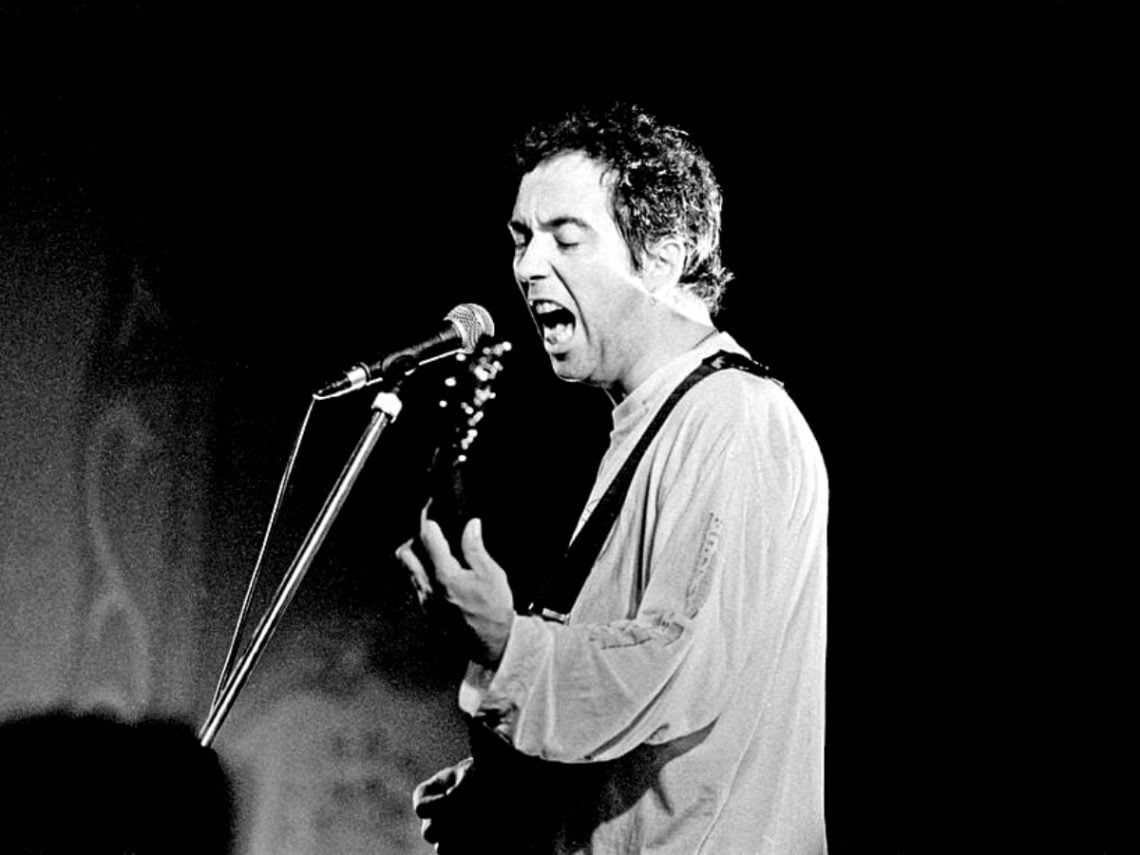
The story of how Buzzcocks and Magazine came to share a song

When looking back on the crucial punk and post-punk years, the names of two groups invariably rise to the top. The type of bands that were so pioneering that, in the main, their music still stands up to scrutiny today. This is not Sex Pistols or The Clash – who hailed from the leafy streets of London – but rather Buzzcocks and Magazine, outfits that remain inextricably linked. Both originated in the post-industrial northern town of Bolton before flourishing amidst the backdrop of 1970s Manchester, a city still very much haunted by the ghosts of the Second World War.
Buzzcocks were formed in 1976, and at the time, the two founding members had no idea how significant they would be. However, their embryonic configuration came together nearly two years prior, after Howard Trafford, a fan of electronic music and a student at Bolton’s Institute of Technology, placed a notice looking for musicians who were fans of The Velvet Underground song, ‘Sister Ray’. A young fan of rock, Peter McNeish, who was also a student, responded to the notice.
By late 1975, the pair had recruited a drummer and formed a very early version of what would become Buzzcocks, with the band then officially forming under the name in February 1976. At this point, the founding pair adopted the names they are known by today. Trafford became Howard Devoto, and McNeish became Pete Shelley.
Perhaps the most consequential moment in their early career was setting up the now-iconic Sex Pistols show at the Lesser Free Trade Hall in Manchester in June 1976, an event which is regarded by many as the catalyst that kicked off the city’s long-running music scene. Demonstrating this, members of Joy Division, Morrissey, John Cooper Clarke, Mark E. Smith and even Mick Hucknall were all in attendance. Buzzcocks had also intended to play this show, but as the other band members dropped out, this was impossible. Nevertheless, after recruiting components of what would become their classic lineup, Steve Diggle and John Maher, they eventually made their debut opening for Johnny Rotten and the gang at their second show in Manchester that July.
In September, the band then confirmed their position as one of the vanguards of the emergent punk genre when they travelled to London to perform at the two-day 100 Club Punk Festival. It featured sets from Sex Pistols, The Damned, The Clash, and the debut of Siouxsie and the Banshees, consolidating punk as a genuine movement and cultural force.
Fast forward to January 1977, and Buzzcocks released their four-track EP, Spiral Scratch, on their New Hormones label, which boasted the punk classics ‘Boredom’ and ‘Breakdown’. It was another significant moment, as they became one of the first punk bands to establish an independent record label, behind only The Saints with Fatal Records, which they had founded to release ‘(I’m) Stranded’. However, the band’s first chapter was about to end, and only a few months later, Devoto left the group, dissatisfied with the direction of the punk movement. In his statement, he said: “I don’t like movements. What was once unhealthily fresh is now a clean old hat”.
In mid-1977, Devoto met a Scottish art student going by the name of John McGeoch. They started writing songs together and quickly formed a group that became one of the most vital post-punk bands, Magazine. Cited as a defining influence on Radiohead and John Frusciante, the band’s oeuvre is always worth checking out for those unfamiliar with them. Together, they pushed the boundaries of what was thought possible, with Devoto’s songwriting improving greatly and McGeoch establishing himself as one of the era’s most eminent guitarists. After his stint with Devoto, McGeoch would go on to play with Siouxsie and the Banshees, The Armoury Show and Public Image Ltd, with his extensive back catalogue speaking for itself.
Concurrently, Devoto’s decision to leave Buzzcocks would lead to the rise of frontman Pete Shelley and, subsequently, give the quartet their most vital chapter. His melodic, high-pitched vocals and taboo-busting lyrics contained more substance than anyone else’s at the time. Augmenting this, Shelley and Diggle began another formidable songwriting partnership that would have a defining impact on the formation of alternative rock, with the likes of Johnny Marr and Nirvana naming them as heroes. From ‘Ever Fallen in Love (With Someone You Shouldn’t’ve) to ‘Why Can’t I Touch It?’, this period of Buzzcocks speaks volumes, with its shimmering quality evident to all.
Although Devoto and Shelley were now not in the same bands, this didn’t stop them from sharing a song. Magazine broke out with their debut single ‘Shot By Both Sides’ in January 1978, which featured the atmospheric yet slightly jarring main riff that has the power to be stuck in your head for days. Bolstering this earworm is Devoto’s performance, with the central motif of the lyrics said to have been inspired by a political argument Devoto had with his girlfriend, when she said to him: “Oh, you’ll end up shot by both sides”.
In what is an astonishing fact, the song’s riff was not a Devoto or McGeoch original. The piece originated with one that Pete Shelley had created when Devoto was aiding him with “some tentative Buzzcocks songs. He played the chord sequence and I was really impressed, said so, and he just gave them to me there and then”. Therefore, Shelley was awarded a songwriting credit for the Magazine hit. In return, when Buzzcocks released the fan favourite ‘Lipstick’ in November 1978, which used the same riff extensively, Devoto also recieved a credit.
