


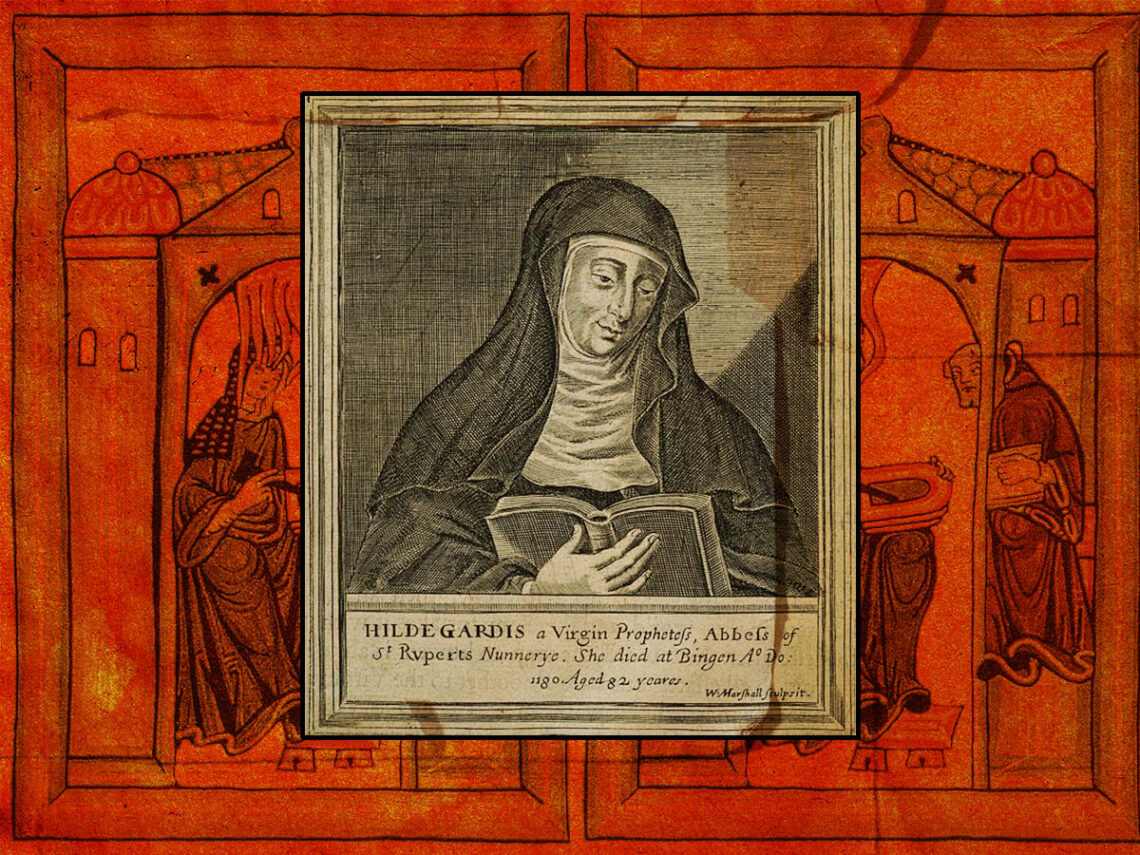
The ancient beats of Hildegard von Bingen: The world’s first composer?

Creativity and spirituality seem like two entirely different concepts from when Hildegard von Bingen emerged. However, that’s exactly what she embodied as a Benedictine abbess, classical music pioneer, spiritual visionary, and singular force and figure of immense wisdom. Not only did she have a meticulous, creative ear, but her abilities crossed into multiple disciplines, making her one of the most truly talented figures to have ever lived.
Though not a household name in today’s world, Hildegard was an immensely influential medieval figure whose life and career were so rich and nuanced that it’s almost difficult to believe she ever existed at all. Born in 1098, in what is known now as Germany, much of Hildegard’s life is—quite literally—from another time and place, having been given to her Catholic Church as a “tithe” from her family at the age of eight.
From a young age, she was gifted and experienced visions, the kind that would still be considered a gift from divinity today. However, these messages, ideas, and visions were always completely spiritual, and Hildegard felt they were gifted to her from an almighty, external force, compelling her to channel and translate them into her own work. And she did.
These visions formed the basis of many of her creations as she became an immensely impactful and influential figure despite her gender. During a time when the church often shunned the women’s voice or neglected to regard them as equals to their male counterparts, Hildegard was a significant touchpoint for bishops and the Pope, who often consulted her for insights and knowledge.
She dedicated herself to the church and became the abbess of the Benedictine community at Disibodenberg at the age of 38 before founding her own abbey at Rupertsberg. Throughout her works, which comprised three books of her visions, she wrote about the revelations she experienced, exploring various themes, like creation, spiritual health, and the role of humanity.

As a musician, Hildegard created some of the most groundbreaking sonic sounds and structures of the entire medieval period, taking the nature of her visions and placing them in a more atmospheric and visceral setting as if the listener would be experiencing them first-hand. Her music took some of the traditional aspects of church music, blended with eery yet uplifting ambience, with innovations that still permeate the walls of contemporary music.
Much of Hildegard’s music survives with strong associations to her influence, process, position, and societal ranking, which is somewhat unusual not only for a woman but also for a visionary from her specific time period. ‘Ordo Virtutum’, for instance, maintains its legacy as one of the earliest examples of liturgical drama and the only medieval drama to survive with accreditation to a creator and the music itself.
Of course, this is also included at the end of her illustrated work Scivias, which includes over 20 different epiphanic visions and revelations she experienced. Though some parts vary in preservation, this is known today as her best work, exploring the connection between God and humanity and detailing the interwoven nature of existence in the cosmos, accompanied by rich visuals and illustrations.
Within the text, Hildegard described how she transitioned from experiencing visions to feeling inclined to write about them in her texts and music. She explained how she felt the desire to document these revelations by an external force, knowing that what she had to say was extremely important. “I saw and heard these things, refused to write for a long time through doubt and bad opinion and the diversity of human words, not with stubbornness but in the exercise of humility,” she wrote.
Adding: “I spoke and wrote these things not by the invention of my heart or that of any other person, but as by the secret mysteries of God I heard and received them in the heavenly places. And again I heard a voice from Heaven saying to me, ‘Cry out, therefore, and write thus!'”
Therefore, by nature and posture, it’s hard to believe Hildegard ever existed at all. As a woman, poised to make history with a gift that literally spawned from the heavens, she emerged single-handedly as a voice of virtue. Hildegard’s visions might have propelled her to stand out, but her talents in various spaces made her one of the most talented figures in all of history.
