


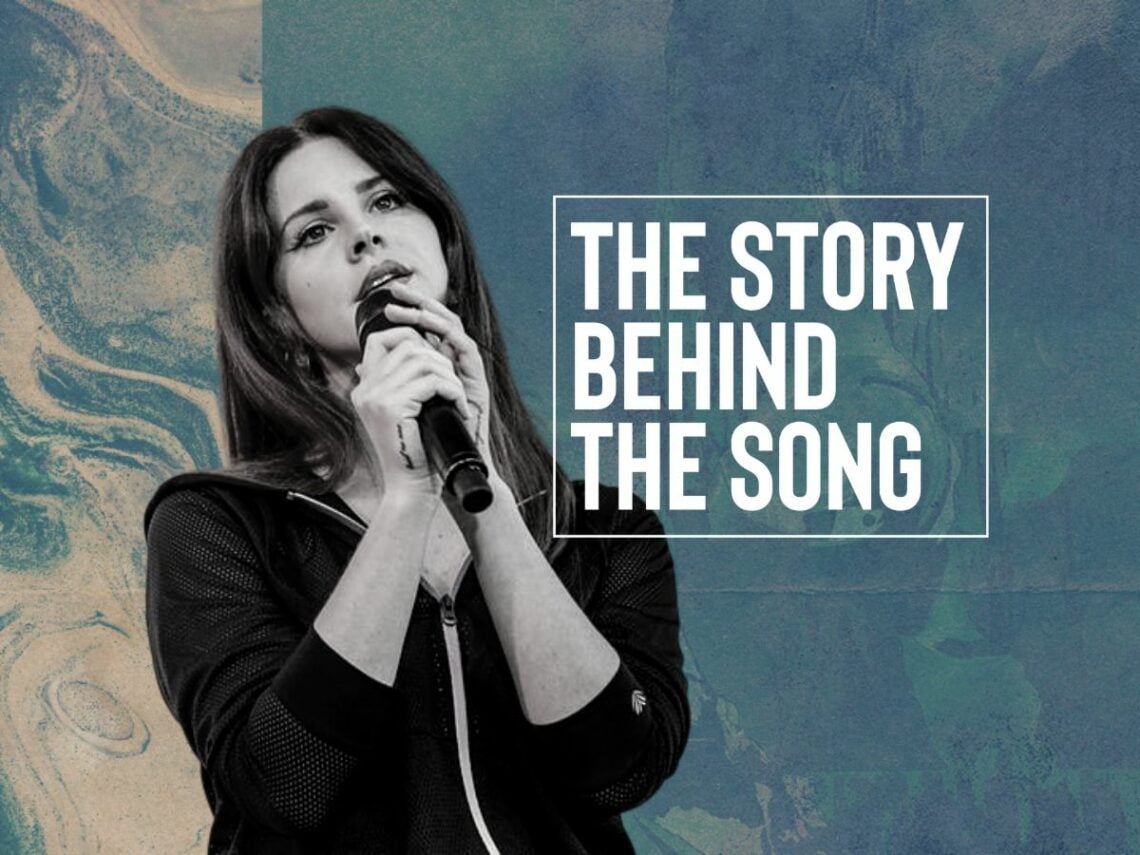
The Story Behind The Song: Lana Del Rey’s masterful mash-up ‘A&W’

It’s hard to imagine what the state of pop music would look like without Lana Del Rey. The singer (real name Elizabeth Woolridge Grant) began her music career in 2005, recording songs under various names such as May Jailer, Sparkle Jump Rope Queen and Lizzy Grant while studying at Fordham University. It didn’t take long for her to score a record contract, although she found little success until her viral hit ‘Video Games’ was released in 2011. Armed with a new stage name, Del Rey found a cult following of dedicated fans upon releasing her second studio album, Born to Die.
Since then, Del Rey has become one of the most influential artists of the 21st century. By blending vintage and contemporary sonic influences, ranging from jazz to trap, she boasts an impressive and diverse discography that has inspired artists from Billie Eilish to Father John Misty. Del Rey’s ninth studio album, Did You Know That There’s a Tunnel Under Ocean Blvd, is set for release on March 24th, 2023, and marks her third collaboration with producer Jack Antonoff.
To tease the album, Del Rey released the title track, an orchestral pop ballad, and ‘A&W’, a seven-minute mashup of folk-pop and hip-hop-inspired trap beats, has already become an instant fan favourite. The track perfectly exemplifies Del Rey’s unique ability to create subtle self-referential pieces that pay homage to different stages of her life and career. The track also contains classically American references – a consistent hallmark of Del Rey’s artistry.
Opening the song are gentle acoustic guitar chords, welcoming Del Rey’s declaration, “I haven’t done a cartwheel since I was nine/ I haven’t seen my mother in a long, long time.” By beginning with a line about her fraught relationship with her mother, Del Rey instantly allows herself to be vulnerable. She quickly segues from childhood into the topic of over-sexualisation, singing, “Look at the length of my hair, and my face, the shape of my body/ Do you really think I give a damn/ What I do after years of just hearing them talking?”
This first verse establishes the song’s overarching themes. Del Rey is so used to her appearance being torn apart by the media – and potentially her mother – that she no longer cares what anyone thinks of her. She embraces the label of being an “American whore” and references the times she has invited men around for casual sex, singing, “It’s not about havin’ someone to love me anymore.” This line presumably references ‘Video Games’, which includes the line, “Only worth living if somebody is loving you.” Thus, ‘A&W’ charts Del Rey’s progression towards embracing her sexuality and independence, asserting that she is not afraid of how others perceive her.
Yet, despite this, she still acknowledges her sadness surrounding romantic relationships, referencing that she feels destined to always be the other woman, a topic she has continuously referenced in other songs. She sings, “Did you know a singer can still be/ Looking like a sidepiece at thirty-three?” Moreover, Del Rey addresses rape culture, continuing the theme of over-sexualisation and being an “American whore,” by singing in a desperate whisper, “If I told you that I was raped/ Do you really think that anybody would think/ I didn’t ask for it?”
However, just over four minutes in, ‘A&W’ takes a sharp change of sonic direction, melding into a string of hard-hitting trap beats. From here, Del Rey almost raps, interpolating the 1960 track ‘Shimmy, Shimmy, Ko Ko Bop’ by Little Anthony and the Imperials, singing “Jimmy, Jimmy” instead. The name Jimmy, and sometimes Jim or J, has appeared countless times in Del Rey’s music, leaving fans to speculate who he is. Whereas some fans believe it to be a codename for drugs or alcohol, it is widely thought that Jimmy is a fictional romantic character. He has been namedropped since 2006, often representing a problematic or abusive figure. Therefore, by bringing Jimmy back for ‘A&W’, Del Rey refers back to the themes he typically evokes, singing, “Jimmy only love me when he wanna get high.” This half of the song, which looks back at an old lover, puts much of the first part of the song into greater perspective.
Additionally, by incorporating ‘Shimmy, Shimmy, Ko Ko Bop’, Del Rey references a phrase that has become a mainstay of popular culture, sampled by rappers such as Kendrick Lamar and even sung by Tom Hanks in Big. Not only does Del Rey maintain her method of referencing classic American cultural iconography, but she also takes the song’s sexual connotations (it is about being seduced by an exotic woman) and contextualises it amongst the first half of ‘A&W’. Near the end of the song, Del Rey also emulates the high-pitched girlish vocal delivery she often used when performing as Lizzy Grant to emphasise the song’s self-reflexive nature.
In essence, Del Rey expertly blends old and new, both sonically and lyrically, to create a commentary on her own progression as an individual and an artist. ‘A&W’ is one of Del Rey’s best songs of the past few years, merging melancholia with honesty, vulnerability and some infectiously catchy beats.
