


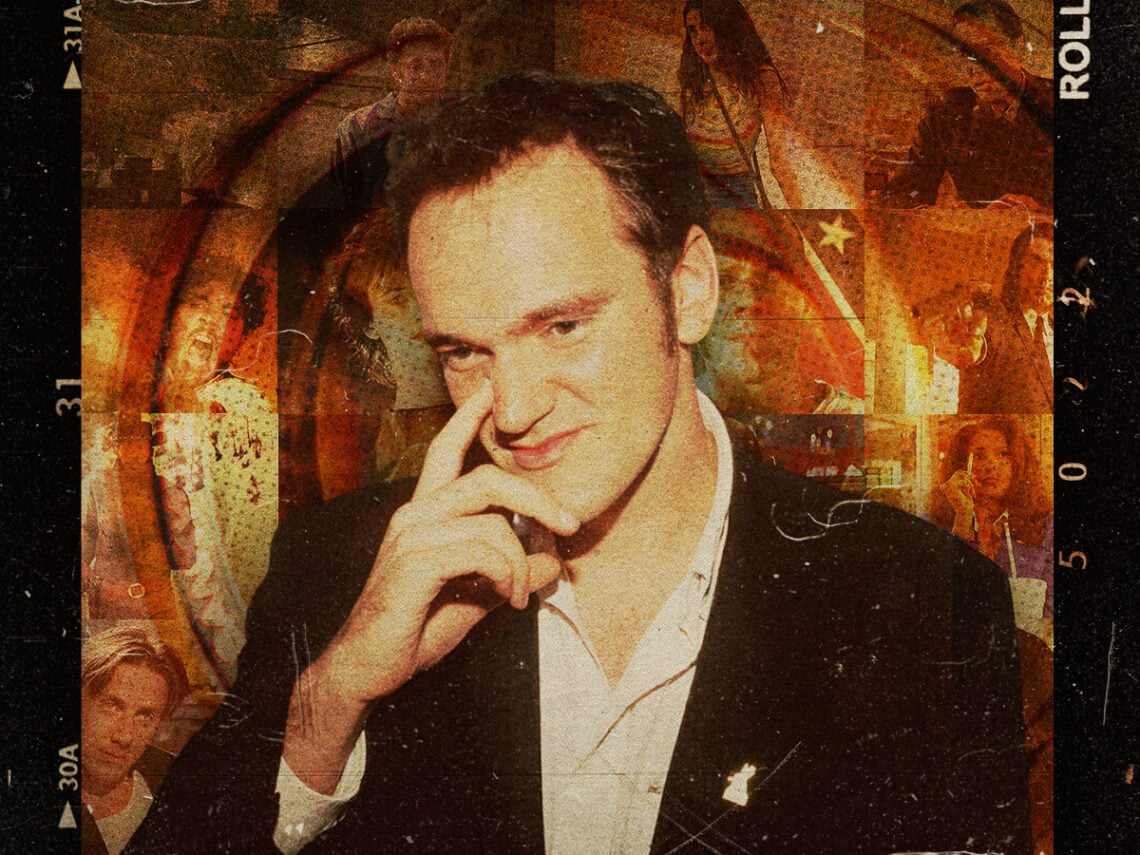
The stories behind five classic Quentin Tarantino music moments

Music plays a vital role in all of Quentin Tarantino’s movies, with many popular songs becoming synonymous with his work, such as Dick Dale’s ‘Miserlou’ in Pulp Fiction or Nancy Sinatra’s ‘Bang Bang (My Baby Shot Me Down)’ in Kill Bill.
Tarantino typically uses pre-existing music in his movies, believing that employing someone to create a score gives “too much power” to someone who isn’t him. He broke his spell of exclusively using popular music and classic film scores in 2015 when Ennio Morricone contributed some original pieces to The Hateful Eight.
However, for the most part, Tarantino relies on existing music, citing it as integral to the production process. “I need to edit to my music anyway to make it work so it has that thing about it,” he explained. “We edit to the beat, we’re shooting to the beat, I need to know what that music is. But I need to choose it.”
Tarantino enjoys the process of picking out songs from his extensive record collection, finding obscure gems or classic hits to elevate certain scenes even higher. The director’s dedication to finding the right tracks clearly pays off – for example, it’s hard to imagine anything other than Stealer’s Wheel’s ‘Stuck in the Middle’ playing during that scene of Reservoir Dogs.
The stories behind five classic Quentin Tarantino music moments:
Stealer’s Wheel – ‘Stuck in the Middle With You’ (Reservoir Dogs, 1992)
The most famous scene in Reservoir Dogs, Tarantino’s debut feature, is easily the torture of Kirk Baltz’s character, Marvin Nash, which results in Michael Madsen’s Mr Blonde slicing Nash’s ear off. Before getting down to the gruesome activity, he dances around to Stealer’s Wheel’s ‘Stuck in the Middle With You’, originally released in 1972.
Talking to Rolling Stone, Tarantino explained, “That was one of those things where I thought [the song] would work really well, and [during] auditions, I told the actors that I wanted them to do the torture scene, and I’m gonna use ‘Stuck in the Middle With You,’ but they could pick anything they wanted, they didn’t have to use that song.”
He added, “A couple people picked another one, but almost everyone came in with ‘Stuck in the Middle With You,’ and they were saying that they tried to come up with something else, but that’s the one. The first time somebody actually did the torture scene to that song, the guy didn’t even have a great audition, but it was like watching the movie. I was thinking, ‘Oh my God, this is gonna be awesome!’”
Chuck Berry – ‘You Never Can Tell’ (Pulp Fiction, 1994)
In Tarantino’s second feature, Pulp Fiction, which contains an incredible ensemble cast, John Travolta and Uma Thurman perform a now-iconic sequence where they do the twist to Chuck Berry’s ‘You Never Can Tell’ at a diner. After slurping milkshakes and puffing on cigarettes, all while a palpable air of sexual tension simmers between them, Travolta’s Vincent and Thurman’s Mia get up and dance, and the lyrics to Berry’s track seem to echo their situation.
According to Tarantino’s music supervisor, Mary Ramos, “I have Quentin’s original handwritten notes for Pulp Fiction, and he wrote down five or six potential songs for each music cue. That was his No. 1 for that particular scene. I had a blast, because I got to call Chuck Berry. He answered the phone like, ‘Hello, friend!’”
David Bowie – ‘Cat People (Putting Out The Fire)’ (Inglorious Basterds, 2009)
In 1982, David Bowie recorded ‘Cat People (Putting Out The Fire)’ for Paul Schrader’s Cat People, yet Tarantino decided to use the track for 2009’s Inglourious Basterds. The song is used as Melanie Laurent’s Shoshanna prepares to destroy some Nazis in her movie theatre. According to Ramos, Tarantino believes the music works better in his movie than in Cat People.
He told Rolling Stone that he has “always really loved that song.” Tarantino added, “It’s one of my favourite David Bowie songs of the ’80s, but I never liked the way it was used in [Cat People] because Paul Schrader didn’t really use it in the movie. He just threw it in the closing credits and I remember me and all the other guys at Video Archives were very disappointed by that. We’d go, ‘Man, if we had a song like that written for our movie, we’d build a 20-minute sequence around it!’ So I did.”
Bobby Womack – ‘Across 110th Street’ (Jackie Brown, 1998)
Jackie Brown is Tarantino’s homage to blaxploitation, with Pam Grier, one of the genre’s biggest stars, portraying the titular character. While the movie is never regarded as highly as some of Tarantino’s other works, it features some great moments, such as Bobby Womack’s ‘Across 110th Street’ playing in the opening sequence. Released in 1972, the track originally soundtracked Barry Shear’s blaxploitation-inspired movie of the same name.
Ramos explained that Tarantino “has a record room in his house and it’s filled with stacks and stacks of records, separated into sections like a record store. He went into his soul and R&B section, and started pulling out various things he wanted to make the vibe and soul of the movie. ‘Across 110th Street’ was one of the first things.”
Nancy Sinatra – ‘Bang Bang’ (My Baby Shot Me Down)’ (Kill Bill, 2003)
Kill Bill, starring Thurman as The Bride – ready to seek revenge on her former fellow assassins from the Deadly Viper Assassin Squad – contains many fantastic musical moments. Yet, no one can forget the use of Nancy Sinatra’s minimal ‘60s hit, ‘Bang Bang’ (My Baby Shot Me Down)’ in the movie’s opening scene. Talking to the Los Angeles Times, Tarantino said, “I think you’ll have a hard time hearing that song after seeing the movie and not thinking about the bride lying in the church.”
He added, “It’s the opening credits. That was in my head six years ago when I first came up with Kill Bill. Along with the whole story, I came up with the idea of using that in the opening credits. One of the things I do when first thinking about a movie is go into my record collection and find the opening credit sequence, music the movie will work to the beat of.”

Never Miss A Take
The Far Out Quentin Tarantino Newsletter
All the latest Quentin Tarantino content from the independent voice of culture.
Straight to your inbox.