


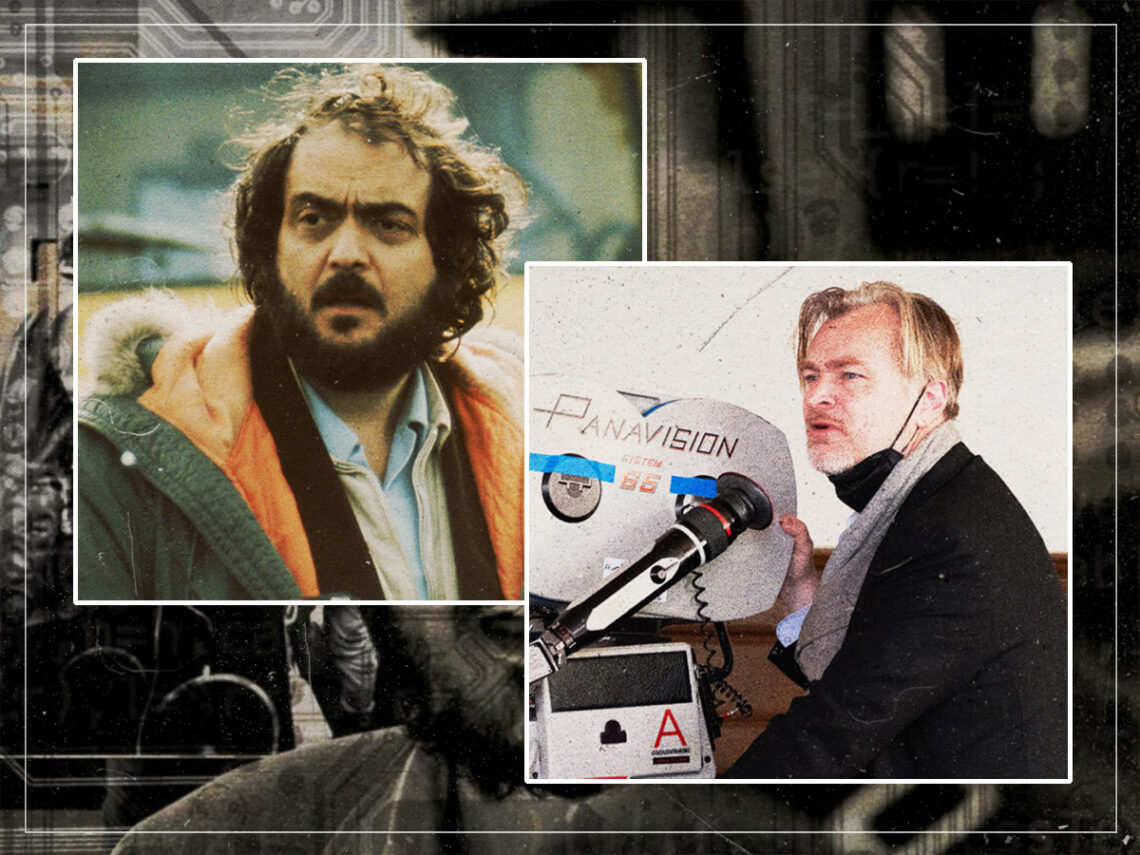
The Stanley Kubrick movie Christopher Nolan called “larger than life”

Christopher Nolan will no doubt be adopted into the realm of the greats with his sharp directorial vision. Populated by the likes of Martin Scorsese, Alfred Hitchcock, Francis Ford Coppola and more, Nolan would also add Stanley Kubrick to the ranks.
The director behind Oppenheimer, Dunkirk, Inception and more, Nolan is quickly becoming regarded as one of the best working directors around. Nolan has already been nominated for five Oscars and five Bafta Awards, amongst others. Known for his dark and lengthy blockbusters, Nolan’s style is instantly recognisable through his winding and twisting plotlines and gloomy cinematography.
Nolan’s singular vision feels reminiscent of Stanley Kubrick’s technique. With Kubrick being the master of twisted cinema, it’s no wonder that he provides a wealth of inspiration to Nolan. Littering his work with signature shots and staples such as the Kubrick stare, Nolan similarly stays true to his own directorial vision and world.
Nolan has previously shared a whole host of films that inspire him. Including modern movies like Charlotte Wells’ Aftersun and Edgar Wright’s Baby Driver, as well as classic takes such as 12 Angry Men or All Quiet On The Western Front, Nolan’s cinematic knowledge is broad.
But one Kubrick film stands out to the director. Describing the film as “larger than life”, Kubrick’s 2001: A Space Odyssey is a vital piece of cinema to Nolan.
The science fiction movie has been written into history as a groundbreaking piece that was way ahead of its time. Written by Arthur C. Clarke, based on his 1951 short story The Sentinel, the movie is eerily accurate. Released a year before the 1969 moon landing, 2001: A Space Odyssey’s depiction of space travel is noted for its accurate depiction of space travel and pioneering use of special effects.
For Nolan, the film connects to one of his earliest memories of cinema. Seeing the movie as a young boy, he recalled to Entertainment Weekly, “I just felt this extraordinary experience of being taken to another world.”
Praising Kubrick’s incredible world-building abilities and how thorough his cinematic universes are, Nolan continues, “You didn’t doubt this world for an instant. It had a larger than life quality.”
The connections between Kubrick and Nolan’s work are clear. In 2001: A Space Odyssey, dialogue is used incredibly sparingly as the film’s score does a lot of heavy lifting. Nolan’s use of silence in Oppenheimer feels inspired by Kubrick in this way.
Nolan was also instrumental in keeping Kubrick’s legacy alive. In 2018, the director helped to restore and re-release a mastered 70 mm print of the film, allowing cinemagoers to see 2001: A Space Odyssey in its original glory, exactly how it was first shown in 1968.
Being a part of the film’s continued legacy, Kubrick superfan Christopher Nolan was surely overjoyed to be written into its history.
