


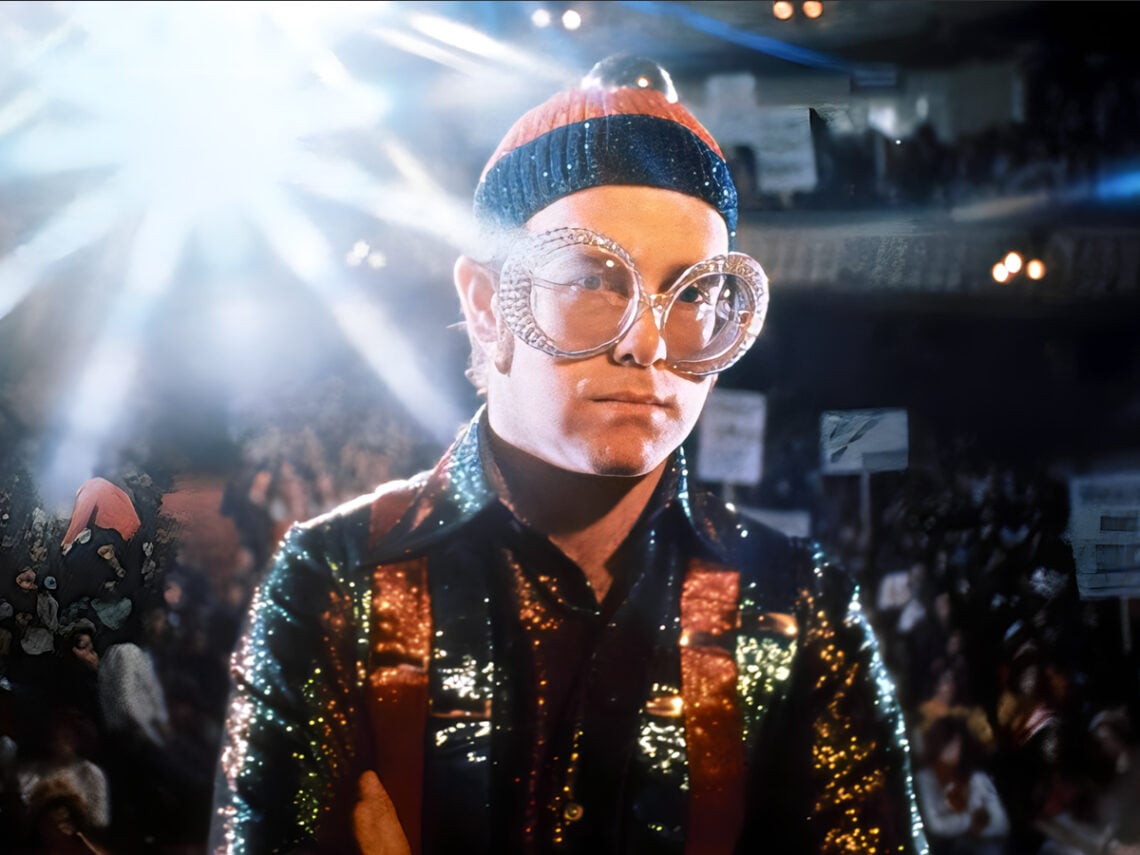
The songwriter Elton John said was out of everybody’s league

It’s tough to imagine Elton John believing anyone was out of his league.
However, when it comes to songwriting, John has a strange relationship. While pulling off a seven-album continuous run of number one records would surely solidify anyone as an untouchable star, he never did it alone, and he rarely picked up the pen.
Instead, any part of John’s powerful career that has focused on lyricism came from Bernie Taupin. It was only after the pair met in 1967 that John’s fortunes changed as he found a perfect collaborator to bring his vision to life. After they both responded to the same advert in the NME when Liberty Records was looking for new staff songwriters, John was handed an envelope of Taupin’s lyrics and tasked with writing music to match.
From then on, minus a brief but fiery feud in the late 1970s, John and Taupin have been an inseparable duo with Taupin writing the words, and John providing the melodies.
It’s one of those relationships that can end up making musical purists cynical. There is definitely still a subset of music lovers who believe that the lyrics should only ever come from the mouth singing them, and that having a writing partner, or even god forbid a ghost writer, makes a song phoney. They think it makes art too business-like, as if music is a commodity to be bought and sold.
The truth is, songwriting is a major business. It was back then, and it still is today. Many of your favourite songs were written by people you’ve probably never heard of. Caroline Pennell is one of them, responsible for several powerful modern pop tracks. Benjamin Francis Leftwich, known for his 2011 hit ‘Atlas Hands’, has since built a successful behind-the-scenes career, writing for artists like CMAT, The 1975, Holly Humberstone, and others.
Back in the 1960s, it was an even bigger industry. Before Carole King was the singer we know her as today, she was a powerhouse songwriter that even acts like The Beatles used to dream about working with. Every record label would have in-house writers churning out hits, or they would even take a song made famous by another artist and simply hand it to someone else, getting them to cover it and hoping the success would translate.
On plenty of occasions, that worked. But when Elton John was presented with a Nick Drake track by a record label trying to turn his folk magic into more money, John knew it would never work.
“At that time, I did some cover versions for Island of Nick Drake songs to make them more commercial and see if people would record them,” he said. Within one attempt, he knew that Drake’s voice was too singular and too powerful to translate to another act, explaining, “They were so Nick Drake–ish that nobody else could really touch them.”
It was the label’s tried and failed attempt to get into the folk wave. “People like Nick Drake came along, the publishers wanted to earn their money by getting other people to record them,” John explained, but the problem was always that a folk songwriter like him had a song far too distinctive to work. It’s not like a song written by a professional songwriter, meant to be passed along. No, Drake’s music is personal and delicate, woven together in a way only he would weave and only for his mouth.
John came away from the experiment with that knowledge, along with a deep love for the artist, stating, “Once you hear a Nick Drake record, you can’t do any better than that. That was a failed experiment, even though I loved recording those songs because they are such brilliant songs.”
