


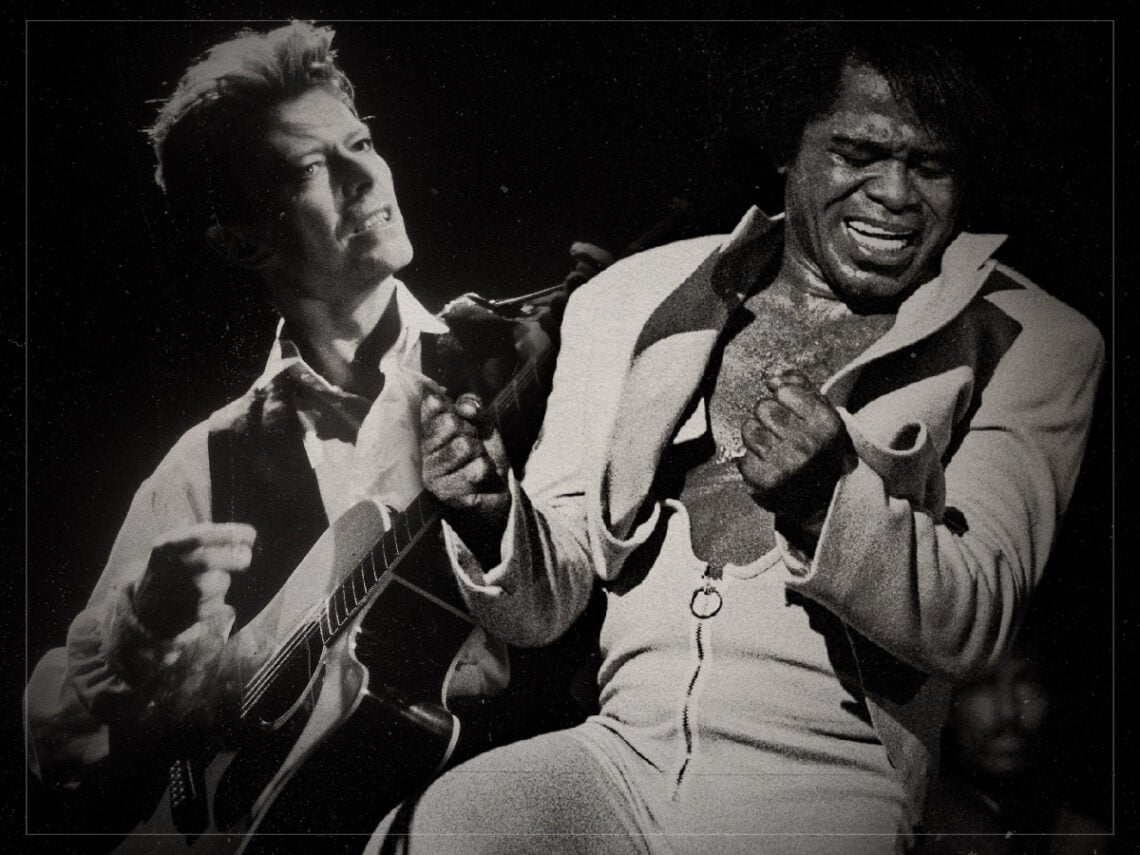
The song David Bowie pulled from James Brown: “What was that riff?”

It’s totally understandable that people would consider David Bowie to be one of the greatest and most versatile songwriters of all time, and the amount of tracks he’s written that seemed to be ahead of the curve are an indication of just how in touch with the musical landscape he’s always been.
After a handful of underwhelming releases at the start of his career, he would begin to gather steam on records like The Man Who Sold The World and Hunky Dory, both of which provided early examples of how he was developing his craft when it came to writing catchy pop rock that was digestible by the masses. Following these two records, however, he’d blow all preconceptions of his ability out of the water with a series of increasingly ambitious works.
With the glam concept albums of Ziggy Stardust and Aladdin Sane coming shortly after, he’d eventually start transitioning between different styles every few albums, and by the end of the ‘70s, he was releasing even more grand and elaborate works such as Station to Station, Low and Heroes, all of which helped him solidify his status forever with how forward-thinking they all managed to be.
However, in the midst of all of these classics is an often misunderstood black sheep of an album where Bowie seemed hell-bent on exploring a variety of genres from across the Atlantic, dipping his toes into blue-eyed soul and funk in ways that it was previously considered unimaginable for a British artist to be doing, and while some fans consider Young Americans to be on a par with his greatest albums, others are less certain about the confusing direction that Bowie opted to take on the record.
In my personal opinion, there’s little wrong with the album as a whole, and some of the individual songs from it stand out in their own right as being shining examples of Bowie’s daring attitude, but in spite of this, there’s one that highlights a glaring flaw in his decision to play around with genres that he hadn’t previously shown an aptitude for.
As much as he may have enjoyed the funk records that were coming out of America at the time, it was as a result of ignorance that ‘Fame’ came to be recorded with the help of John Lennon, his guitarist, Carlos Alomar, and a riff that he accidentally ended up pilfering from the Godfather of Soul himself, James Brown.
While in the studio with the two aforementioned co-writers, Bowie overheard something that he thought would have been a great basis for a track that he ended up trying to develop, and in a 2003 interview with Performing Songwriter, he revealed that he may have ended up unwittingly copying something that had already existed.
“The song was a guitar riff that Carlos Alomar had,” Bowie explained. “He used to play in James Brown’s band and he’d come up with this riff for a song called ‘Foot Stompin’’ When we were in the studio with John Lennon, I asked Carlos, ‘What was that riff you had?’ And it went from there.”
While Bowie is wrong in asserting that it was Brown’s song, with him having been covering The Flares in the first place, there’s an undeniable similarity between the two tracks. It’s not a direct rip-off, however, and the additional elements and production that Bowie added to his interpretation for ‘Fame’ helped it become a standout song from the Young Americans sessions, even if he had mistakenly heard a riff and assumed it would be ripe for the taking.
