


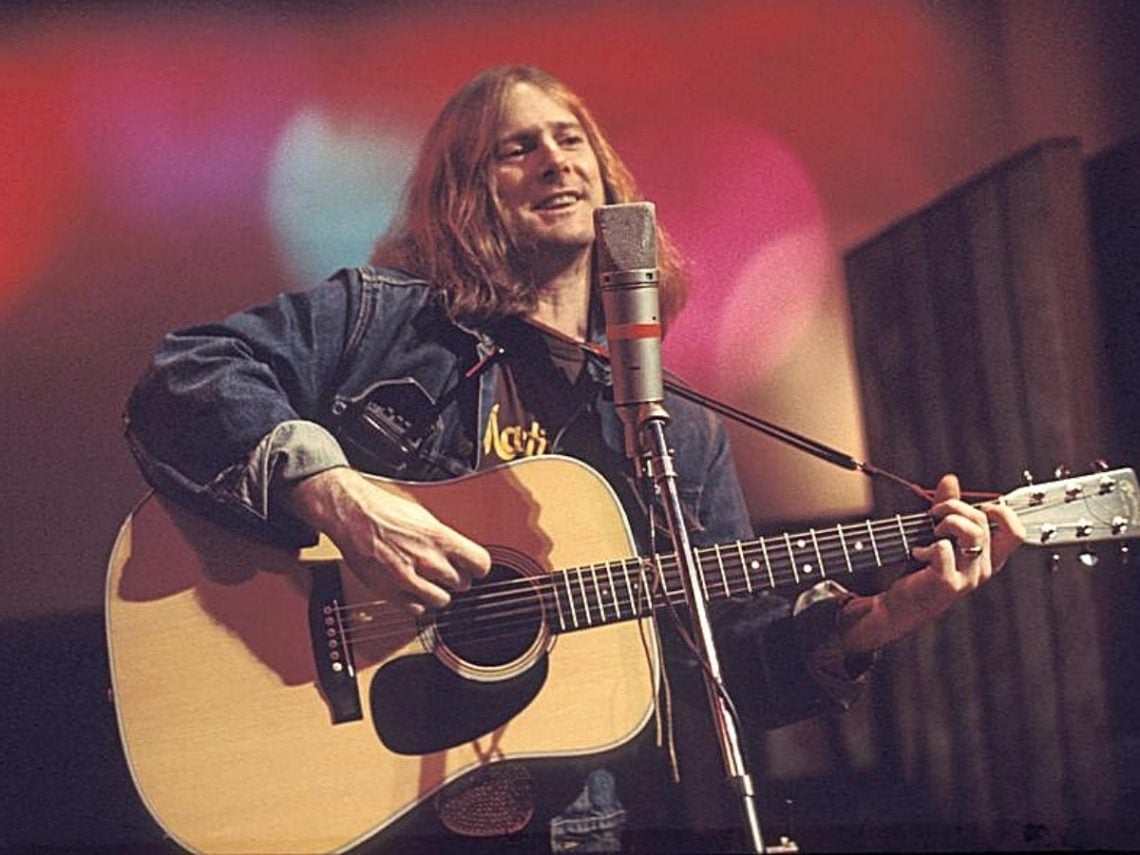
The secret to the guitar sound of The Byrds’ Roger McGuinn

As one of the more influential musicians of the 1960s, Roger McGuinn is a chief architect of what became the classic mid-1960s sound. Although McGuinn was originally a folk purist, he soon jumped ship and formed The Byrds once rock and roll made a resurgence in America during the early 1960s. It’s no surprise who led that particular charge: The Beatles.
It was George Harrison’s iconic work on the 12-string Rickenbacker guitar that inspired McGuinn to pick up his own. Just a year later, McGuinn was using the specialised guitar to create the chiming tones of folk rock, with The Byrds leading the pack as the cutting-edge band of the day. McGuinn was so adept at using the 12-string that he eventually influenced Harrison on the song ‘If I Needed Someone’, completing the loop that originally started with Harrison’s influence on McGuinn.
But McGuinn had some difficulty getting the guitar to sound good, at least at first. “The ‘Ric’ [12-string Rickenbacker guitar] by itself is kind of thuddy. It doesn’t ring,” McGuinn noted in 2009. But with some studio trickery, McGuinn stumbled onto his signature sound. “But if you add a compressor, you get that long sustain. To be honest, I found this by accident.”
“The engineer, Ray Gerhardt, would run compressors on everything to protect his precious equipment from loud rock and roll,” McGuinn said. “He compressed the heck out of my 12-string, and it sounded so great we decided to use two tube compressors (likely Teletronix LA-2As) in series and then go directly into the board. That’s how I got my ‘jingle-jangle’ tone. It’s really squashed down, but it jumps out from the radio. With compression, I found I could hold a note for three or four seconds and sound more like a wind instrument. Later, this led me to emulate John Coltrane’s saxophone on ‘Eight Miles High’. Without compression, I couldn’t have sustained the riff’s first note.”
Besides utilising technology, there was another secret to McGuinn’s mastery of the instrument: seemingly endless practice. “I practised eight hours a day on that ‘Ric,'” McGuinn adds. “I really worked it. In those days, acoustic 12s had wide necks and thick strings that were spaced pretty far apart, so they were hard to play. But the Rick’s slim neck and low action let me explore jazz and blues scales up and down the fretboard and incorporate more hammer-ons and pull-offs into my solos.
There was more than just jazz and blues involved in McGuinn’s style. A potent amount of bluegrass also helped define The Byrds’ sound. “I also translated some of my banjo-picking techniques to the 12-string,” McGuinn concluded. “By combining a flat pick with metal finger picks on my middle and ring fingers, I discovered I could instantly switch from fast single-note runs to banjo rolls and get the best of both worlds.”
The results would be instantly iconic, spread across hits like ‘Mr. Tambourine Man’ and ‘Turn! Turn! Turn!’, both of which saw McGuinn explore new territories with his 12-string Rickenbacker.
