


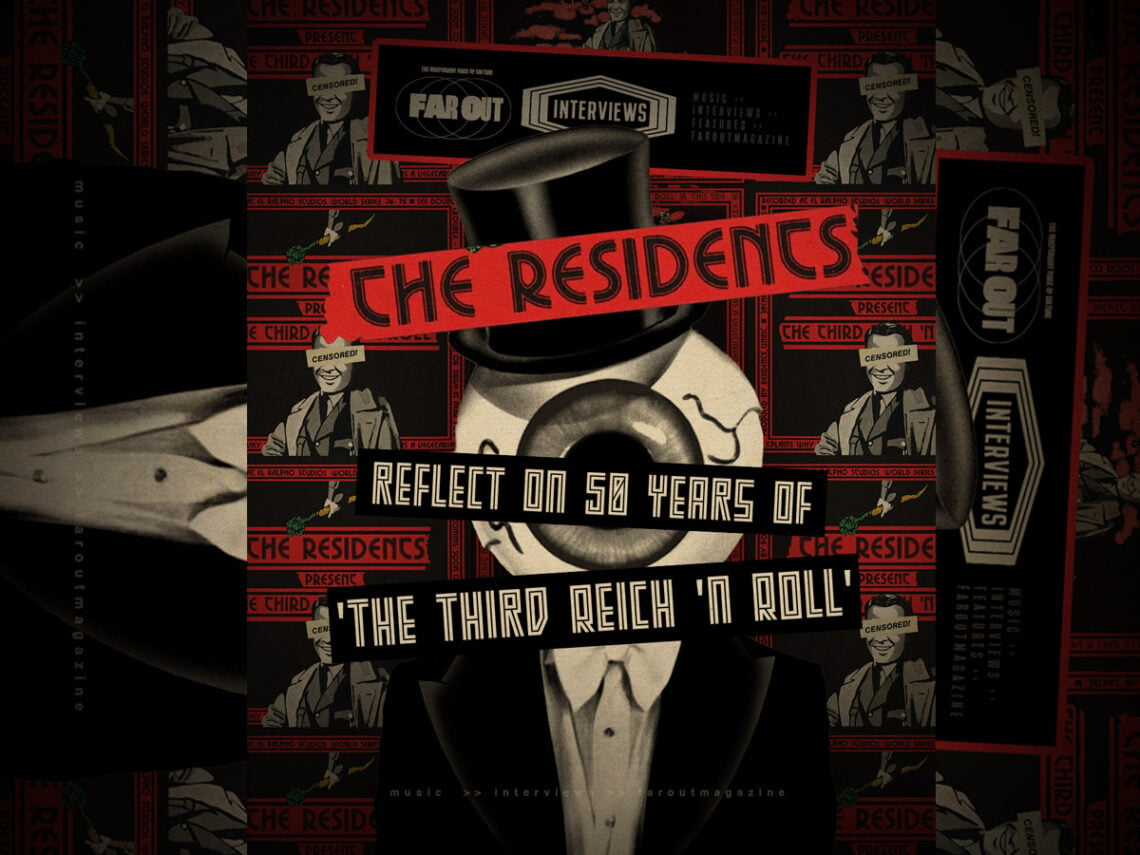
The Residents reflect on 50 years of ‘The Third Reich ‘n Roll’: “It was more funny than anything else”

It’s now 50 years since San Francisco’s incognito oddballs The Residents first unleashed on the world The Third Reich ‘n Roll, a record that radiates among the mysterious art collective’s oeuvre with the most confounding, ludicrous, and controversial bite they’d ever muster.
Burnished in the West Coast’s psychedelic underground at the tail-end of the 1960s but avoiding hippy deadends like the plague, The Residents orchestrated a slice of conceptual mayhem and feverish experimentalism closer to punk than the stodgy Woodstock residue clogging the charts. Across avant-garde LPs, elaborate stage shows, interactive multimedia, and award-winning film projects, the top-hatted eyeball masked miscreants still operate under their ‘Theory of Obscurity’ to this day, engaging with the press via their public relations, management and production company The Cryptic Corporation.
According to Residents lore, The Cryptic Corporation “Captain Doc” – abandoning the title president in 2017 after US President Donald Trump had rendered the heading “a nasty nine-letter word” – Homer Flynn has been a friend and collaborator since the group’s earliest days in Louisiana’s Shreveport. Many fans will maintain that Flynn, along with former co-founders Hardy Fox, Jay Clem, and John Kennedy, is indeed the mischief makers behind the ocular disguises, but Flynn stresses to the Far Out team the company line.
“Please understand that I didn’t officially start working with The Residents until 1976,” Flynn makes clear when fielding our questions. “If any of them come by in the next few days, I’ll run your questions by them and see if I can get any clarity.”
Still, as the sole remaining spokesperson for The Cryptic Corporation since Fox’s death ten years ago, Flynn remains a paramount authority on exploring the strange history and inner workings of The Residents’ cabalistic inner circle. Casting his mind back to The Third Reich ‘n Roll’s inception in late 1974, Fox reveals the ensemble’s creative drive on how they would tackle their quasi-sophomore LP – 1978’s fourth album Not Available, supposedly the second LP recorded but sealed in a vault four years prior.
“It’s my understanding that The Residents felt like they needed to put an album out, and Meet the Residents was the result of several separate or disconnected ideas they were working on at that time,” Flynn clarifies about the group’s debut album in 1974. “But they are storytellers and conceptualists at heart, and while they were ultimately pleased with Meet the Residents, they strongly felt that the next album had to be more conceptual.”
Eager for a more cohesive theme, The Residents looked to the day’s Billboard Hot 100. Viewing the preceding decade or so of rock and pop chart hits through their acerbic lens, the group began to spot the curse of The Beat born from the beloved rock ‘n’ roll of their youth now annexing other genre forms with rapacious, homogenous march. Deeply enamoured with pop as much as the old Americana artforms and the avant-garde underground, The Beat’s perceived hostile takeover of contemporary music’s myriad terrain began to shape their official second album’s conceptual character in earnest.
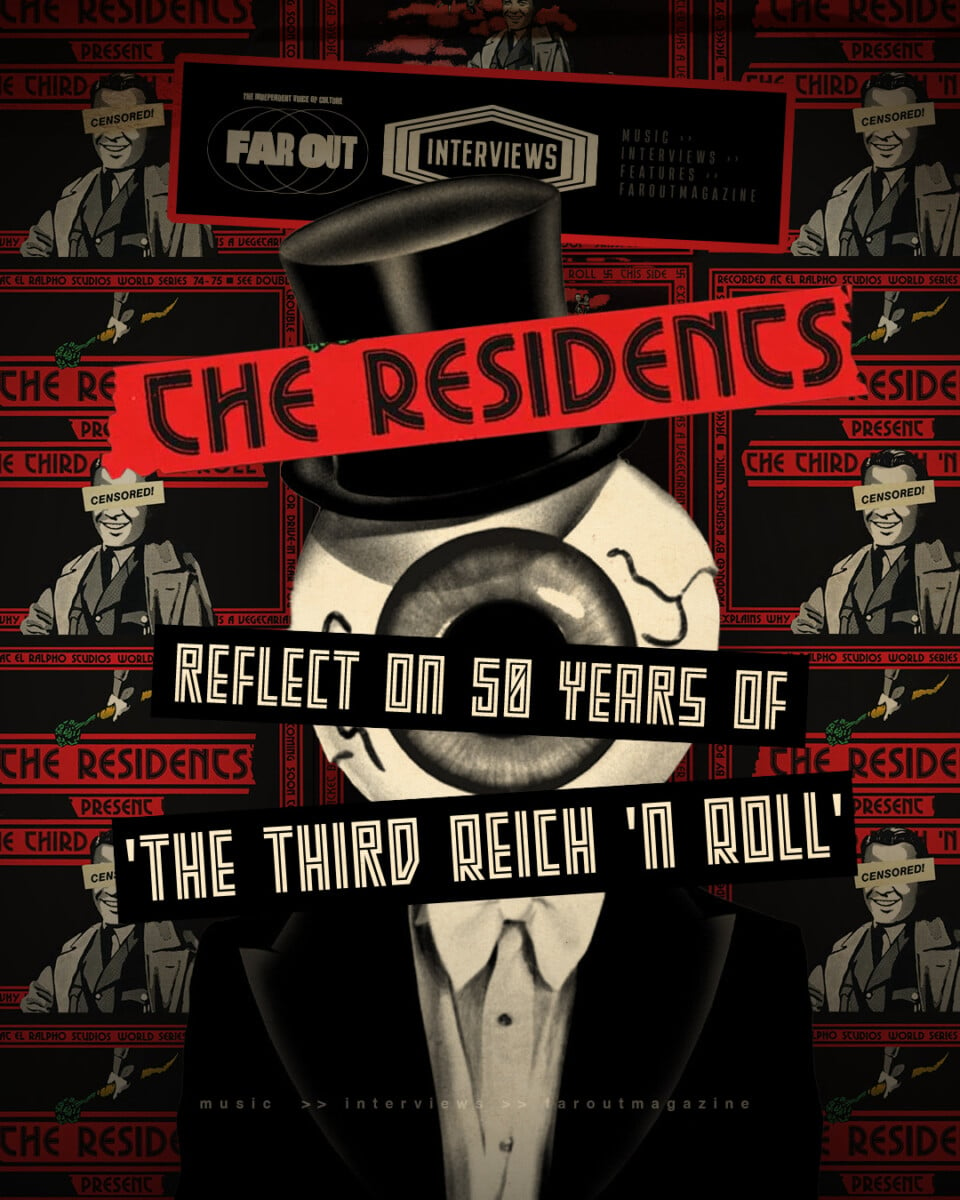
“The Residents had this feeling that the music business was being taken over by the rock beat, not unlike the way Europe was taken over by the Nazis,” Flynn tells us. “Their point of view was that it was all about media and money. The media put a spotlight on The Beat, and money followed the media. From their point of view, a similar thing happened with swing, and in the 1940s and ‘50s, everything was being pulled to the swing beat. But then rock came along, and the money it attracted, overshadowed everything, resulting in all forms of music being played to the ubiquitous rock beat.”
The theme began to write itself. Scooping out the Top 40 and dumping its contents into The Residents’ sonic mangler, the group recorded two long-form collages across 1974-75 comprised entirely of the rock and pop canon dipped in their battery acid subversion. Akin to a butcher slicing off fat strips and gristle from their meat stock, everything from rockist deities The Beatles, The Doors, Iron Butterfly, and Cream, to grabs of Ohio Express’ bubble gum pop ‘Yummy Yummy Yummy’ or The Tornadoes’ ‘Telstar’ sci-fi surf are slapped on their multi-track studio canvas and ‘de-beated’ into strange new forms. While it’s impossible to glean an exact list of the tunes reinvented amid its atonal honk, Flynn tells us The Residents have maintained Scott McKenzie’s 1967 anti-war paean ‘San Francisco (Be Sure to Wear Flowers in Your Hair)’ is buried somewhere on The Third Reich ‘n Roll’s second side.
The Residents were not a band to do things in half measures. Committed to the analogous examination of The Beat’s Lebensraum into surrounding chart territory, while touching on “the corruption of the music business by the rock beat,” Flynn’s in-house art direction for the band’s Ralph Records label saw the American Bandstand host and “America’s oldest teenager”, Dick Clark, dressed in full Sturmabteilung Brownshirt gear, replete with swastika armband and curiously holding a carrot as a nod to the Führer’s ‘ethical’ aversion to meat. Titling the two sides of collaged pieces ‘Swastikas on Parade’ and ‘Hitler Was a Vegetarian’, it appeared The Residents were eagerly inviting controversy.
“One of the curious things about the cover was how naïve The Residents were in regard to the power of the imagery,” Flynn confesses. “For them it was more funny than anything else. This was the mid-70s; World War II was thirty years earlier, and the group saw it as safely in the past. They made a window display at Rather Ripped Records in Berkeley featuring a photo of one of The Residents with a huge swastika on his head. They thought it was hilarious, but the people of Berkeley didn’t agree. It was ripped down within two hours after the store opened. If anything, I see the imagery as more powerful now than it was then.”
The swastika burns with a fiercer peril today than ever since the immediate post-war years. In an age of a resurgent hard right, racial hatred furthering itself in mainstream political discourse, and a creeping authoritarianism casting its shadow across the Western world, the fascist threat doesn’t feel quite so historically remote anymore. When considering the Nazi shock theatre littered among the pop scene in 1976, from the punks’ crass brandishing of the swastika to piss off mum and dad or David Bowie’s self-indulgent “Hitler was the first rockstar” remarks when blitzed on Thin White Duke hubris and cocaine, The Third Reich ‘n Roll’s deployment of Nazi aesthetic stands with greater, if still queasy, satrical merit half a century later.
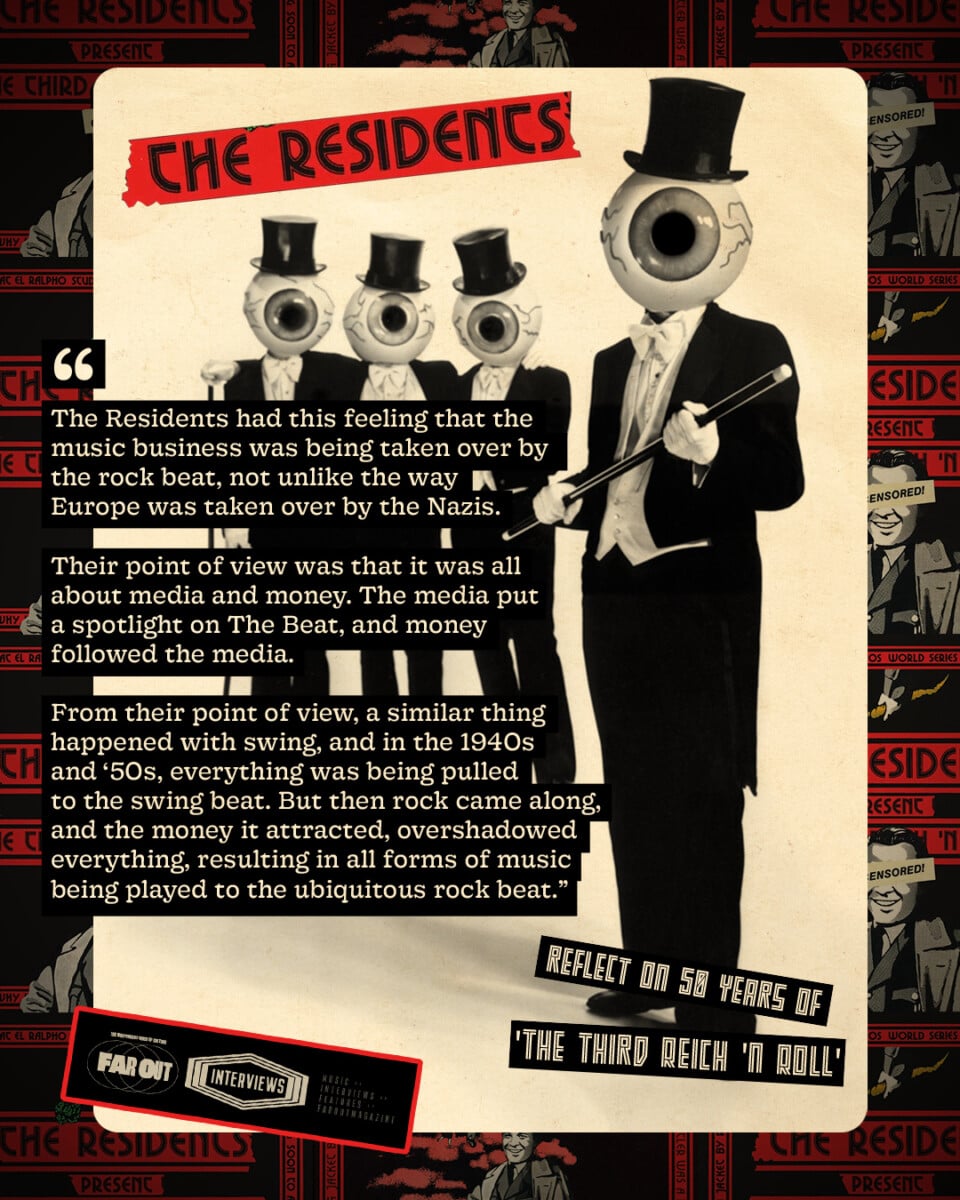
“I can’t say I’ve followed any recent discussions about the relationship between rock music and the swastika, but it seems to me that The Residents fit in there, except that their motivation was more focused on naïve humour than outrage, but that was in there, too,” Flynn states frankly. “Regardless, I have my doubts as to whether or not they would have created the window display if they had anticipated the reaction it received. They like the cover and would have done it regardless.” So, allegedly, did Dick Clark, legend being the paragon of teen pop culture, proudly hang a framed copy on his office wall.
Dropped in February 1976 – Germany waiting til 1981 due to the artwork- The Third Reich ‘n Roll promoted The Residents’ second LP offering with one of the earliest examples of the music video, syncing an earlier short film of the quartet dressed in newspapers in a broadsheet-slathered room with an edit of ‘Swastikas on Parade’ on top and spliced with excerpts of their unfinished film project Vileness Fats, now in the permanent collection of New York’s Museum of Modern Art. Standing as a quasi-single, the album sessions also yielded their warped take on The Rolling Stones’ ‘(I Can’t Get No) Satisfaction’, a good year before Devo cut their discombobulated synthpunk version.
The Residents would yield greater commercial success and arguably more defining moments, from the Duck Stab! EP’s surprise sell-out to Eskimo’s cementing of the now famous eyeballs and top hat costume default, and the music industry’s corporate maw would inspire an even sharper take-down on 1980’s Commercial Album, but The Third Reich ‘n Roll stands as the band’s most pivotal LP, where the collective’s artistic fancies soldiered past mere studio tomfoolery to a more visionary idea of what their obscure explorations could be capable of.
Their sophomore album anticipated the sampling culture by as much as a decade, too, The Third Reich ‘n Roll, along with its orbiting The Beatles Play the Residents and the Residents Play the Beatles Fab Four mash-up, set the stage for sampling trends to arrive in earnest in the late 1980s, lifting the German version of Chubby Checker’s ‘Let’s Twist Again’ and even possibly featuring the first James Brown sample well before hip-hop producer’s began rifling through their old soul records.
Is the Hot 100 still strangled by The Beat’s dreaded monoculture? “Personally, I haven’t looked at a Billboard magazine in 20-30 years, so I can’t say I’m qualified to speak about it in terms of today’s culture,” Flynn reflects. “It’s my feeling that the whole music business has become so fragmented over the past few decades that nothing now has the influence on pop music that Billboard did in the ‘70s and ‘80s.”
Pop music’s ebb of monolithic cultural command perhaps has blunted The Third Reich ‘n Roll’s comic swipe on how “rock and roll has brainwashed the youth of the world” according to the album’s original liner notes, but 50 years on and the corporate bigwigs’ iron grip on the music world only affords The Residents’ eerie Nazi pastiche extra surrealist snarl. With Flynn placing the album in their “top five albums”, The Third Reich ‘n Roll still glares with beckoning energy after all these years, picking at society’s scabby taboos via an aggressively strange but awfully fascinating cartoon mulch of inside-out historical revulsions and intoxicating absurdity that only The Residents could ever pull off.
