


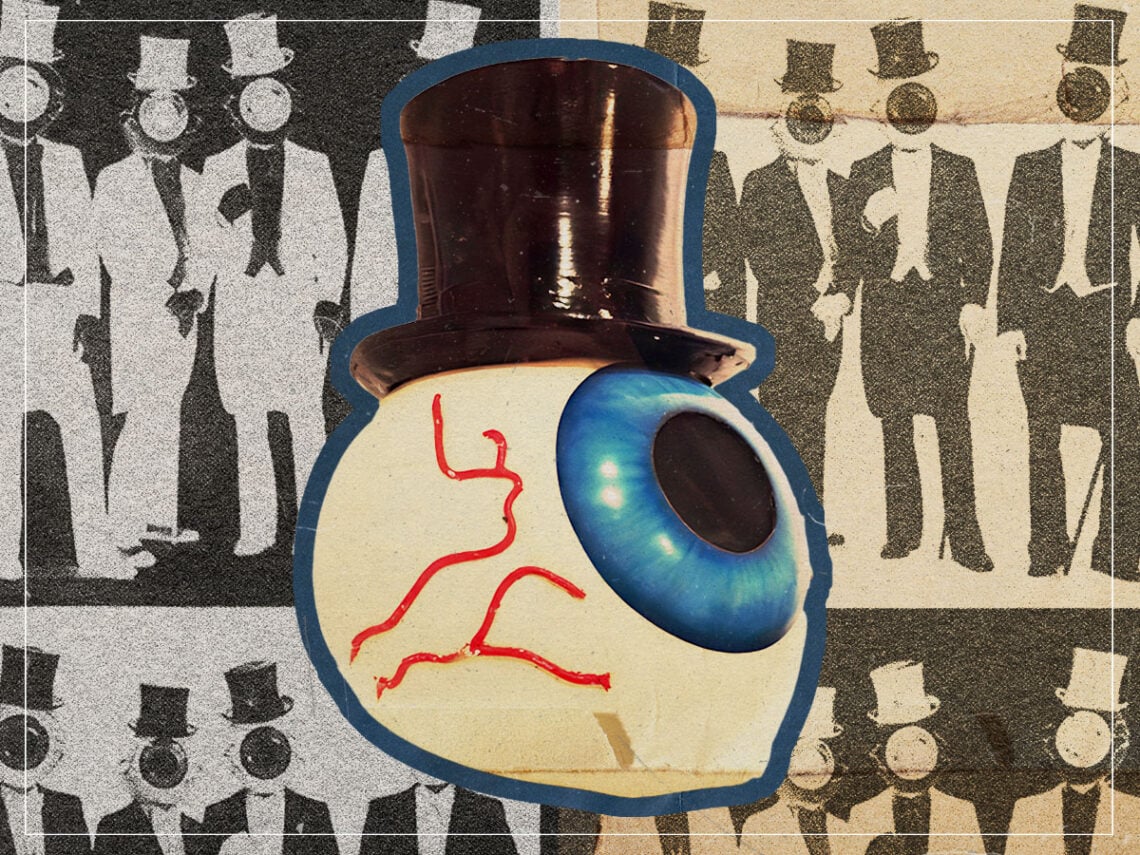
The Residents: how Hardy Fox developed his eyeball fixation

The use of masks within music is certainly not an uncommon occurrence. From the papier mâché head of Frank Sidebottom to more recent artists like Glass Beams or Lynks, masks are used by artists to serve a variety of purposes, usually centring around style and anonymity. However, few masked musicians have received the acclaim or legendary status of Louisiana avant-garde outfit The Residents.
Kings of the surreal and avant-garde, The Residents rose to prominence in 1970s San Francisco amid the remnants of the city’s decaying hippie population. Finding a dedicated cult following for their bizarre avant-garde music, though, across their career, they have incorporated a countless array of musical styles, encompassing jazz, house, disco, synthpop and many others. With 43 studio albums under their belt, there is something for everyone within The Residents’ work. However, even if you haven’t heard their unforgettable tunes, you probably recognise their image.
The iconography of the collective is arguably as important as the music itself. The band will often appear silent, wearing top hats, tailcoats, and giant helmets that look like eyeballs. The eyeball image began on the cover of their 1979 album Esmiko and has stuck with the band since then. Their recognisable image and bizarre tunes made the collective a mainstay of early MTV, gaining them an audience illustrated by the likes of Matt Groening, Devo and Eric Andre, among others.
Reportedly, the eyeball comes from the influence of Hardy Fox, the primary composer of the group. Growing up amid the oil fields of Longview, Texas, Fox had a penchant for musical expression from a young age. His older sister, Linda Perez, once revealed, “He had a windup record player and some children’s records, and if nobody was looking, he would sing and dance to those with his own movements. But if somebody was looking, he wouldn’t do it.” Perhaps explaining The Residents’ need for anonymity.
Throughout his childhood and into his teens, Fox asserted himself as an uncompromisingly creative young man, always with a project on the go. From constructing homemade musicals to mowing his initials in the family’s lawn, his head was clearly brimming with ideas from a young age, though they were not always appreciated by his hardworking southern father. “There was something lost in the bonding, and my brother didn’t seem interested in anything that my father might want to do,” his sister explained.
It was not until Fox left the confines of Longview, Texas, that he began to experiment more freely with his artwork. Producing abstract paintings and avant-garde music, he was in a world of his own, far away from the judgement of his father and the older generation. His family might not have understood his life choices, but Fox didn’t seem to mind – he was a true original, forging his own path through life.
Such was the breadth of his creativity and infallible spirit that Fox managed to incorporate into his art the rejection his work had faced from his father and wider Texan suburbia. The eyeball helmets were not simply a kooky addition to a surrealist group; they provided an opportunity for the band to remain anonymous, allowing them to experiment and innovate freely without the worry of ridicule or rejection.
