


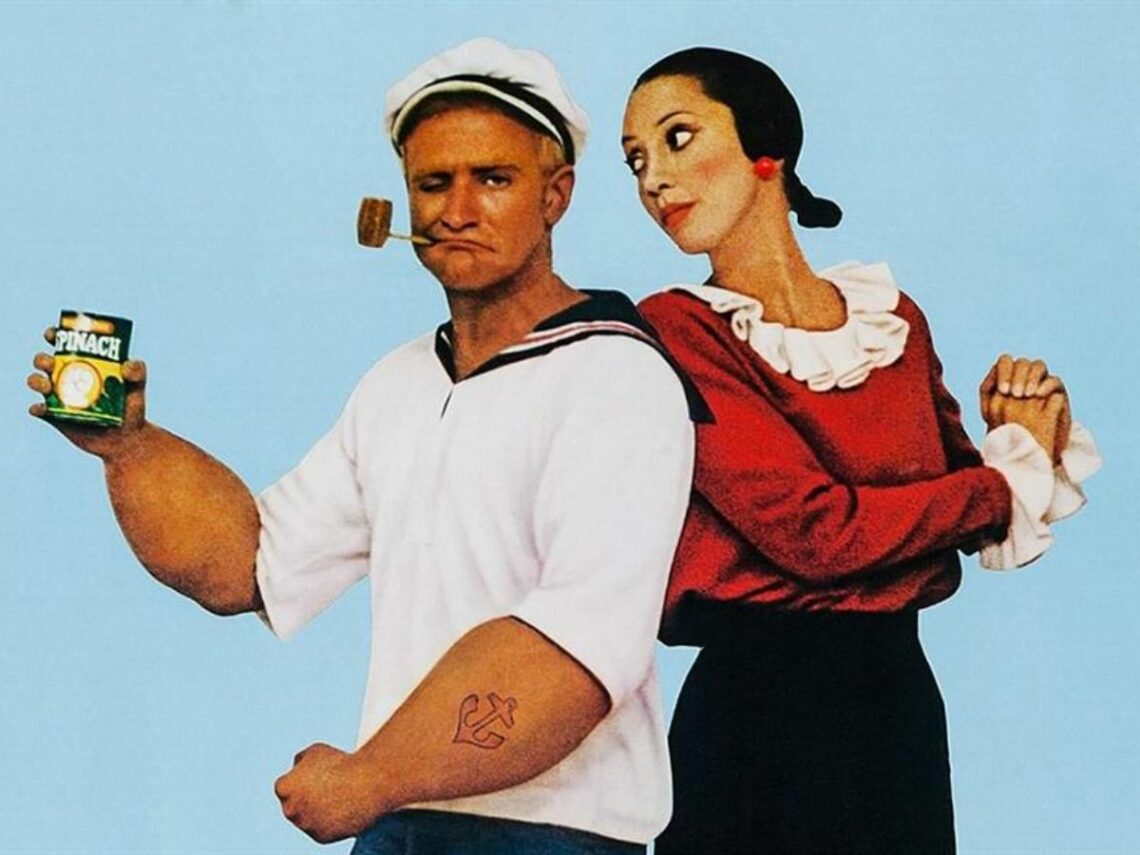
The ‘Popeye’ movie set that was transformed into a theme park

Hollywood isn’t known as being the most environmentally friendly industry in the world. As well as the physical energy that is needed to fuel each and every production process, often physical sets also need to be built to house any given story, with many of these being disregarded after use. Just look at the damage that the 1979 movie Apocalypse Now, directed by Francis Ford Coppola, caused to the local Vietnamese surroundings.
Still, not every production is so careless, with some constructing well-built sets that can be used long after the movie has been completed. One of the finest examples of this is Popeye Village, a theme park in Malta that was used during the making of Robert Altman’s 1980 movie Popeye, an adaptation of the TV series of the same name and featured a surprisingly star-studded cast that included the likes of Robin Williams, Shelley Duvall and Ray Walston.
Telling the story of a spinach-eating sailor and his friends who resided in the seaside getaway of Sweethaven, Popeye was a peculiar creative property that was most certainly of its time. In an industry without CGI, Sweethaven was instead constructed to a meticulous level of detail, with the cost of the production soaring thanks to the complexity of the build. Yet, thanks to just how well-built the set was, it has now become a popular tourist destination.
Consisting of 19 wooden buildings, the village, which is located in Anchor Bay, just outside of Mellieha village, was constructed using tree trunk logs lugged over from Holland, whilst wood shingles from Canada were used to create the rooftops. Thanks to a construction crew of 165 members strong, eight tons of nails and 2000 gallons of paint, the set was completed to the production crew’s satisfaction.
Referred to as “Stalag Altman” by Robin Williams according to James Robert Parish and his book Fiasco: A History of Hollywood’s Iconic Flops, the set for Popeye was certainly strange considering the rather small budget for the movie. The vast set far outweighed its practical need, and, as a result, Altman’s film is seen as a cinematic oddity, to say the least, being aesthetically marvellous but feeling rather sub-par in every other area.
It’s fair to say that the film, which we remind you was helmed by the same mind who directed The Long Goodbye and Nashville, was considered a commercial and critical flop, with journalists quick to question the film’s somewhat surreal nature. In fact, the reception towards the film was considered so toxic by Altman that the filmmaker fled to Paris and took to directing small-scale theatre adaptations for the remainder of the 1980s.
Still, there’s something beautiful about the fact that a theme park that has long generated such joy and timeless memories can come out of such nonsense. Not only has Popeye Village played host to thousands of tourists throughout the years, but the location has also been used for weddings, where cinema lovers and passionate fans of cartoonish lands can tie the knot. Surely, it’s what Popeye would’ve wanted.
