


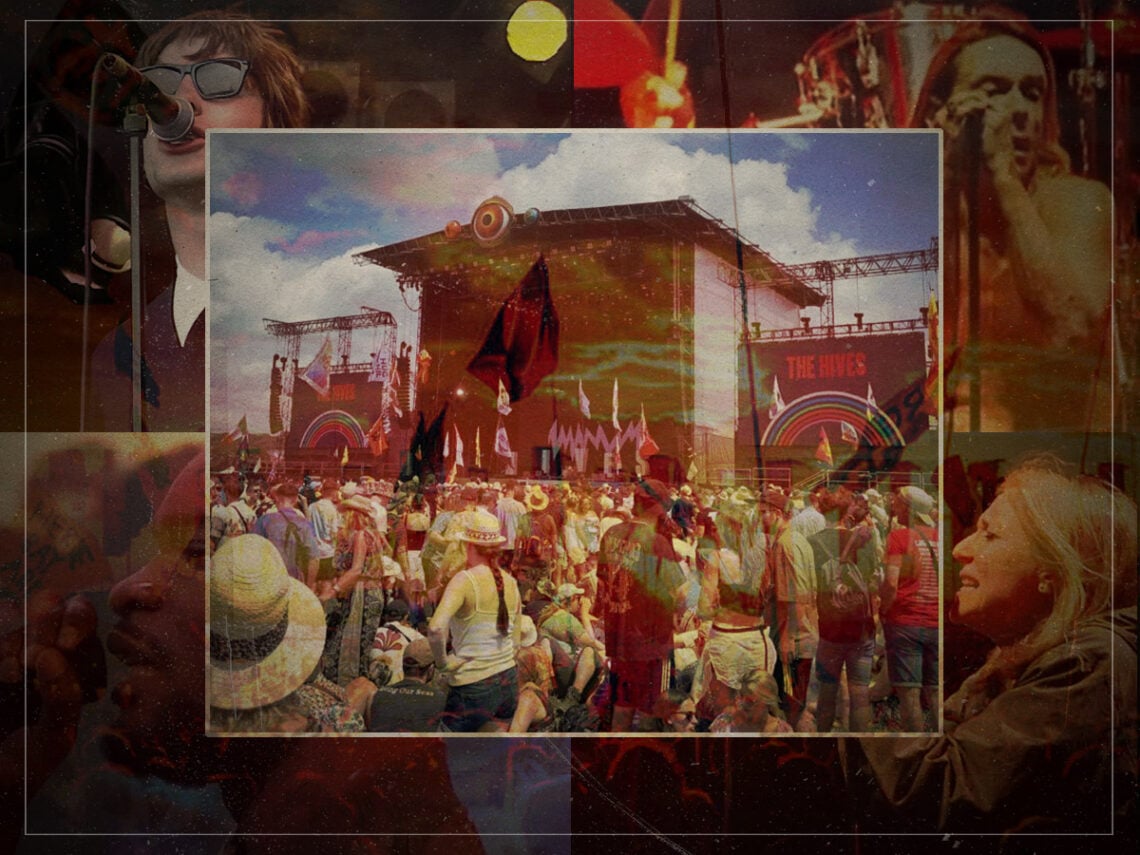
The origins of Glastonbury’s fabled secret sets

In 2002, Glastonbury changed forever. In a way that, according to some, wasn’t just a change in the festival’s set-up, but a fundamental betrayal of its values. By erecting a 12-foot-high “superfence” stretching four and a half miles along the festival’s entire perimeter, a large chunk of its original, die-hard hippy following legitimately thought ‘Glasto’s’ soul had died. That its spirit of wild, utopian togetherness had finally been laid to rest to make way for Glastonbury Festival, the moneymaking scheme.
As a result, the 2002 version ended up being a very different experience from the previous editions. One that initially seemed to favour the depressed hippies bemoaning the death of their beloved ‘Glasto’. You see, the open secret about the fabled atmosphere of the world’s greatest music festival was that for decades, it was hosting a lot more punters than the official capacity. On more than a few editions of the Pilton spectacular, the capacity was basically doubled by gatecrashers who bypassed the festival’s feeble excuse for security (sometimes aided by Michael Eavis himself).
The effect of the “superfence” was immediate. The 2002 iteration is famous for being one of the most boring editions in the festival’s history. A line-up weaker than month-old tea didn’t help, with the headliners being Coldplay, Stereophonics and *checks notes* Rod Stewart. Yet the blame for the festival’s dying atmosphere was laid squarely on the fence, and a number of new ideas were implemented to get the on-site atmosphere working again.
The most successful idea came to fruition in 2008, one that united both generations of the Glastonbury Festival. Keeping the anarchic, anything-could-happen spirit of the festival’s early years and combining it with the biggest names in music that the festival attracted in its later years. An idea that, today, is one of the most beloved and exciting traditions of the event. That makes headlines every single year and has people speculating months in advance, and that tradition is the “secret set”.
Why have secret sets become such a fixture of Glastonbury?
Like the best things about Glastonbury, this happened mostly by accident. In 2008, Peter Doherty’s post-Libertines project Babyshambles were due to headline the Park Stage on Friday night but pulled out at the very last second. After a scramble to find a replacement, Franz Ferdinand were tapped up to replace them due to being relatively nearby and having a gap in their touring schedule. However, what really made the set so iconic was how word spread about it.
Or in this case, how the word wasn’t spread about it. Rather than publicising the appearance of the ‘Take Me Out‘ hitmakers, the band and the organisers decided to take a more grassroots approach. If you checked in with the festival’s official website, then the Park Stage headliners were “TBA”. However, if you bumped into anyone handing out fliers on-site with caricatures of Franz Ferdinand on them (the band, not the long-dead Archduke of Austria-Hungary), then you were in the know.
Thus, there was an intoxicating mix of mystery and grassroots community about the whole set. Of strangers excitedly passing around the fliers, or letting anyone they were idly chatting to, that if they were stuck for anyone to see, Franz flipping Ferdinand would be on stage in 20 minutes if we got a hustle on. The band played an absolute blinder, and Glastonbury history was born.
Over the next decade and cycles of change, some of the festival’s most celebrated moments have come from their secret sets. Lady Gaga in 2009; Pulp in 2011; Radiohead the same year; The Killers in 2017; Foals in 2019. The list goes on and is part of the reason that the question of “atmosphere at Glastonbury Festival” is one that hasn’t needed to be asked in a very long time. Here’s to many more to come!
