


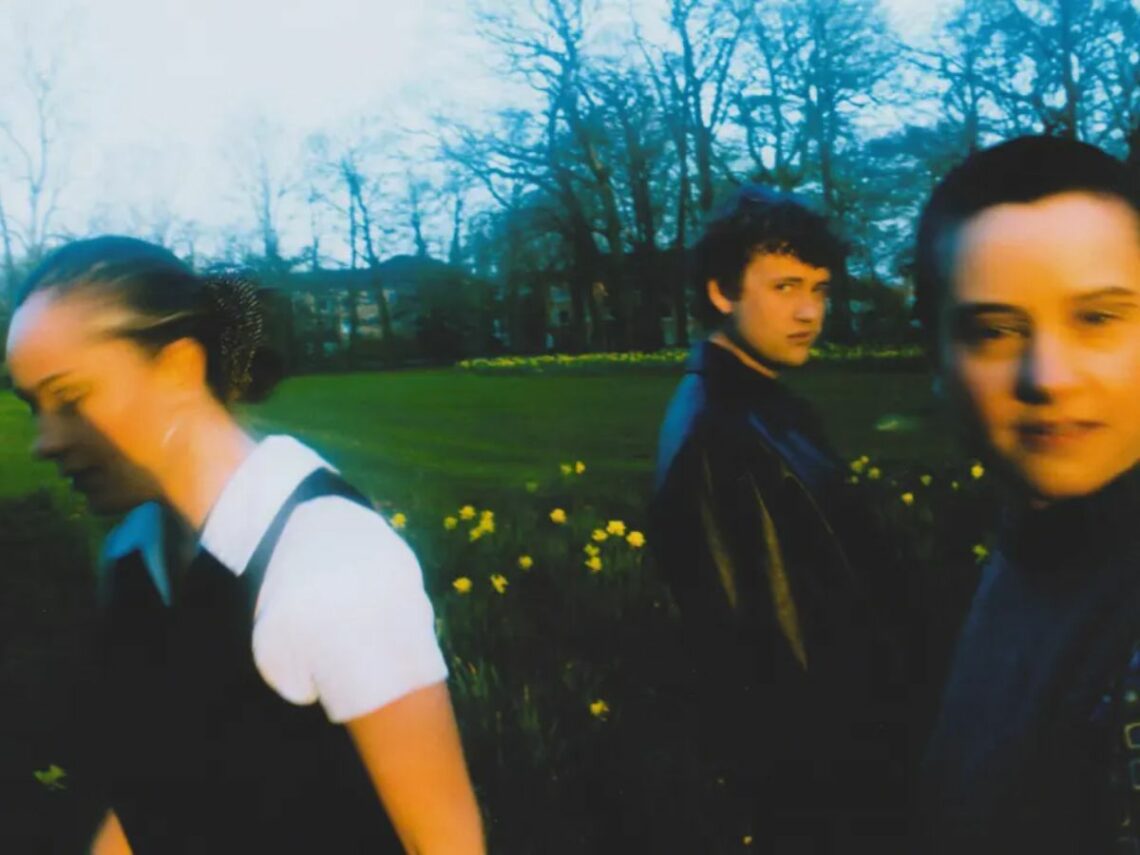
The Orielles – ‘Live at Stoller Hall’ album review: a transcendent and experimental live set

In October 2022, The Orielles outdid themselves with the release of their stunning third album, Tableau, a project which saw the trio depart from their indie-rock sound and lean into experimentalism. Inspired by Brian Eno’s Oblique Strategy cards, the band blended swirling synths with cosmic slices of ambience, beautiful string arrangements and abrasive guitars. Tableau demonstrated The Orielles’ maturity as songwriters and musicians, unafraid to release something strikingly different from the sound that got them to this point in their career.
Now, the band have a live album to share, recorded at Manchester’s Stoller Hall in November 2022. The Northern Session Collective backed the trio with their orchestra, allowing the songs from Tableau to come to life in the way they were designed. The group described the album as a “difficult set of tracks to do full live justice to due to the improvisational and experimental processes of recording it”. Yet Live at Stoller Hall proves that the band can easily translate this new work into a live setting and maintain the album’s immersive sound.
Live at Stoller Hall begins with an expanded string-led version of ‘Chromo I’, offering a cinematic take on Tableau‘s opener. As the band’s instruments build around the strings, giving us an alternative cut of the track, it becomes clear that their new music is in a constant state of evolution and metamorphosis.
The abrasive guitars of ‘Chromo II’ soon take over, with lead vocalist Esme Hand-Halford experimenting with autotune, allowing her voice to blend into the soundscape as one of the instruments. There’s a sense of controlled chaos brewing in the song, which comes to a halt with skilled efficiency before one of Tableau‘s highlights, ‘Airtight’, kicks into action. The bubbling synths create a mesmerising atmosphere, accompanying Hand-Halford’s rich bassline, which holds the whole piece together.
Although Live at Stoller Hall mainly contains songs from their recent studio album, the band throw in two tracks from earlier in their career, ‘Bobbi’s Second World’ and ‘Sunflower Seeds’, giving them a Tableau-esque makeover. These tracks allow Hand-Halford to sing naturally, although on ‘Bobbi’s Second World’, her voice sounds weaker than usual, lacking the emotion the song deserves. Nonetheless, the addition of strings gives the track a captivating rework, elevating it from its indie rock territory.
Another Tableau highlight, the highly emotive ‘Beam/s’, is played with striking accuracy; its mixture of rough guitars, fizzling synths and gorgeous strings represents a defining moment in the band’s career, marking out their full potential as musicians. The energetic synth cut ‘The Room’ loses some of his dynamism in a live setting, appearing slightly flatter and slower. However, it still manages to maintain enough energy for the set closer, ‘The Instrument’, to segue in with pummelling drums before building to a crescendo of crashing sounds.
By moving away from their indie rock roots on Tableau, The Orielles highlighted that their true talents lie in a much more loosely-defined setting. With no limits imposed on their creativity, their experimentation paid off. On Live at Stoller Hall, the band continue their journey towards a new direction, using a live setting to evolve their sound even further. Although including earlier tracks fractures the album’s fluidity, The Orielles demonstrate their inventiveness in attempting to adapt and rework old material. Nevertheless, this live album marks another huge leap forward in the band’s career, and the importance of this performance to the band is not lost on the listener.

Never Miss A Beat
The Far Out New Music Newsletter
All the latest New Music from the independent voice of culture.
Straight to your inbox.