


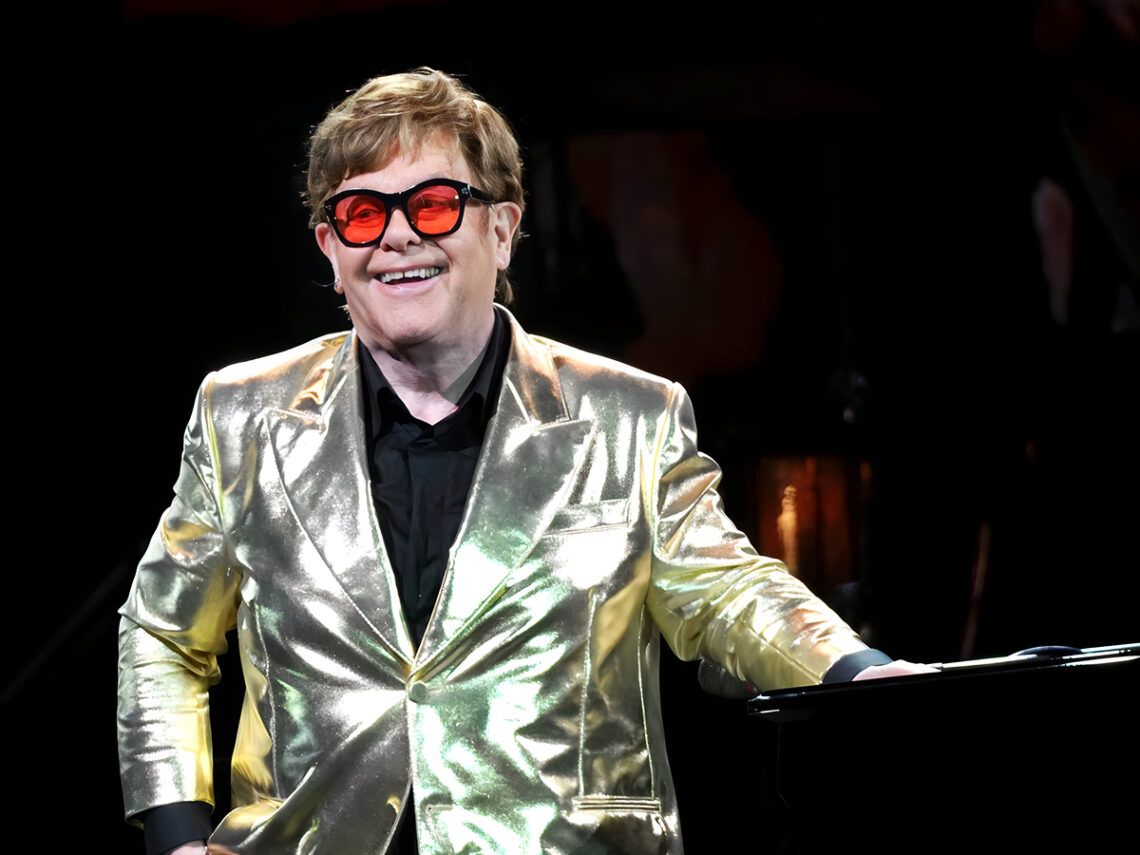
The one song that saved Elton John’s life: “Still, now, I cry”

Following a kerosene launch to stardom in the late 1960s and early ’70s, Rocketman Elton John relocated to the US to join the rock star elite. When he wasn’t getting down to the latest funk and disco innovations at Studio 54 on the East Coast, one could usually find Elton raising the roof at his opulent mansion in Los Angeles.
Thanks to Rocketman, Dexter Fletcher’s immensely popular 2019 biopic, it is well documented that John survived three decades of death-defying drug and alcohol addiction. What started with social lubrication derailed towards excess, isolation and addiction.
By the 1980s, Elton’s substance abuse had taken a severe toll, and the once-gregarious performer became increasingly reclusive. “This is how bleak it was: I’d stay up, I’d smoke joints, I’d drink a bottle of Johnnie Walker,” John revealed in a 2010 TV interview with Piers Morgan. “And then I’d stay up for three days, and then I’d go to sleep for a day and a half, get up, and because I was so hungry because I hadn’t eaten anything, I’d binge and have like three bacon sandwiches, a pot of ice cream and then I’d throw it up because I became bulimic and then go and do the whole thing all over again”.
“I’m not being flippant when I say that when I look back, I shudder at the behaviour and what I was doing to myself,” Elton added.
When asked how close a shave he had with death, John replied, “Very close. I mean, I would have an epileptic seizure and turn blue, and people would find me on the floor and put me to bed, and then 40 minutes later, I’d be snorting another line.”

Thankfully, Elton sought help after a wake-up call in the late 1980s and has been sober since 1990. “I still dream, twice a week at least, that I’ve taken cocaine, and I have it up my nose,” he told NPR in 2012. “And it’s very vivid, and it’s very upsetting, but at least it’s a wake-up call.”
Naturally, Elton’s road to recovery was fraught with temptation, depression and anxiety. Although lots of music comforted Elton through this period, no song quite measured up to the life-saving message of ‘Don’t Give Up’, the third single from Peter Gabriel’s 1986 album, So.
“When I took drugs, in the worst period, that is when I was perfectly aware of where I was slipping, a song helped me resist: ‘Don’t Give Up’, by Peter Gabriel and Kate Bush,” Elton revealed in a 2001 interview. “I was listening to it, and I was continuing to repeat aloud: ‘I will not let go, I will not throw in the sponge.'”
“The problem was that I did not know how to abandon the hole into which I was hurled,” he continued. “Then I understood; I would have to ask for help: to say, ‘I need help.’ I will never forget that track from the album So by Peter Gabriel. Every time that I allowed the situation to beat me down, every time that I thought that this life was not worth anything, I put on ‘Don’t Give Up’, and I convinced myself, ‘Yes, it is worth the pain.’ Still, now, I cry when I feel it.”
A touching duet, the song wasn’t original crafted as such. “The sensitive treatment Kate gave our give-and-take on that song was gratifying, because it’s not just a song about a woman supporting a man in a demanding relationship,” Gabriel told Spin in 1986. “The chief thing dragging them down is unemployment, which is presently tearing the social fabric of Thatcher’s England apart.” He added: “Without a climate of self-esteem, it’s impossible to function.”
Gabriel’s wife, Jill, said of the song’s conception, “I saw an article in a newspaper about a woman who jumped out of a huge block of flats with her child and killed herself. I gave it to Peter and it was the original inspiration and he was heartbroken to read it. However his lyrics are always multilayered with many different influences.” It provided the exact level of tender connection that would resonate with audiences everywhere, including Elton John.
Listen to Peter Gabriel and Kate Bush’s beautiful duet, ‘Don’t Give Up’, below.
