


The one genre Angus Young couldn’t stand: “We’d be in the audience punching the shit out of ‘em”

No other genre had quite the same effect on rock and roll as punk in the early 1970s. Even though it sprung up as more of a fashion in its genesis, the idea of bands stripping rock and roll down to its essentials and adding boatloads of attitude was the perfect retort to the sounds of progressive rock clogging up the airwaves.
Although there wasn’t much difference between punk and AC/DC’s brand of rock and roll, the Young brothers wanted nothing to do with the genre once it started blowing up.
Then again, AC/DC was already doing the equivalent of what punks were known for years before ‘The Class of ‘76’. Throughout albums like Let There Be Rock and High Voltage, the riffs of Angus and Malcolm Young were meant to be the ultimate example of ballsy rock and roll, boasting brash power chords and a particular snarl in the guitar tone.
That overlap is what makes the divide between AC/DC and punk feel more like a matter of identity than sound. On paper, both were chasing the same stripped-down aggression, but where punk leaned into chaos and confrontation, AC/DC were rooted in something far more traditional.
For the Young brothers, rock and roll wasn’t something to be torn down and rebuilt; it was something to be preserved and pushed forward. Their approach might have been loud, brash, and unapologetic, but it still came from a place of reverence for the greats that came before them.

So while punk may have looked like a kindred spirit from the outside, it never quite aligned with what AC/DC were trying to achieve. They weren’t interested in making a statement about society or tearing up the rulebook; they just wanted to plug in, turn it up, and let the riffs do the talking.
If anyone were the progenitor of the punk rock frontman, though, it would have to have been Bon Scott. Much like Sex Pistols’ singer John Lydon, who came after him, Scott knew the power of playing up the unsavoury character whenever the band played live, looking like the kind of person that people would steer clear of at the bar if they weren’t looking for trouble.
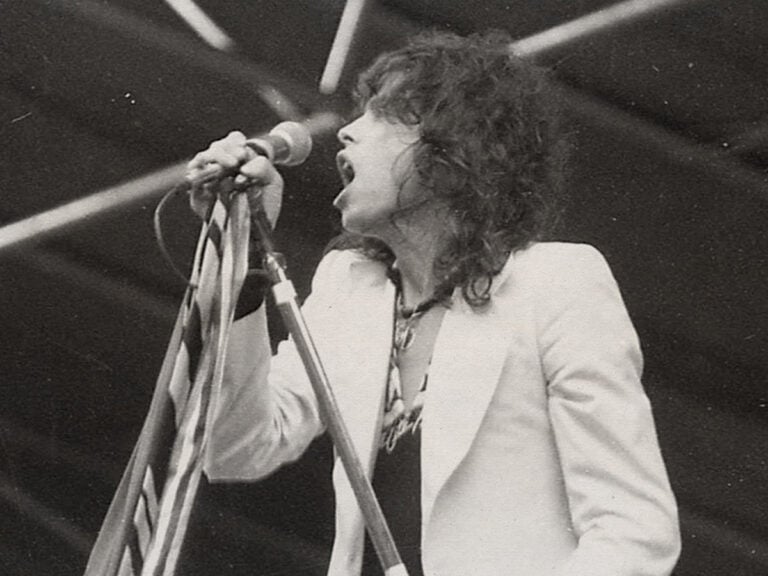
Once artists like Ramones started to clog the airwaves, Angus wanted nothing to do with it. Compared to the maniacs that turned up at their gigs, Angus felt that the fans had little to no respect for the music and were more concerned with causing as much destruction as possible during the gigs.
When talking about those early days, Angus went on to say that he was disgusted with what those fans stood for, saying, “[Punks] were locked into selling anarchy, like a political thing. To be honest with you, the first time I heard the word’ anarchy,’ I had to get a dictionary to look up the fucker! I’m limited – meaning a limited education – so that wasn’t communicating anything to me.”
Although the band would have many instances of punk showing up at their shows, Angus remembers taking care of them properly, explaining, “We would get punks showing up, and spitting, and when anyone got hit by gob, we’d be in the audience punching the shit out of them.”
Despite having the ethos of punk whenever they played live, Angus was chasing the thrill of rock and roll throughout every iteration of the band. Throughout the band’s time, either with Scott or Brian Johnson behind the microphone, Young was still trying to capture the kind of dreams that he saw when listening to Chuck Berry for the first time, down to co-opting his trademark ‘duck walk’ whenever he strutted across the stage.
While there might be a few similarities between Sex Pistols and AC/DC on the surface, Angus always emphasised the musicality before anything else. No matter how simple AC/DC’s music might seem from an outsider’s perspective, there’s a good chance that anyone in the band could play circles around their punk competition.
