


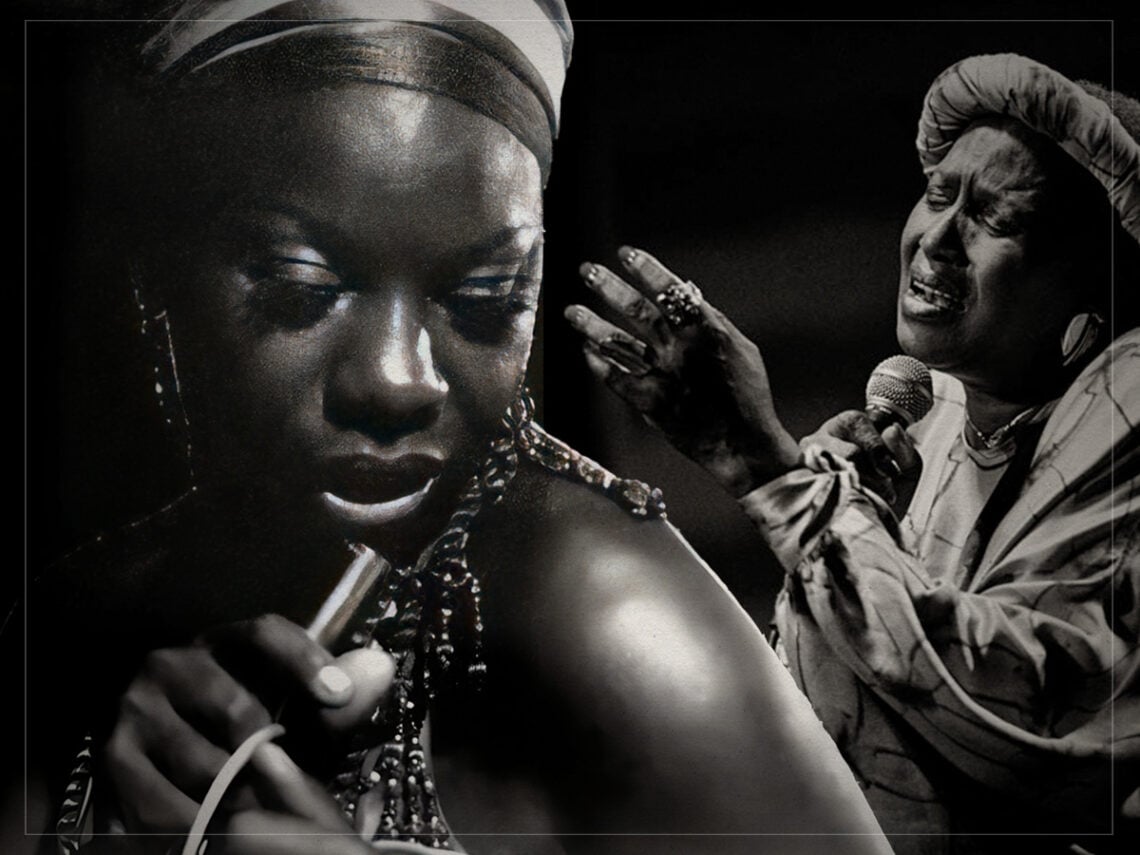
The remarkable night Miriam Makeba and Nina Simone joined forces

Usually when two artists collaborate, it’s due to an overlap in musical interests and styles, but for Nina Simone and Miriam Makeba, there was a far stronger kinship between the two performers that drew them together.
Simone was one of the most singular jazz musicians of the 1950s and ‘60s, with her husky contralto vocals and emotive piano playing being two features of her sound that set her apart from most of her peers. Her studio releases were, of course, special examples of her talent, but it’s arguably her live albums that she released that she’s gained more recognition for, due to how they proved how she was beyond comparison as a performer.
Makeba, on the other hand, was not necessarily as widely known in the Western World, but was just as unique in her own way for how she utilised her mother tongue, singing in the Xhosa language of South Africa, which features extensive use of click consonants. Given how the pair of them both had unique traits that set them apart from the rest of the field, there was already something there that linked the two, and it’s understandable that they would have expressed an interest in each other’s work for this reason.
There might not necessarily have been much of a musical overlap, except for the fact that you could reasonably describe it as being ‘folk music’ that has taken two different forms, but what they did have in common was their commitment to activism and the civil rights movements of their respective nations. Both had experienced the horrors of racism and segregation and were using their platforms as artists to spread a message of hope and solidarity within their communities to strive towards equality for black people.
Prior to performing together in May 1961, the duo had known each other for a couple of years due to Makeba having previously performed at the Village Vanguard for an audience consisting of jazz royalty like Miles Davis, Duke Ellington and Simone herself. This would lead to the two joining forces for a one-of-a-kind performance at Carnegie Hall in Manhattan, as part of a benefit concert for the Presbyterian Church of The Master in Harlem. While one might question whether this would have worked stylistically, attendees noted how there was virtually nothing that Simone couldn’t turn her hand to, and that the accompaniment of Makeba’s vocals played off her own input perfectly.
For a first appearance at the esteemed venue, this was a brave choice, and having her band playing in completely different styles could easily have alienated her audience. Guitarist Al Schackman played with Indian styles, while drummer Bobby Hamilton used finger symbols from the Middle East, adding to an already worldly sound which was already being established by Makeba’s vocals. Reviewer Robert Shelton summed up this fusion perfectly in his report for the New York Times: “It had little to do with the traditional song she was working on but it is useless to measure the unpredictable and whimsical Miss Simone by any narrow standards.”
Simone clearly had an existing interest in music from around the world, but her relationship and performances alongside Makeba evidently solidified this, and they’d end up becoming close friends and collaborators for many years. In fact, Makeba was responsible for Simone’s decision to move to Liberia in the 1970s to explore her heritage further, and when they reunited in 1991 to release a version of ‘I Shall Be Released’, it marked 30 years of a special transcontinental relationship between two icons of black folk music.
