


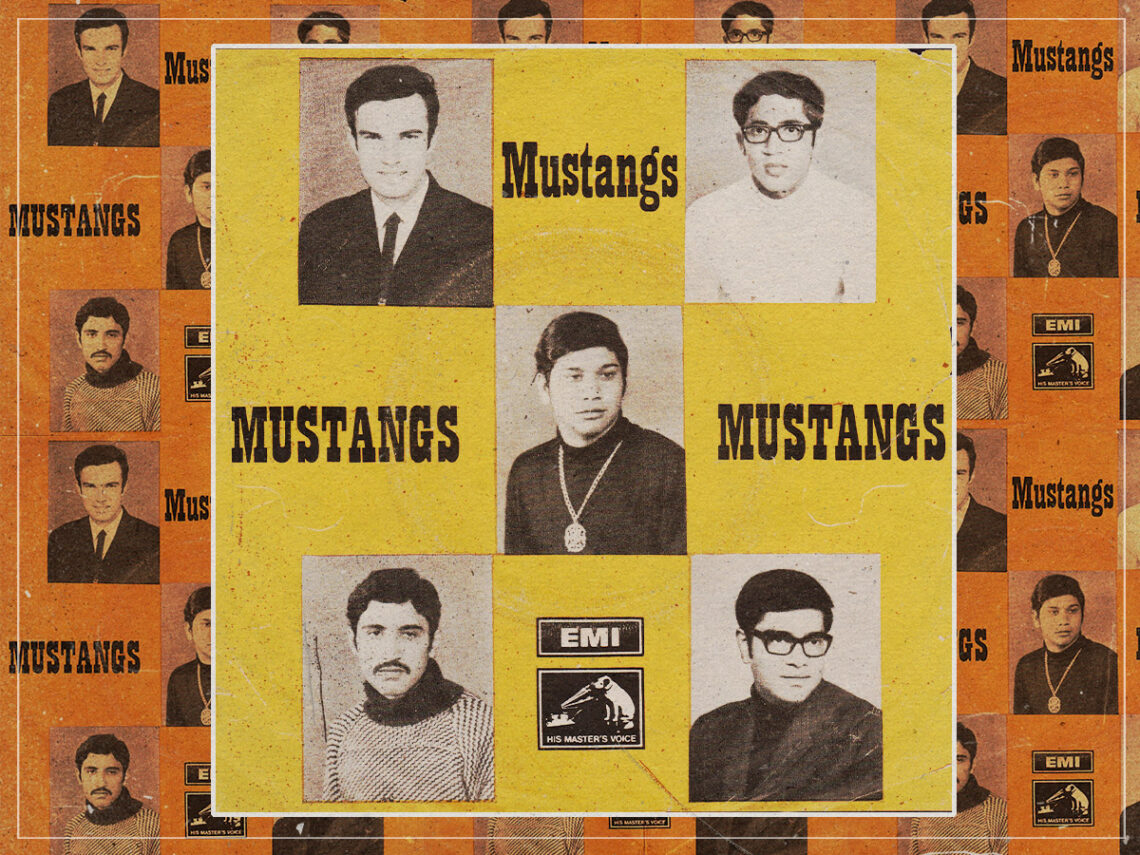
The Mustangs: the Indian rock band that transcended cultural barriers

The 1960s was a period of dramatic cultural development that saw the baby boomer generation question antiquated norms in the West. As hippie freedom fighters protested against an oppressive US establishment that felt duty-bound to fight communism in Vietnam, a great soundtrack adorned their wake. Although the rock bug was most virulent in the West, several noteworthy groups formed in the East during the 1960s; The Mustangs were undoubtedly one of them.
Over the past half-century, the war map may have shifted somewhat, but the anti-war outcry is sadly just as relevant today. As the Beatles showed in the 1960s, one could uphold the values of a movement without being artistically active in it. Of course, John Lennon would fold protest anthems into his solo canon with great profusion in the 1970s, but through the 1960s, the Beatles simply exuded love and peace, rarely politicising their lyrics.
Similarly, The Mustangs, a rock band formed in Madras (now Chennai), India, became a cultural phenomenon by simply existing as they were in the right place at the right time. Just as the Beatles brought traditional Indian music to the West in the mid-1960s, The Mustangs brought Western rock traditions to the heart of India. These cultural connections posed a passive symbol of international peace and unity.
The Mustangs, initially comprising frontman Derek Norris, lead guitarist George Cherian, rhythm guitarist Tim Tharasingh, drummer Anand Padmanabhan and bassist Haroon Mohamed, formed in 1965 at the height of the British Invasion wave. Although the band only lasted four years in their initial run, they became the biggest Indian name in rock music thanks to a string of historically significant singles.
After establishing their sound, a mixture of surf, blues and rock, in small venues across Madras, The Mustangs were singled out for a landmark deal with HMV. The band recorded their first 45 records in 1968, which contained ‘Escape’ and ‘Theme from the movie – Gonks Go Beat’, the first Indian songs ever to appear on a Western LP. This was followed up soon after by an EP containing ‘Love Is Blue’, ‘Lies’, ‘Nina’s Theme’ and ‘Summer Wine’.
Tharasingh and Cherian left the band in 1967 before the group welcomed Daryl Cordeiro to replenish the guitar roster. The band finally dissolved in 1969, but in January 2010, 45 years later, Norris, Cherian, Ratnam, Padmanabhan and Mohamed reunited for a couple of shows across Chennai and Bangalore.
As a convergence of cultural backgrounds, including Muslim, Hindu, and Christian members, The Mustangs’ significance wasn’t confined to India’s borders. In an era when cultural exchanges were limited, their diverse lineup and harmonious records sent a pertinent message to the world. The band showed that music, much like love and compassion, knows no religious boundaries. As their art travelled the globe in landmark 45s, it carried with it a tacit yet profound call for unity amid diversity.
Listen to The Mustangs’ ‘Escape’ below.
