


Why the ‘British Invasion’ wasn’t quite what it seemed

The world is a place of great hypocrisy and contradiction, especially in the West. Italian explorer Christopher Columbus first landed his ship, Santa Maria, on the shores of the “New World of the Americas” in 1492. Little did he know then, but this would mark the beginning of a new era, a firm string to the bow that ejected us further from the Middle Ages towards an increasingly globalised and industrialised planetary civilisation – one that would eventually produce The Beatles.
This newfound rock was seen as the land of opportunity, a place where the oppressed classes of Europe and the British Isles could run away and start over, free from the clutches of high taxation, overpopulation, famine and persecution. The mass population of North America was a gradual process that burgeoned from the 1500s to the 1800s, with unspeakable bloodshed following in the wake of imperial posturing.
The British, French and Spanish tugged at the undefined mass of land with wide eyes, imagining the near-infinite space for economic growth. As we know, the conflicts simmered in various combinations of allegiance, all the while with flagrant disregard for the livelihoods of indigenous peoples. Eventually, like tectonic plates settling into relative dormancy following the Big Bang, The United States of America became a matured nation, independent of British rule, on July 4th, 1776.
Winding past the years of civil war, industrialisation and urbanisation, the USA became one of the strongest economies in the world thanks to the country’s seemingly inexhaustible resources. This young country became the spearhead of the capitalist machine and, heading into the 20th century, was one of the most powerful players in the brave new world.
Globalisation, as it became apparent in 1914 and again in 1939, wasn’t without its hiccups. With the added flavour of industrialisation, stressed relations between countries led to the first worldwide conflict in human history, followed by a second for good measure. These brutal world wars consolidated the US’s position as a dominant global force and reinforced a steady transatlantic bond, with no lingering indignation over Independence Day.
The British enjoyed a close relationship with the USA through the early 20th century, but always at arm’s length. As is well-documented in contemporary literature, the British often regarded the Americans as a little ostentatious with their newfound wealth and freedom. In return, the Americans often prejudged the Brits as reticent and polite, if intellectually snobbish. Great Britain was the East Egg to the USA’s West Egg in Great Gatsby terms.
While many Brits would take a long time to submit to the fun-loving jazz age of the USA, the generation that held hands with the Americans on the beaches of Normandy on D-Day would begin to embrace the cultural stir with open arms. With the English language in common, cultural alignment between the USA and Britain was elevated by the early rise of Hollywood.
A staggering technological revolution allowed the Golden Age of Hollywood to join the early expansion of recorded music for the general listener. As rhythm and blues records flew from shelves and cinemas shot up on both sides of the Atlantic, global stars like Elvis Presley and Marilyn Munroe became more commonplace.
When the 1960s arrived, the UK’s babyboomer generation began to emerge from ration book inertia to bring a little colour into the world. Much to haughty parents’ despair, rock ‘n’ roll hit the shores of Blighty and ignited a cultural revolution.
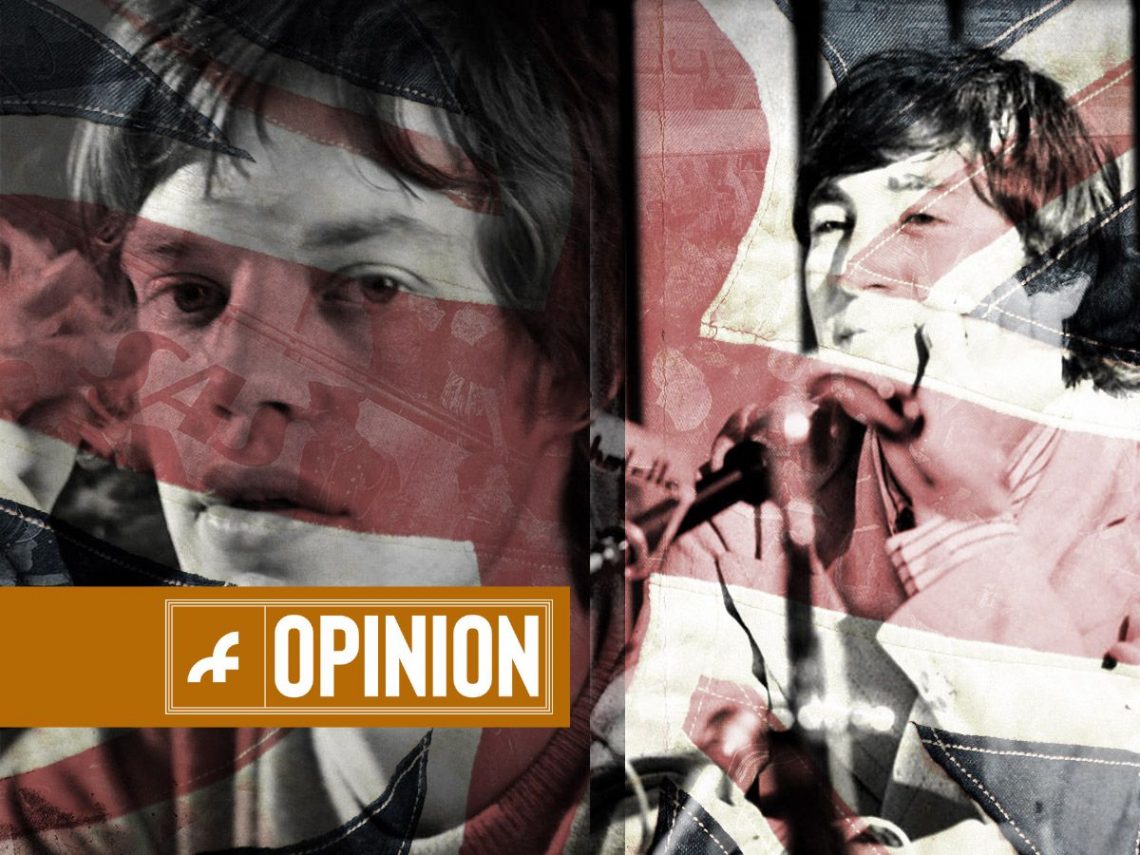
Bands like The Beatles, The Rolling Stones, The Kinks, The Who and so on saw the attention Elvis and Chuck Berry garnered over the pond and wanted a slice of the pie. These bands and musicians are famously thought to be the central protagonists of a “British Invasion”. Alas, I argue that this martial term for the British takeover of the American charts can be contradicted. In many respects, it was the consolidation of an American Invasion.
Having grown up in Britain, I’m no stranger to Brits calling one another out for adopting “Americanisms”. I recall my mother once reminding me that “gotten” does not exist in the English language and that I never “dove” into the swimming pool; I “dived”. This pride in language transcends the “British Invasion” generation, and I have no doubt that, as a father, I’ll go to some lengths to stop the rot of Americanisation that threatens to debase our culture. Fundamentally, I know these are merely lingual trivialities, but deep within me, a desiccated antediluvian limey smoking a pipe and sipping his tea has a hand on my subconscious.
When The Beatles proudly brought British music to America with their US TV debut on the Ed Sullivan Show in February 1964, they played five of their early smash hits. Among them was the eternally popular earworm ‘She Loves You’, a song Paul McCartney and John Lennon excitedly performed for McCartney’s father shortly after writing.
“When John and I had just finished writing the song ‘She Loves You’, we were in the parlour of the little house [where] we lived in Liverpool,” McCartney once told NPR. “And John and I went next door to one of the rooms where my dad was. And we played it — ‘She loves you, yeah, yeah, yeah’ — and he said, ‘Oh, that’s very good, son. But there’s just one thing. Couldn’t you sing, ‘She loves you, yes, yes, yes?’ He said, ‘There’s enough of these Americanisms around.’ We said, ‘No, sorry Dad,’ it’s got to be ‘yeah, yeah, yeah.'”
This anecdote of McCartney’s perfectly illustrates the argument that while the “British Invasion” musicians ransacked the US charts and brought Britain into the modern age, it was, in essence, quite the reverse. A new floodgate had been opened, and British culture, as the pre-World War II generation knew it, had almost completely surrendered to transatlantic influences.
Over the 1960s, British culture could be seen as having caught up with that of the US as it became one and the same. After years of regimented classical literature, the American Beat Generation ushered in a new age of poetry and lyricism that pervaded Britain just as the hippie culture began to rail against age-old values. Concurrently, youth in London stood with their counterparts across the US in protest against the American war in Vietnam. Increasingly, something deemed a problem in the US became a problem in Britain, too, by default.
From my meditations, you may have construed that I’m against the cultural revolution in Britain that occurred over the second half of the 20th century. On the contrary, I’m mostly thankful for it, not just because of the explosion of colour, music and fashion, but because it saw the young question the old. Abstract thought and a sense of global community beckoned an age of compassion and freedom, which regrettably still has a way to go.
Naturally, it’s difficult for some people to suppress contempt toward Americanisation – the old pipe smoker inside me will attest – but ultimately, we have to remember that the evolution of language has never stood still. As mankind continues to evolve and invisible borders are redrawn, the values that really matter are the ones in our minds as individuals. Cultural pride is a virtue, but to impose one’s values on others is an act of violence. We must lead by example, learn from history and never dwell.

Never Miss A Beat
The Far Out Beatles Newsletter
All the latest stories about The Beatles from the independent voice of culture.
Straight to your inbox.