


The musical dragon: What is the koto instrument from Japan?

Six feet from one end of the ryūtō (the dragon’s head) to the ryūbi (dragon’s tail), the koto is one of the most instantly recognisable sounds in traditional Japanese music, but, as much as we associate the hypnotic and mystical sounds of this plucked string instrument with a history of Japanese folklore, its origins actually lie in another Far Eastern country.
Imported into Japan from China between the 7th and 8th centuries, it first became incredibly popular among the nobility and could often be heard around the imperial court.
A beautiful, wood-carved stringed instrument, now often ornately decorated at either end with traditional Edo-period carvings or prints, each part of the koto is named after a body part of the dragon: a creature as deeply and richly embedded into Chinese folklore and history as is Yōkai, food and music in Japanese tradition.
Set into the dragon’s head are the ryūgan (the dragon’s eye) or the holes where the strings are attached, which are plucked with the tsume (dragon’s claws), which in the West would be called plectrums, which is much less interesting and evocative.
The strings, of which there are either seven, 13, 20, 25 or even 30, depending on the kind of koto you’re playing, run over a long wooden panel (the topside is known as the ryūkō or dragon’s shell, while the underside is the ryūfuku, or dragon’s stomach) and are suspended by the ji, movable bridges, which adjust the tuning and pitch of the instrument, and give it the koto’s iconic and instantly recognisable sound.
These can be moved once the strings have been plucked to give a pitch-bending sound, but are more often positioned between songs to keep a consistent tuning. The ji are then used with the right hand to pluck the strings on one side, while the left hand depresses or lifts the strings on the other side of the ji to change the notes, much in the same way you’d hold or bend the strings on the fretboard of a bass or guitar.
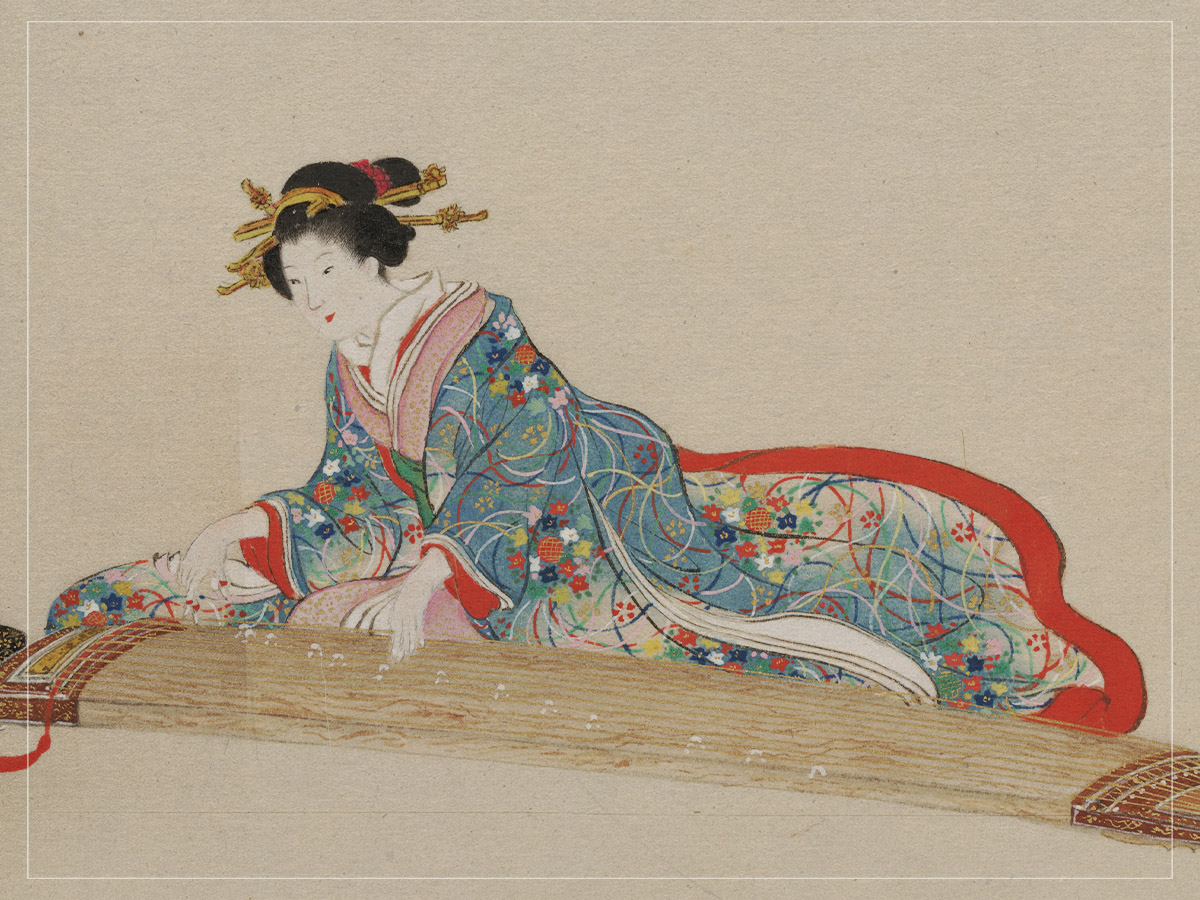
Though the instrument was originally associated with the nobility and imperial courts, becoming firmly embedded in the Gagaku form of ceremonial, reverent and religious music, the koto became a widespread and widely popular instrument during the country’s Edo Period. During this time, the Koto became an important part of the everyday music playing that could be found outside the courts and palaces, and became as common as the piano would have been in 19th-century England, and, much like those pianos, the kotos of Edo-period Japan were more broadly played by women than men.
Sounding like something halfway between an oversized zither combined with an undersized harp, the koto is capable of crafting myriad moods and atmospheres, which can be traced in its history of ceremonial and celestial court music to being manipulated into something more sinister-sounding. In literature, the koto played a central role in Seishi Yokomizo’s 1951 novel The Inugami Curse, where it anchors both the traditional elements of the story with heightened tension and murderous suspense, and helps detective Kosuke Kindaichi eventually solve the case.
Owing to an increase in Westernisation of Japanese music and a modern propensity towards pop and hyper-pop, the koto has unfortunately become a much less established part of the Japanese music scene. Over the years, it has been incorporated into a wide range of genres and styles, perhaps most notably in the Wamono style of Japanese funk, soul, jazz and the fusion of all three, thanks to artists like Minoru Muraoka, Kiyoshi Yamaya, Toshiko Yonekawa and Kifu Mitsuhashi.
More recently still, plenty of players, like Tokiko Kimura, Satsuki Odamura and Mitsuki Dazai, are fighting to keep the tradition of the instrument alive, while others still are finding new and inventive ways to bring the music into a more modern period, including artists and groups like Michiyo Yagi (jazz), Rin’ (pop), Kagrra (rock), BABYMETAL (metal, obviously) and even some dance music producers.
Outside of Japan, the instrument has occasionally featured in Western works, including songs by groups as diverse as The Rolling Stones, Queen, David Bowie, A Taste of Honey, Maribou State, Gold Panda and Dr Dre, but it will always be most widely associated with its place in the mythical and mystical Japanese tradition and folklore.
