


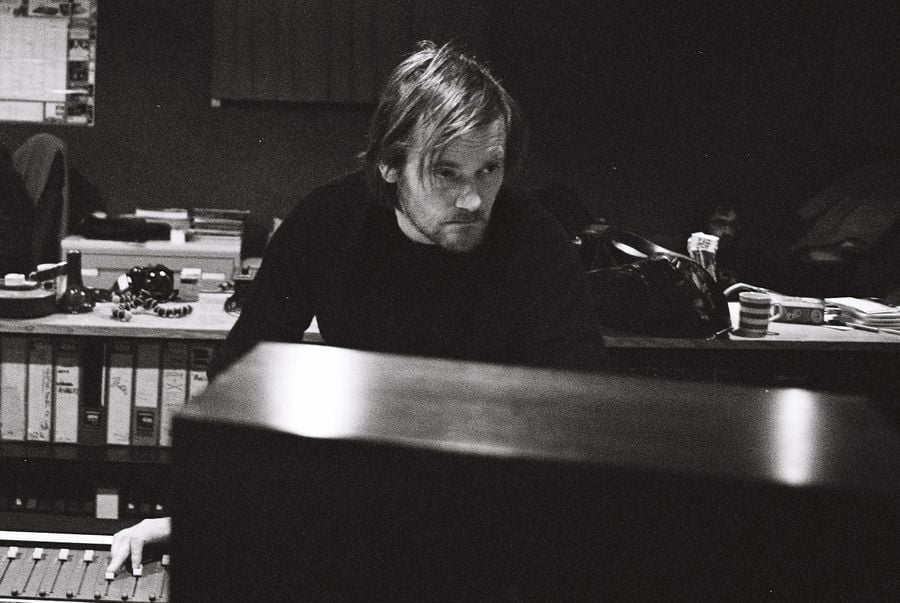
The music that shaped Geoff Barrow’s life

After playing in local bands, Geoff Barrow took his first job as a tape operator at Coach House Studios shortly after it opened in 1989. Soon enough, he was assisting the creation of Massive Attack’s Blue Lines, one of the most influential British albums of the 1990s. However, it wouldn’t be long before he began working on his own music, forming Portishead in 1991 alongside Beth Gibbons. By 1994, the band had released their debut album Dummy, which also became one of the most pioneering releases of the decade.
“I just wanted to make interesting music, proper songs with a proper life span and a decent place in people’s record collections,” Barrow stated. With Portishead, the musician has been highly successful, winning multiple accolades such as the Mercury Prize and an Oustanding Contribution to British Music prize at the Ivor Novello Awards. Barrow has gained a reputation as a prolific remixer and producer, working with high-profile acts such as Primal Scream, Depeche Mode, and Tricky.
Alongside Portishead, Barrow is also a member of Beak, an experimental electronic rock project, and has scored several films, such as Alex Garland’s Ex Machina and Men. With an extensive and eclectic list of musical credits, it’s clear that a wide array of genres has inspired Barrow. Talking to The Guardian, Barrow revealed that his first musical memory was Charles Jolly’s ‘The Laughing Policeman’. He said: “When I was four I’d go into the local village shop after infant school. I was in there buying my sweets and I noticed there was this strange noise coming out of a Cornflakes packet. It sounded like a really scary bloke laughing.”
He continued: “The shop owner must have had his radio on the shelf behind the packet, but I remember my brain having to work out what it was. When you’re really young, you don’t really notice music in the same way, and then there’s this realisation – ‘That’s a song’. I was scared by it, but I felt intrigued by it too”.
When Barrow was nine, he started playing the drums, although he claims: “The drums can be very unmusical; if you’re playing by yourself, you’re not really making music, you’re making a racket.” The musician cites The Honeycombs’ ‘Have I the Right?’ as a particular favourite to play along to, which he found in his dad’s record collection. “It was actually produced by Joe Meek and the beat I’d play along with was the sound of people jumping up and down the stairs. But I didn’t know anything about him or production then, I just liked it because it had a real stomping beat.”
By 14, Barrow was really into hip-hop and electro. He loved ‘Planet Rock’ by Afrika Bambaataa and the Soulsonic Force, “It’s got a roughness and an evilness to it,” he said, before adding: “I was the body-popper who became the scratcher. We’d go into local towns where there were the blokes who were our arch enemies and we’d dance against them. It was like a terrible scene from Footloose.”
Similarly, as a teenager, going to an underage club night in Bristol led Barrow to discover Public Enemy’s ‘Rebel Without A Pause’. “When it came on, I had to sit down. I was absolutely floored by it,” he said. “It was a life-changing moment for me. The enormity of Chuck D’s voice and the enormity of the sub-bass and the complete fuck-offness of it! It was like punk. It was my punk.”
In 1991, Barrow had discovered German krautrockers Can, particularly the track ‘Vitamin C’, via a radio broadcast of Mark E. Smith playing his favourite songs. “It freaked me out so much that I put it aside for a long time; it was almost like I couldn’t understand them properly until I’d grown up. I had a long period of time off [after Portishead’s second album] when I wanted to change the whole way I worked, and Can were one of the instigators of that period of growth and change.”
The musician claims to have found himself getting sick of hip-hop by 1999; however, the release of Jaylib’s 2003 album Champion Sound captivated Barrow. “There’s no one like Madlib. He’s like the Frank Zappa of hip-hop; they’re both trying to push music to its outermost limits. He brings a completely human element to beat-making, which is almost impossible to do, and his music is always evolving, even between the start and the end of a track.”
Finally, a record that Barrow has always returned to is Assault on Precinct 13 by John Carpenter. The score was a huge source of inspiration for Portishead: “There’s one bit that led to ‘Roads’ (from Dummy) – it’s not the same chords, but it’s trying to achieve the same emotion – and it inspired ‘Machine Gun’ on Third and film projects I’ve done since,” he said. “It’s a very short soundtrack made with a couple of synths and a drum machine in a little studio, but the simplicity is incredible. It made me realise you don’t need to overindulge musically to create emotion.”
Music that has shaped Geoff Barrow’s life:
- ‘The Laughing Policeman’ – Charles Jolly
- ‘Have I The Right?’ – The Honeycombs
- ‘Planet Rock’ – Afrika Bambaataa and the Soulsonic Force
- ‘Rebel Without A Pause’ – Public Enemy
- ‘Vitamin C’ – Can
- ‘Champion Sound’ – Jaylib
- ‘Assault on Precinct 13’ – John Carpenter
