


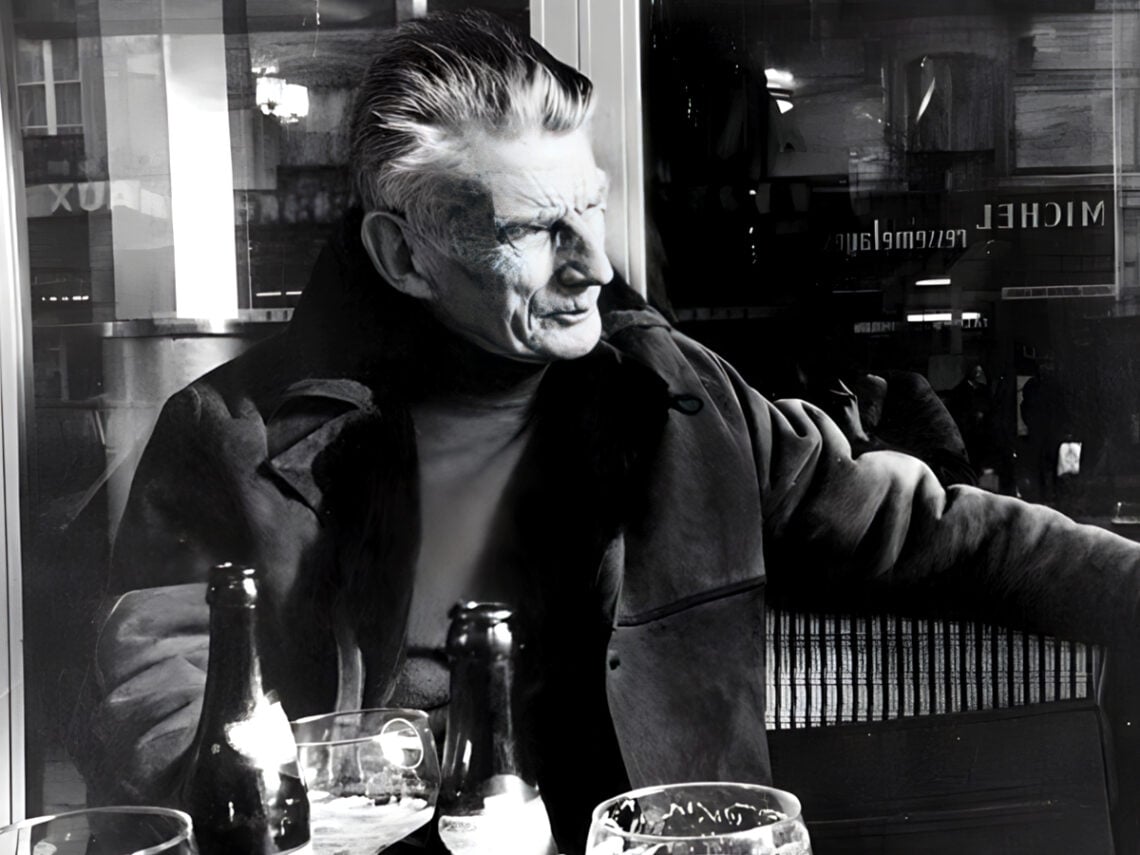
The music that inspired Samuel Beckett: “Intensity beyond anything I have ever heard”

Like his contemporary writer Ernest Hemingway and then later Cormac McCarthy to come, the Irish novelist and playwright Samuel Beckett was an economical practitioner and a man who firmly believed in the maxim that less is more. Again, like those writers, his works can be staggeringly bleak, and they address existential issues and explore the human condition. More so than with Hemingway or McCarthy, though, Beckett’s work is shot through with absurdity, black humour and tragic comedy.
Beckett was such a staunch absurdist and minimalist that his most famous character, the titular entity from his 1953 play Waiting for Godot, never even makes an appearance on stage or on the page.
His early writings included essays on James Joyce, who he had crossed paths with in the late 1920s while working as an English Lecturer at the École Normale Supérieure in Paris, and Marcel Proust. His later works were more informed by playwrights, poets and philosophers like Dante Allegro, Rene Descartes and Arnold Geulincx, though his earliest published piece of work was actually a music review, To a Toy Symphony (Haydn), written in the early 1920s under the pen name John Peel.
Like fellow Nobel Laureate Albert Camus, Beckett’s existential writing could be shockingly sparse and yet absurd in both its mundanity and profundity. Camus won the Literature Laureate in 1957, though he tried to refuse the honour, while Beckett was celebrated for his achievements in 1969.
And while he was inspired by Joyce, Dante, Descartes and other literary luminaries, he was also inspired by a deep and abiding love of music, chiefly classical.
As well as a playwright and novelist, Beckett was also a prolific letter writer, as the various collections of his missives that have been posthumously published attest. He would often praise or critique the classical performances that he had witnessed.
Though at first he wasn’t sold on certain selections from one of history’s most famous, and his otherwise most favoured, composers, writing that “I feel that Beethoven’s Quartets are a waste of time”, because “he needed a piano or an orchestra”, although he was eventually won round when witnessing the Busch Quartet play Beethoven’s Quartet Opus 130, of which he wrote that “although it is only his penultimate quartet it has as its finale the last composition we have from his hand, an incomparably beautiful Allegro. But it is the Cavatina that immediately precedes that Allegro that made the greatest impression on me. A movement which in calm finality and intensity goes beyond anything I have ever heard by the venerable Ludwig”.
As a boy, Beckett was sent for piano lessons in Stillorgan, Dublin. Later, when he remembers duetting with Beckett, himself on the violin with Beckett at the piano, his cousin Morris Sinclair says, “Well, with what conviction and elan he would play the last movement of Beethoven’s ‘Pathétique’! The intensity of his absorption was almost ferocious.”
Music stuck with him throughout his whole life. As his closest friend in Paris, the artist Avigdor Arikha, remembered, “Listening to music was essential to him”. Arikha added that “it was a ritual. Concerning pianists, his favourites were Yves Nat, [Alfred] Cortot, [Artur] Schnabel, Solomon [Cutner], [Rudolf] Serkin”. Beckett would attend as many concerts as he could, and his favourite contemporary composers included Debussy, Ravel and Bartok, while his most beloved of all was from an older age: Haydn, Beethoven and Schubert.
Later in his career, Beckett would fold these passions and influences into his own work as he moved into working with more transdisciplinary mediums such as music, painting, sculpture, and television. In his television plays Ghost Trio (1977) and Nacht und Träume (1983), Beckett took musical excerpts from Beethoven and Schubert, respectively, to structure his work.
Similarly, contemporary composers such as Pascal Dusapin, Philip Glass, and Heinz Holliger have all been inspired to write using Beckett’s own texts.
Although he is best known, remembered, and celebrated for his writing, when composing his 1962 radio play Words and Music, Beckett uttered the three-word resignation to himself that “music always wins”.
