


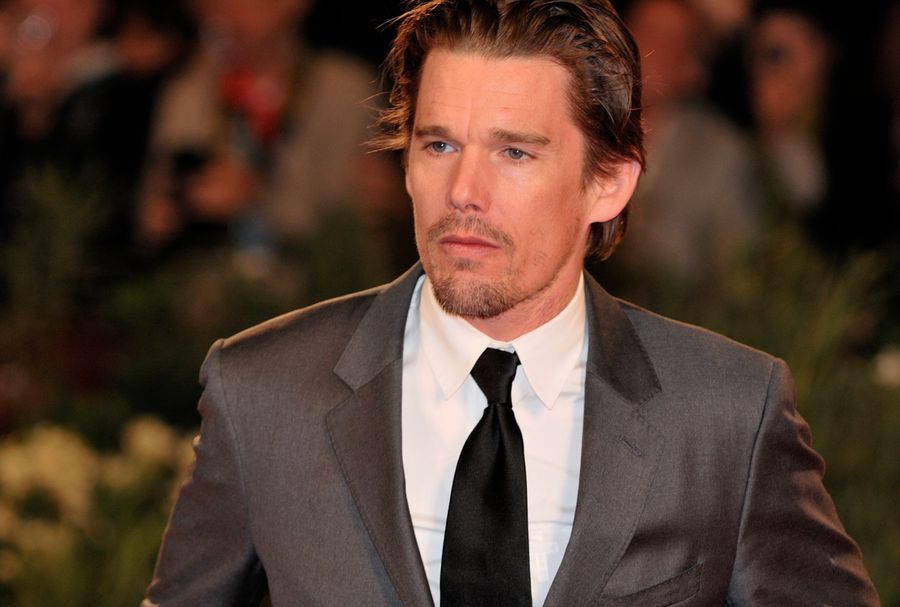
A career in three acts: The movies that define Ethan Hawke

A fixture on film and television screens for nearly 40 years, Ethan Hawke has carved out a career that effortlessly straddles Hollywood and the indie circuit. From his early days as a child actor to his evolution into one of the most quietly compelling performers of his generation, Hawke has consistently sought out rich, thought-provoking roles.
He’s dipped into nearly every genre—starring in era-defining romances, cerebral sci-fi, and horror thrillers that might have otherwise been forgettable if not for his magnetic presence. Never one to chase box office glory, Hawke instead built a legacy rooted in artistry, curiosity, and authenticity.
Few films capture his storytelling instincts better than Richard Linklater’s iconic Before trilogy. As Jesse Wallace, the lovestruck wanderer whose on-screen relationship with Julie Delpy’s Celine unfolds over decades, Hawke delivered a masterclass in naturalistic acting. His earnest, restless charm made him an audience favourite, but his versatility didn’t end there. From the mind-bending sci-fi of Predestination to his bone-chilling performances in Sinister and The Purge, Hawke has long been a cinematic shapeshifter—capable of elevating even the most unexpected material.
Whether in introspective dramas or pulse-pounding thrillers, Hawke’s ability to inhabit characters with sincerity and depth sets him apart. Here are three pivotal roles that map out the fascinating trajectory of his career, proving he’s never needed to play by Hollywood’s rules to leave an indelible mark.
Three films that define Ethan Hawke:
Dead Poets Society (Peter Weir, 1988)
Hawke’s breakthrough came in 1988, when he began filming Peter Weir’s Dead Poets Society at a private boarding school in Delaware just after his 18th birthday. The baby-faced Hawke appeared alongside comedy legend Robin Williams as new kid Todd Williams, a deathly shy prep school student who is given a new lease on life by his English teacher’s contagious passion for life and poetry.
Hawke’s ability shines through here in his ability to convey an entire aching heart’s worth of feeling through a single look and very little dialogue. He’s also the most crucial element of the film’s most iconic scene, where a stickler principal orders Robin Williams from his classroom and turns to see his students mounting their desks in an act of defiance and solidarity. The film’s final shot is young Hawke staring down at his teacher and vital mentor, framed through another student’s legs. A swelling score verging on overwrought and Hawke’s face just nearly breaking in those last few milliseconds must have left enough of a lasting impression for the film to land a range of Oscar nominations the following year.
Behind the scenes, Hawke wasn’t close to breaking at all. In 2021, he told a film festival Q&A session in the Czech Republic that he found Williams irritating on set and found himself unable to laugh at the comedian’s banter. He said, in retrospect, he was intimidated by the star’s intensity and earnestness. The two left it on good terms, apparently, with Williams helping the younger actor to get an agent.
Dead Poets Society wasn’t Hawke’s first film role—see 1985’s Explorers by Joe Dante, where Goonies-style adventure meets alien encounters put through a Looney Tunes filter—but it was definitely the thing that put him on the map, leading to high-profile roles in films like White Fang and Alive not long after. And with the 1990s winding up and Generation X finally able to take their space on the adult stage, things were set for Hawke to become a household name—at least for fans of Richard Linklater.
Before Sunset (Richard Linklater, 2004)
There’s a long list of symbiotic relationships between actor and director: Martin Scorsese and Robert De Niro, John Waters and Divine, David Lynch and Jack Nance. Somewhere down that list must feature Austin native Richard Linklater, who shot to fame during the 1990s with his stripped-down Gen X renditions of life in suburban America like Slacker and Dazed and Confused. And Linklater has worked with nobody more closely than fellow Texan Hawke.
There’s one particular set of Linklater films that show a miniature career in three acts for Hawke: the Before trilogy. Co-written with Hawke and co-star Julie Delpy, the films are a cinema verité depiction of a real-time relationship spaced out with nine years between instalments.
It’s the second act that really shows where Hawke was heading. Taking place in Paris nine years after his brief encounter with Celine, Hawke’s Jesse finds himself reunited with her for a few fleeting hours. While the first film is a true blank verse tribute to young and free love, the second film is about when the wrinkles start to set in. Both characters have ongoing lives and commitments that they would have to derail were they to give in to this romance. Both of them have felt the weariness of the road. They’re a little sadder and a little wiser than the last time we saw them. It feels true to life—Jesse points to a wrinkle between his eyebrows that he obviously shares with his actor, proof of mileage.
But like in Dead Poets Society, its the last few moments of Hawke’s performance that will stay with you. Already running late for a flight, Jesse follows Celine into her Parisian apartment. Together they listen to Nina Simone, and he sits back on her sofa and watches her. “Baby, you are going to miss that plane,” Celine says. “I know,” says Jesse.
It’s an understated exchange, capturing so much passion in such a small container. Then cut to black. Not just for the film, but for Hawke’s time as poster child for Gen X coolness and a transition into something else.
First Reformed (Paul Schrader, 2018)
As character actors hit middle age, they get to play parents. It hits women worse than men, but it remains true across the board. While Hawke once had a run at action star status with Training Day in 2001 and 2005’s Assault on Precinct 13 remake, the 2010s saw a shift into a series of dads.
The Purge, Boyhood and Sinister all squandered interesting premises and formats and left Hawke with little to do. Meanwhile, genre works like Daybreakers and Predestination presented interesting challenges (including playing his own father), but they failed to garner much in the way of critical acclaim. But while most of the casting calls seemed to be to play some up-and-comer’s dad, this middle-aged period for Hawke has also garnered him some of the most interesting roles of his career.
The Northman saw him don full Viking garb and beard to play a betrayed king, while The Black Phone underused his scene-chewing abilities but allowed him to stretch some new muscles as a masked quasi-demonic killer. But the best role Hawke has put to screen in the last decade has to be his turn as Reverend Ernst Toller in Paul Schrader’s ice-cold and pessimistic masterpiece, First Reformed. As a small-town preacher tortured by apocalyptic visions brought on by climate change, Hawke brings a Captain Ahab-level intensity to the role while keeping it understated and always deliberate.
With another final scene worthy of the first two acts of his career, it may be the best thing Hawke has ever done. At any rate, its the kind of work that makes it worth watching out for what he’s going to get up to in Act Four.
