


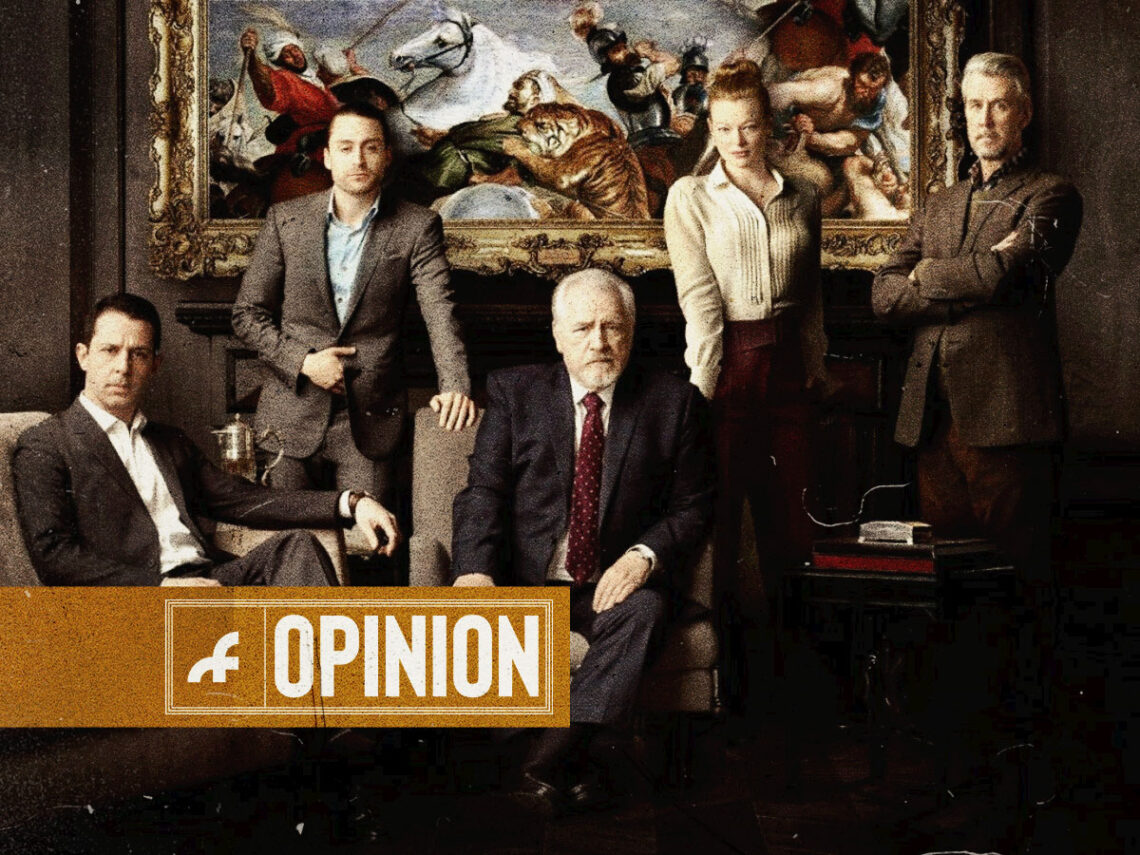
The most important lesson ‘Succession’ teaches us about society

We all want achievement in life. Even the people who don’t want achievement want the achievement of reaching the point where they can be satisfied with not wanting achievement. It is also true that achievement and opportunity go hand in hand. When I was young, the thing I strived for most in the world was to become the first astronaut to win every individual event at the Olympics. Naturally, reality eroded this dream, but if I had been raised by Yuri Gagarin and Olga Korbut then who knows, perhaps I would be currently floating in space, bemoaning the fact my medals were stripped on account of unprecedented doping charges. Alas, the line of succession that parentage set up for me was decidedly working-class and now I am shivering in a rented flat bemoaning that instead.
This nuanced point runs beneath TV’s best series since Breaking Bad. Succession is a riot, but it’s a riot that subtly illuminates a lot about society from a perspective that we very rarely see. Prior to the series, I would often find myself sat in a pub with my left-leaning friends, and a bastard figure like Elon Musk would enter the conversation. Invariably, a point similar to the following would be made after Googling his net worth and getting a suspect answer from celeb-worth.com or some other unscrupulous source: “Jesus, $193billion! Why wouldn’t you just give it all away, be hailed as a hero for healing the world, and then retire and live happily ever after on the $500million you kept for yourself.”
Quite right, we would all nod and sip our Boddingtons before returning to football chat, pleased that we had bothered to take pause to momentarily put the world to rights. Obviously, we were aware that we were skirting logic and being glib about the matter, but the central point remained: What is it with these guys who want the world on a dessert spoon, and seemingly slave away at unimaginable stress levels just to be the cock of the walk to the detriment of the world when they have everything anyone could ever want anyway?
Well, as Succession has now shown, striving forever forward rather than resting on laurels is something capitalism has engrained. There is a marching line of little achievers making it impossible for the person at the front to turn around, to take pause. Suddenly trying to reverse the desperate parade of green arrows would be like stopping your car on the motorway and deciding, ‘Actually no, I would like to drive down the other side of the road’. You can’t. The perpetuation of economic growth is bigger than you, even if you’re at the very top.
Capitalist progress is like an infinite line of people climbing an incomplete staircase with the leader laying down the next step as everyone moves on. You can’t stop at the top to level things out; you can only be pushed off the edge for the next person to start laying steps. This is not just symbolically true in the arc of Succession; it is near enough constitutionally true in the code of capitalist conduct.
As the economic expert and Chancellor of the Delaware Court of Chancery, Leo E. Strine Jr., argues in the Wake Forest Law Review: “The continued failure of our societies to be clear-eyed about the role of the for-profit corporation endangers the public interest. Instead of recognizing that for-profit corporations will seek profit for their stockholders using all legal means available, we imbue these corporations with a personality and assume they are moral beings capable of being ‘better’ in the long-run than the lowest common denominator. We act as if entities in which only capital has a vote will somehow be able to deny the stockholders their desires, when a choice has to be made between profit for those who control the board’s reelection prospects and positive outcomes for the employees and communities who do not.”
In essence, it is profit uber-alles and to stay at the top you have to ensure this is the case or you will be replaced. Likewise, if you are a pawn in this system then you must also abide by the same profit-over-ethics code, because – as the series expertly points out – a virtuous undertaking might only “spread the virus” further. As the wise sage of Succession, Gerri Kellman, puts it: “Have you ever heard of the sin cake eater? [No] He would come to the funeral, and he would eat all the little cakes they laid out on the corpse… He ate up all the sins. And you know what? The sin cake eater was very well-paid. So long as there was another one who came along after he died, it all worked out.”
This, in essence, perfectly explains the role of those on the middle rungs of social mobility in a capitalist system too. The bottom feeders are simply disposable anyway, they are there as fodder driven purely by survival and have no choice but to be compliant. However, they are also upholding to the people in the middle, who simply have to eat the sins of those at the top to keep the whole thing moving, because if they don’t, somebody else will. And as for the people at the top, well, often these were raised in a world of profit so they are pressured by the perceived pinnacle of economically progressive achievement rather than being schmucks living off their parent’s accounts. Hence why the world economy is a family business.
The comedy of Succession is the human comedy of modern society. We imagine that being at the top means you get to huff down the rarefied air of freedom, but as Succession hilariously exhibits, that is far from the case. We are all – from the Logan Roys to the folks watching illegally at home – trapped in the same system where profit perpetuates the same unending cycle, and if it’s not moving forward then it’s collapsing catastrophically in on itself. And as it chugs on, this system subtly decrees that virtues will always be superseded by achievement. If you opt-out then you can’t change a thing, so better to be the bastard in charge slightly trying to alter things for the better than the nobody doing nothing, pushed aside by the chaos of money’s evergreen march.
