


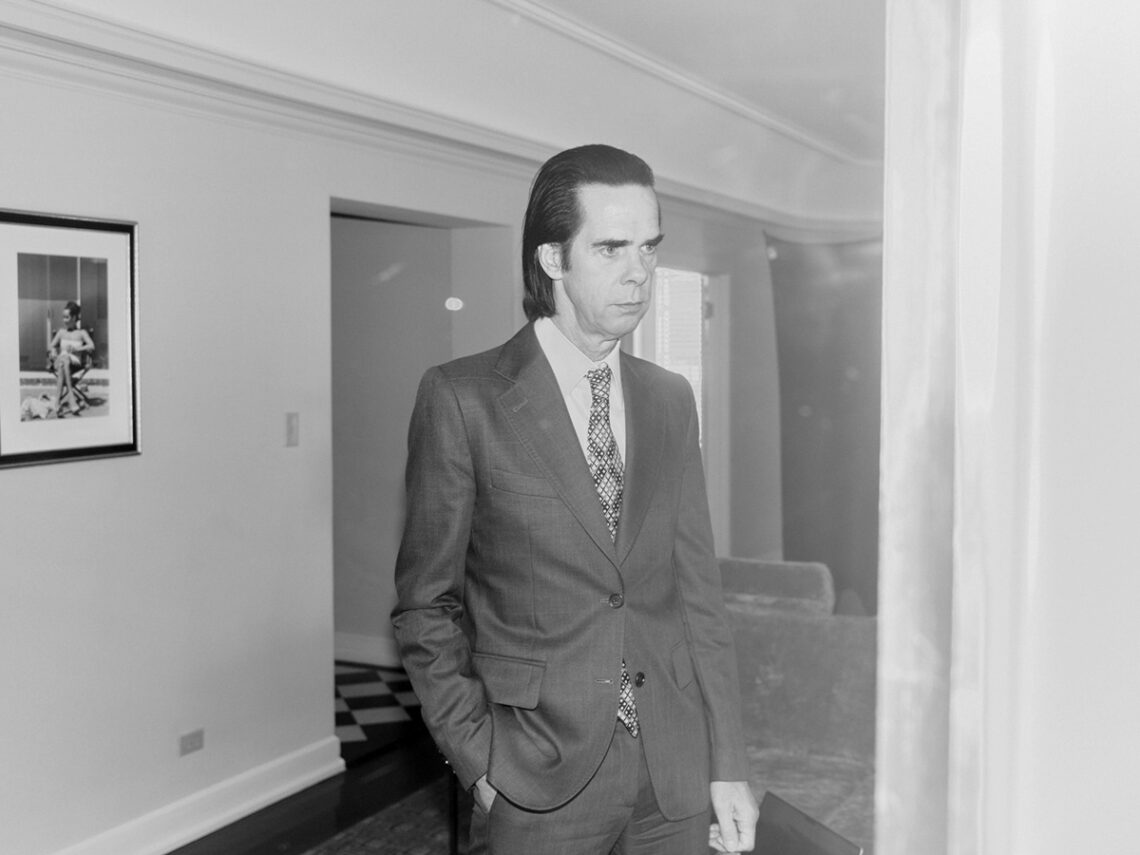
The tragic memory that inspired the entirety of ‘Ghosteen’ by Nick Cave

Death changes everything. It might sound bleak, blunt, even, but it’s true—the idea of someone suddenly not being there anymore is near incomprehensible. Even in those moments when it does hit home, it feels exactly as it should: cold, unwarranted, and completely unfair. Nick Cave lost his son in 2015 after he suffered a tragic fall near his family home in Brighton, and part of his grieving process was channelling everything he felt into his 2019 opus Ghosteen.
More than just a simple record, Ghosteen was a prayer, a heartfelt ode to those loved and lost, and an artistic attempt at communicating to those beyond the grave. “Arthur was snatched away,” Cave later reflected, the loss of his son constantly weighing heavy on his heart like a series of concentric spirals not always prominent but forever etching at the edge of his psyche. “He just disappeared,” he said, “And this felt like some way of making contact again and saying goodbye.”
The headiness of such a metamorphic state permeates every section of Ghosteen as Cave carries his deep-rooted heartache in vocals alone, ghosting along the lines of his poetic lyricism with the conjecture of someone whose heart floods with sorrow. Every song and every lyric offers a consistent push and pull of harshness and softness as Cave lays out grief in all its tragedy and ugliness: “Your soul is my anchor,” he sings in ‘Waiting For You’. “I never asked to be freed. Well, sleep now, sleep now, take as long as you need, ’cause I’m just waiting for you to return.”
Many of the songs focus heavily on metaphor and visual imagery, reflecting facets of Cave’s fragmented heart and pulling together the interconnectedness of his own experiences. For ‘Spinning Song’, for instance, he infuses folklorish energy with real memories of his wife, Susie, sitting at the kitchen table listening to the radio. It’s a harmless picture and one that could even appear mundane in solitude. However, as the last “intact” memory the singer has of his wife before they receive the news of their son’s passing, it carries a certain prominence.
For Cave, therefore, it reflects more than just a moment—it became the genesis of the entire record, a starting point by which he could measure his grief, and the first pain point that sparked this entire chapter. The vision of Susie in the kitchen wasn’t just a part of the whole; it was the core that inspired the record’s first song and a consistent thread Cave referred to while completing the project.
From there, he was able to access parts of himself with ease, almost as if he witnessed him exuding creative flow from an outsider’s perspective. “Now, for me, this image of Susie sitting at the kitchen table listening to the radio is crucial because it became the locus not only of this particular song but of the album itself,” the musician explained in his 2022 book Faith, Hope and Carnage. “This is the last intact memory I have of my wife before we heard the news of Arthur’s death.”
In ‘Spinning Song’, Cave utilises his memory of his wife in the final segment when an entity floats higher and higher before reaching the image of her in the kitchen. It’s a full circle moment where life ends and begins in one swirling motion, and the uncertainty and disassociation of grief mistify the mind in a manner that perfectly reflects the abstract appearance of death itself. This continues throughout Ghosteen, with Cave delicately yet purposefully addressing the starkness of loss, occupying the space where, even in death’s proximity, it feels like the furthest thing from reality.
