


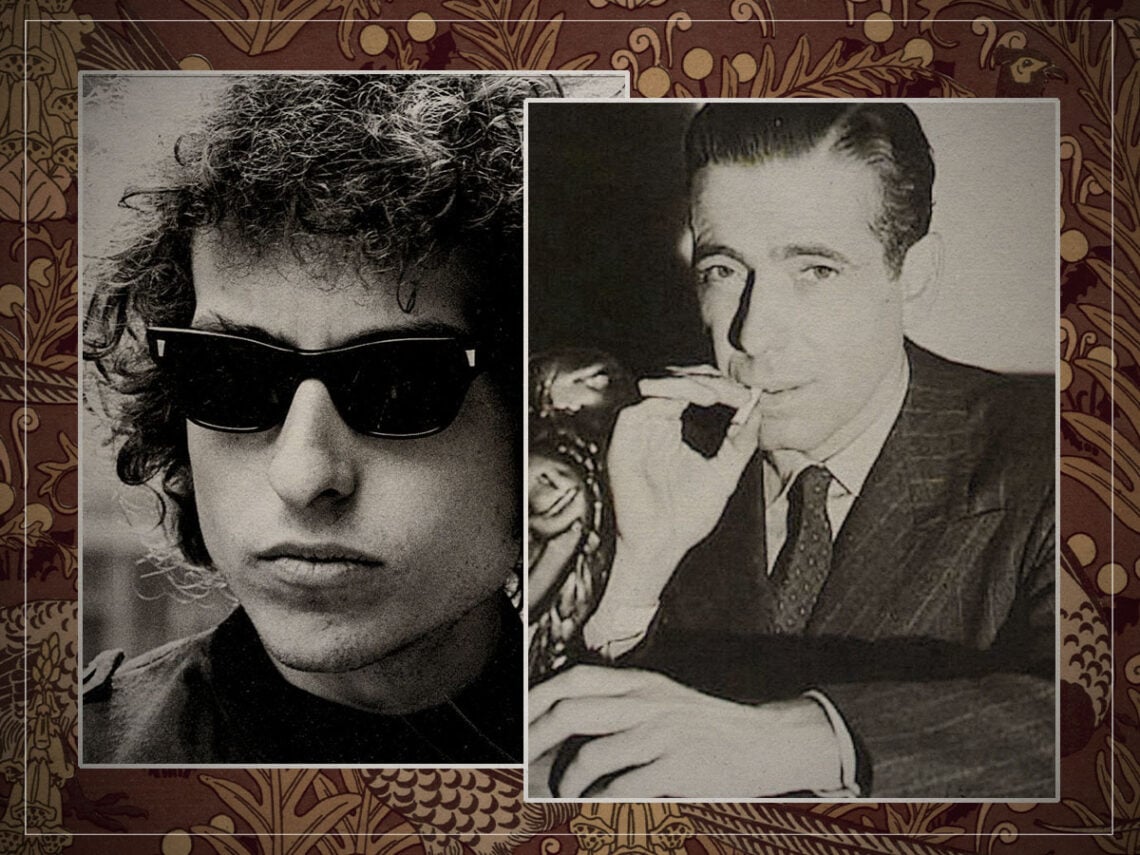
Which lyrics did Bob Dylan directly lift from Humphrey Bogart dialogue?

Bob Dylan has had a lifelong obsession with the cinema. Dating back to his earliest days in his hometown of Hibbing, Minnesota, Dylan would spend endless hours at the local picture house, the Lybba Theatre, which was run by his uncles and named after his grandmother. Later, his public image was connected to that of James Dean’s Rebel Without a Cause, and his songs and stories carried a cinematic edge or were regularly featured in key scenes in films, such as Easy Rider, Forrest Gump, Jerry Maguire, The Big Lebowski, High Fidelity and Watchmen. Dylan himself has appeared in plenty of films, too, and on top of that, has had plenty of them made about him, and, in 2001, he even picked up both an Oscar and a Golden Globe for the song ‘Things Have Changed’, which he wrote for Curtis Hanson’s Wonder Boys.
Some of Dylan’s recent artwork has also included paintings he made based on stills from films such as Gordon Parks’ Shaft and Jerry Schatzberg’s The Panic in Needle Park, Scorsese’s Taxi Driver and Wong Kar-wai’s iconic 2000’s movie, In the Mood for Love.
It’s not the first time that he has taken direct inspiration from the movies for his own works, though. While on Rough and Rowdy Ways, he merely mentions the “Godfather Brando and the Scarface Pacino”, he was a lot more direct in his movie references throughout the 1980s. Some of his most striking lyrics from the time would be lifted verbatim, or else, only slightly tweaked, from old film noir flicks. His lyrical approach has always been deeply intertextual, cross-pollinating, almost patchworked, and so it is no surprise when references, allusions and borrowed phrases turn up in his works. Steal a little and they throw you in jail, steal a lot and they make you king.
And, if you’re going to refer or allude to, or else, steal from anyone at all, you might as well refer, allude and steal from the best, which might explain why so many of Dylan’s borrowed lines from the era can be traced back to either Humphrey Bogart’s dialogues, or else films that Bogart had a starring role in.
Though the majority of his borrowings turn up on his bonkers-yet-often-brilliant 1985 synth-pop album Empire Burlesque—with even the music video from the lead single having a Hollywood connection, being directed by Taxi Driver screenwriter Paul Schrader—his first Bogart quote came one album earlier. “What would a sweetheart like that Miss Hamilton dame be doing in a dump like this?” is what Bogart’s character, ‘Gloves’ Donahue, asks at one point during his 1942 feature, All Through the Night, while in 1983, Dylan’s song, ‘Sweetheart Like You’ from Infidels, has him ending each verse with the similar, “What’s a sweetheart like you doing in a dump like this?”
When you watch Bogart’s pictures, not only the very best of them like In a Lonely Place and Casablanca, but any of them, it’s easy to see why they so captured Dylan’s attentions and imagination. Bogart is magnetic, maybe one of, if not the most magnetic, leading men that Hollywood ever produced. He was tough and masculine but warm; not infallible but not that eager to make a mistake, either. He was just like any other golden age leading man, only much more so. A little like Dylan himself, who has always been drawn to the archetypal American outlaw figure, the honourable rogue who doesn’t mind knocking a few men down if it means helping the little guy up. That’s the kind of character that Bogart could play the best. Even his most unscrupulous characters, such as his breakout turn as Duke Mantee in 1936’s The Petrified Forest or the down-on-his-luck boxing promoter Eddie Willis that the actor played in his swansong The Harder They Fall, care more about their sense of morality than their ego.
It is interesting to note how much mileage the singer was getting out of certain movies, too; drawing dialogue from various passages and scenes of The Maltese Falcon and incorporating them into three separate song lyrics, while there are lines from multiple movies over the short course of his 1985 song ‘Seeing the Real You at Last’ (among others).
Dylan must have spent a lot of time in the mid-1980s watching old movies. Though Bogart was the most-often featured in his lyrics, the singer’s most famous lifting of a line from an earlier film came during the sprawling, gargantuan ballad ‘Brownsville Girl’, where he quoted Gregory Peck instead, and at length, too. The song rewrites Dylan’s memory of the excellent 1950 film The Gunfighter and wraps his own Southern-epic narrative and trademark genius up with the reminiscence of what has long passed. At one point during the song, he sums up his whole approach to writing and borrowing at the time with the line, “Oh, if there’s an original thought out there, I could use one right now”, and later draws a line under his dalliance with the golden age of cinema with the off-hand “seems like a long time ago, long before the stars were torn down”.
From then on, Bob stopped borrowing from Bogart, but he did later go on to include a performance of ‘As Time Goes By’, which is just as important and iconic a part of the greatest movie of all time, Casablanca, as the phrases “here’s looking at you, kid” or “we’ll always have Paris” and ‘La Marseillaise’ are, on his 2017 album Triplicate.
Every line that Bob Dylan borrowed from a Humphrey Bogart movie
The Maltese Falcon (1941)
Humphrey Bogart, as Sam Spade: “I don’t mind a reasonable amount of trouble”.
Dylan, ‘Seeing the Real You At Last’, Empire Burlesque (1985): “Well, I don’t mind a reasonable amount of trouble/trouble always comes to pass”.
Bogart, Sam Spade: “I’ll have some rotten nights after I’ve sent you over, but that’ll pass”.
Dylan, ‘Seeing the Real You At Last’, Empire Burlesque (1985): “Well, I have had some rotten nights, didn’t think that they would pass”.
Bogart, Sam Spade: “All we’ve got is that maybe you love me and maybe I love you”.
Mary Astor, as Brigid O’Shaughnessy: “You know whether you love me or not”.
Dylan, ‘When the Night Comes Falling From the Sky’, Empire Burlesque (1985): “Well I’ve walked 200 miles, now look me over/ It’s the end of the chase and the moon is high/ It won’t matter who loves who/ You’ll love me or I’ll love you”.
Jerome Cowan as Miles Archer: “You don’t have to look for me, I’ll see you, alright”.
Dylan, ‘When the Night Comes Falling From the Sky’, Empire Burlesque (1985): “Stick around, baby, we’re not through/ Don’t look for me, I’ll see you”.
Barton MacLane as Lieutenant Dundy: “We wanna talk to you, Spade”.
Bogart, Sam Spade: “Well, go ahead and talk”.
Dylan, ‘Tight Connection To My Heart (Has Anybody Seen My Love?), Empire Burlesque (1985): “You want to talk to me? Go ahead and talk/ Whatever you’ve got to say to me, won’t come as any shock.
Casablanca (1942)
Humphrey Bogart, as Rick Blaine: “It’s the end of the chase”.
Dylan, ‘When the Night Comes Falling From the Sky’, Empire Burlesque (1985): “Well, I’ve walked two hundred miles, look me over/ It’s the end of the chase and the moon is high”.
To Have and Have Not (1945)
Humphrey Bogart, as Steve Morgan: “Stick around, we’re not through yet”.
Dylan, ‘When the Night Comes Falling From the Sky’, Empire Burlesque (1985): “I saw thousands who could have overcome the darkness/ For the love of a lousy buck, I watched them die/ Stick around, baby, we’re not through/ Don’t look for me, I’ll see you”.
Lauren Bacall, as Slim Browning: “You gave me something to think about, said you can help me”.
Dylan, ‘Never Gonna Be the Same Again’, Empire Burlesque (1985): “You give me something to think about baby, every time I see ya / Don’t worry baby, I don’t mind leaving, I’d just like it to be my idea.”
Bogart, as Steve Morgan: “Stop that baby talk”.
Dylan, ‘Seeing the Real You At Last’, Empire Burlesque (1985): “I’m gonna quit this baby talk now, I guess I should have known/ I got troubles, I think maybe you got troubles/ I think maybe we’d better leave each other alone”.
Bogart, as Steve Morgan: “No, but I’ve handled quite a lot of gunshot wounds. You can trust me now”.
Dylan, ‘Under Your Spell’, Knocked Out Loaded (1986): “You were too hot to handle/ You were breaking every vow. I trusted you, baby/ You can trust me now”.
The Big Sleep (1946)
Sonia Darrin, as Agnes Lowzier: “There’s some people you don’t forget, even if you’ve only seen them once”.
Dylan, ‘I’ll Remember You’, Empire Burlesque (1985): “There’s some people that you don’t forget/ Even though you’ve only seen them one time or two”.
Humphrey Bogart, as Philip Marlowe: “What’s wrong with you?”
Lauren Bacall, as Vivian Rutledge: “Nothing you can’t fix”.
Dylan, ‘Seeing the Real You at Last’, Empire Burlesque (1985): “At one time, there was nothing wrong with me that you could not fix”.
Key Largo (1948)
Edward G Robinson, as Johnny Rocco: “Think this rain would cool things off, but it didn’t”.
Dylan, ‘Seeing the Real You at Last’, Empire Burlesque (1985): “Well, I thought that the rain would cool things down/ But it looks like it don’t/ I’d like to get you to change your mind/ But it looks like you won’t”.
Robinson, as Johnny Rocco: “Didn’t I take chances?”
Dylan, ‘Seeing the Real You at Last’, Empire Burlesque (1985): “Well didn’t I risk my neck for you?/ Didn’t I take chances?”
Sirocco (1951)
Humphrey Bogart, as Harry Smith: “I’ve got to move fast, I can’t with you around my neck”.
Dylan, ‘Tight Connection To My Heart (Has Anybody Seen My Love?), Empire Burlesque (1985): ‘Well, I had to move fast/ And I couldn’t with you around my neck/ I said I’d send for you and I did/ What did you expect?”
Bogart: “I don’t know whether I’m too good for you or you’re too good for me”.
Dylan, ‘Tight Connection To My Heart (Has Anybody Seen My Love?), Empire Burlesque (1985): ‘You’re the one that I’ve been looking for/ You’re the one that’s got the key/ But I can’t figure out if I’m too good for you/ Or if you’re too good for me”.
Sabrina (1954)
Walter Hampden, as Oliver Larrabee: “No gentleman makes love to a servant in his mother’s house”.
Dylan, ‘Driftin’ Too Far From the Shore’, Knocked Out Loaded (1986): “No gentleman likes making love to his servant/ Especially when he’s in his father’s house”.

Never Miss A Tale
The Far Out Bob Dylan Newsletter
All the latest stories about Bob Dylan from the independent voice of culture.
Straight to your inbox.