


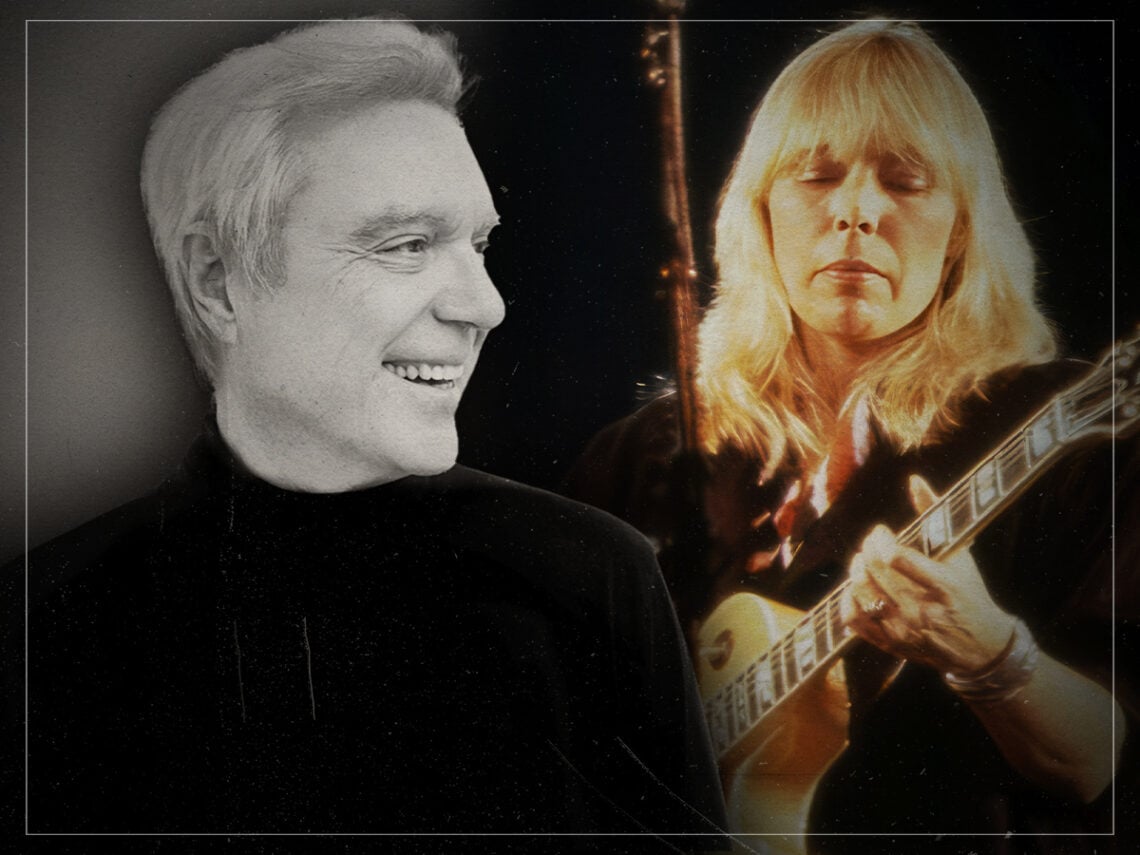
David Byrne believes Joni Mitchell had the ability to open new worlds

The top comment on David Byrne’s recent Tiny Desk Concert is a pretty good summary of his legacy. “It’s 2025, and David Byrne is still from the future,” it reads.
It’s 2026 now, but the point still stands – somehow, at 73, Byrne still feels ahead of his time as a singer, performer, writer, and visionary. It’s hard to think of literally any other name that gives that same otherworldly quality, and the reasons are clear: Byrne has always been the true definition of innovative, even back at the Rhode Island School of Design, without his future legacy coat of armour.
Unlike the other ringleaders of the CBGB scene, like Blondie, Talking Heads were a patchwork of individual artists, an amalgamation of four different artistic minds who all wanted to make good music. According to Tina Weymouth, this was precisely why their unity worked: because they each brought something different to the table, a unique approach that, when blended, resulted in that familiar, quirky, world music-leaning Talking Heads sound.
At the epicentre of this, Byrne was a single operation, a genius who worked on the emotion and viscera of stream of consciousness, where his worlds often ventured deep into his own personal psyche, both to navigate the modern world and to critique it. As a result, Talking Heads were a phenomenal example of music that feels universal yet precise, a result of Byrne’s particular way of thinking and expressively neurodivergent worldview.
Many of these facets were nurtured during the creative process, especially as Byrne often experienced writer’s block and sometimes found it difficult to put his emotions into real, usable lyrics. But by working with musical soulmates like Brian Eno, Byrne was able to extract himself from himself and throw things at the wall to see what stuck – a technique that no doubt still helps him today.
Eno once said that some of the best musicians are the ones who experiment without caring about failure, and Byrne has been around long enough to know exactly how it feels when you do something risky and get it right. He also knows because he’s lived through one of the most tumultuous periods in history, the early 1970s, when artists were scrambling to find ideas at the dawn of a new era, when everything felt more uncertain than ever.
When it comes to influences, you probably wouldn’t think that Joni Mitchell was one of Byrne’s, but back in 1971, when she released Blue, Byrne remembers how much it opened up new worlds for artists to be able to find their voice and tell their stories more authentically than before. For Byrne, Blue was a magnificent achievement because it honed in on everything he later came to cherish: honest writing and personal experience.
For Track Star’s recent ‘Testing David Byrne’s Music Knowledge’ on YouTube (a video which also includes the revealing aforementioned comment, “I am not convinced he is aware hs is a world-famous, all-time legend”), Byrne praised Mitchell’s “unbelieavable” ability to “open up this world of personal transparency and talk about things that people could relate to”.
He also said that he only properly appreciated Blue decades later, but that it still resonated all the same. It’s strange that Byrne wasn’t into her music sooner, but perhaps that’s another telltale sign of someone who probably is actually from the future: that he’s able to pinball around and sink his teeth into whatever, whenever, and still manages to be ahead of the curve in his own music.
