


‘The Last of Sheila’: the savage and essential 1970s whodunnit

The whodunit genre is more common in the literary world than the cinematic one, just look at Agatha Christie. It is, therefore, no coincidence that most of the on-screen examples are based on books. 1941’s The Maltese Falcon, 1974’s Murder on the Orient Express, and 1986’s The Name of the Rose all had literary precursors, and even the movie Clue is based on a pre-existing story, albeit a board game. There is, however, one notable example of an original cinematic whodunit that deserves classic status.
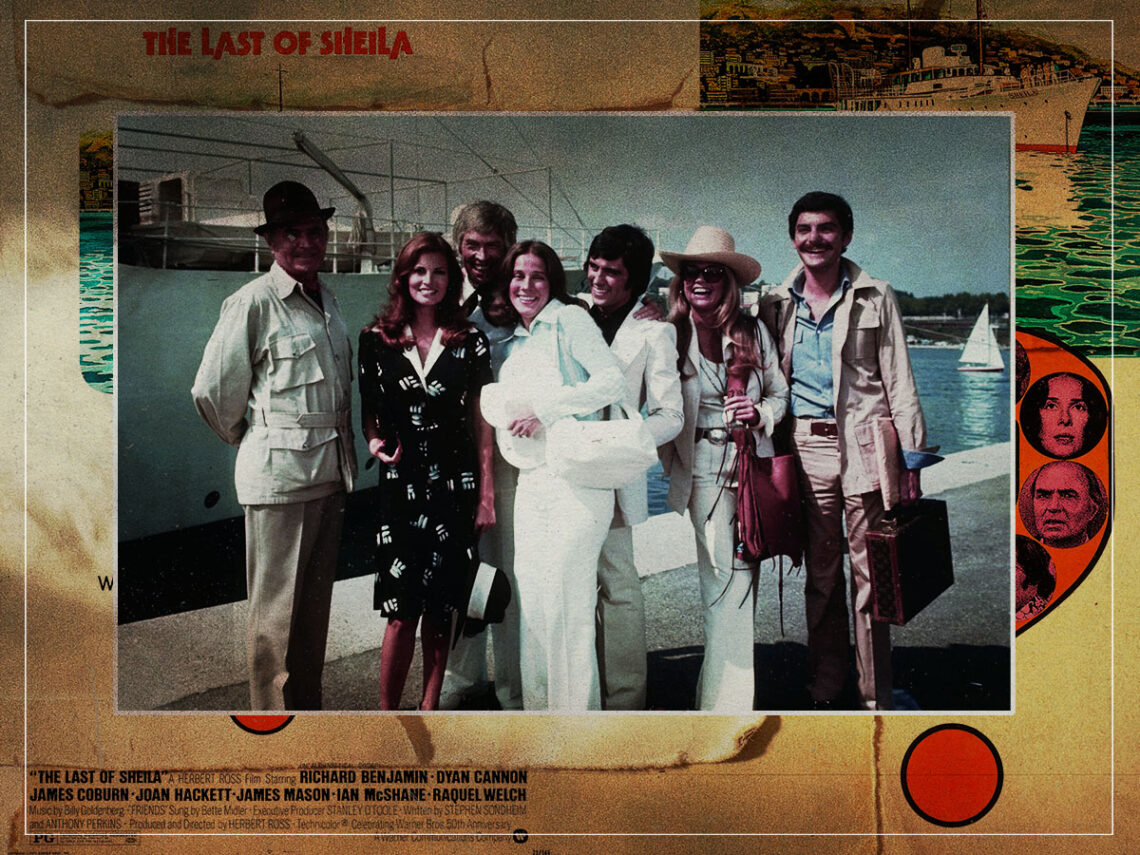
The Last of Sheila is a 1973 mystery about a wealthy movie mogul (James Coburn) who sends cryptic invitations to a group of his lackeys for a vacation of puzzle-solving in the Mediterranean to commemorate the one-year anniversary of the death of his wife, Shiela, in a hit-and-run accident. Each of the guests has an ulterior motive for attending. Richard Benjamin plays a talentless screenwriter desperate to get one of his scripts produced by anyone other than his wife (Joan Hackett), the wealthy daughter of one of Coburn’s industry pals. Dyan Cannon plays a manic talent agent looking to shore up her industry connections. James Mason plays a washed-up director reduced to making dog food commercials. Raquel Welch plays a calculating starlet looking for her big break. A young Ian McShane plays her husband and manager, who wants to get his foot in the door of the movie business.
What begins as a gathering full of false friendship, posturing, and cringe-worthy obsequiousness centred around a carefully constructed, multi-day scavenger hunt turns into a real murder mystery. Any further description would require a spoiler alert, but suffice it to say that once the real murder happens, there is still an hour or more of ingenious twists and turns.
If all of this sounds familiar, it’s probably because you’ve seen Glass Onion, Rian Johnson’s follow-up to his hit 2019 whodunnit, Knives Out. The director has frequently cited The Last of Sheila as inspiration for both films, and it’s easy to see why. Written by composer Stephen Sondheim (yes, that one) and Anthony Perkins (the actor known mostly for playing Norman Bates in Psycho), it was inspired by the elaborate murder mystery games and scavenger hunts they would conduct for their friends. It was also the result of the pair’s growing disdain for Hollywood. In addition to being a twisty murder mystery full of red herrings, visual clues, and a genuinely shocking climax, it is a savage satire of an industry that both men were disillusioned by.
This is most obvious in Cannon’s portrayal of a talent agent, who, by everyone’s admission, was based on larger-than-life talent agent Sue Mengers. The other characters were amalgamations of the writers’ acquaintances. Sondheim would later claim that Welch’s character was actually based on Welch herself, though this may have had more to do with her difficult behaviour on set during the production.
Full of soul-withering takedowns, lightning-fast inside jokes about the industry, and breezy indifference to human life, it strikes a tone so poisonous and comedically pitch-perfect that it’s hard to imagine any filmmaker daring to replicate it. Johnson didn’t even try. Although Glass Onion follows a similar plot, it opts for a much broader comedic register with more simplistic characters. This produces a cosy and re-watchable caper, but it doesn’t burn itself into your brain with the devilish brilliance of The Last of Sheila. In the 1973 film, the revelation isn’t “whodunnit”. It’s that the characters are so self-involved that they barely care to know the answer.
Luckily for the audience, Sondheim, Perkins, and director Herbert Ross do care and turn that revelation into more questions, more clues, and more twists before ending up at the most satisfying conclusion of a whodunnit since The Murder on the Orient Express.
