


The interracial ‘Star Trek’ kiss that changed history

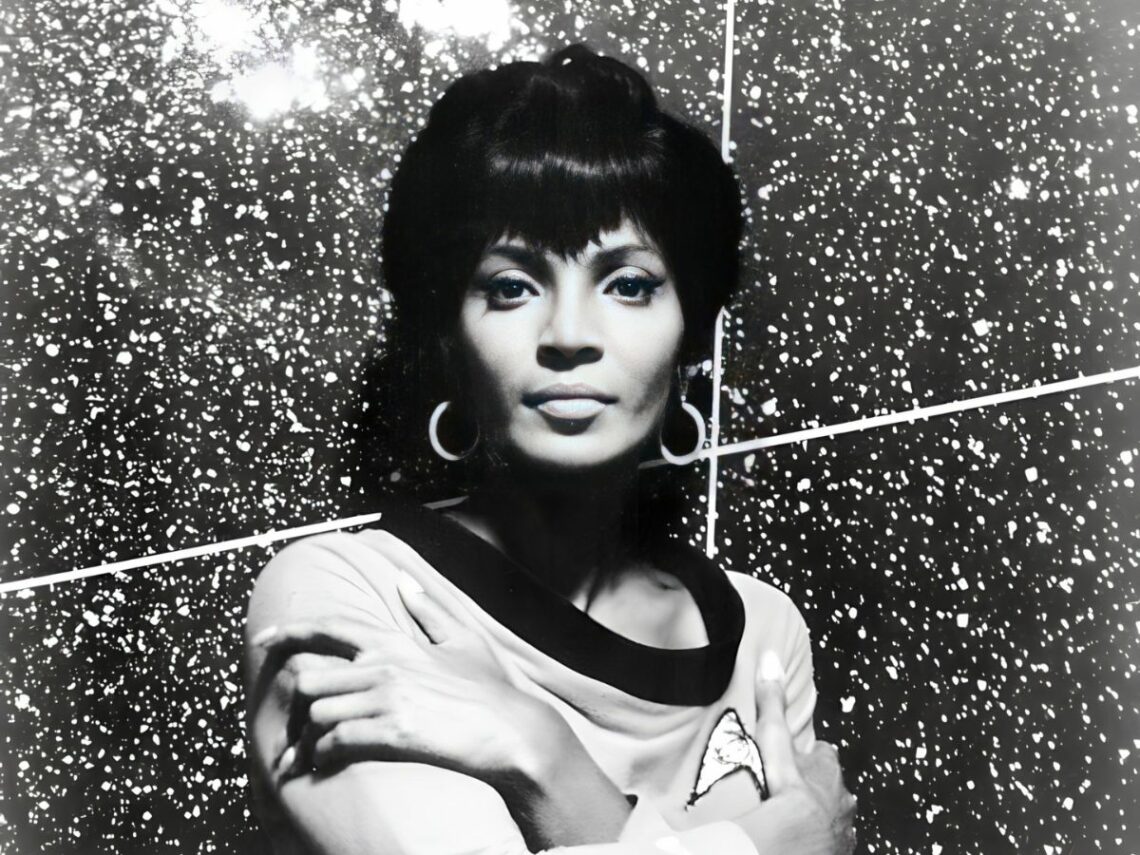
In 1968, the iconic American television series Star Trek boldly went where no show had gone before, featuring television’s first interracial kiss. This historic event was between Nichelle Nichols, who played Lieutenant Uhura, and William Shatner as Captain Kirk.
Star Trek had already proved itself to be a shining beacon of progression in an otherwise unenlightened age – particularly with the television and film industry. Save for a few brave filmmakers and films which actively challenged the status quo, the prevailing attitude within mainstream media was one of misogyny, homophobia and racism.
Now, looking back at old episodes of Star Trek, Kirk’s treatment of women is often very clearly inappropriate. However, the show itself was trailblazing in its frequent depiction of people of colour in high-ranking positions and with multiple dimensions to their character. In the tenth episode of the third series, ‘Plato’s Stepchildren’, the show went a step further by showing a white man and a Black woman kissing.
Nichols reflected on the momentous event during a 2010 interview with the Archive of American Television. Due to anxiety from the studio, the production team wanted to film an additional version where the characters didn’t kiss. Nichols explained how Shatner, adamant that the kiss be included, chose to ruin any alternate versions and render the kiss version the only usable take. “When the camera zoomed in,” Nichols shared, “Bill crossed his eyes, and the director didn’t notice it until the next day in dailies. Of course, the last scene was unusable, and they had to go with the kiss scene.” Unbeknownst to them at the time, this decision would etch their names into television history.
Nichols and Shatner’s on-screen kiss was not an outpouring of mutual affection but rather a consequence of their characters being controlled by space aliens. Even though the kiss was enforced within the fictional storyline of Star Trek, its real-world implications were far-reaching. Its broadcast marked a bold challenge to existing racial taboos, establishing the episode as a landmark event in the ongoing journey towards more inclusive representation on television. Clive James, a noted author and critic, stated in 1972, “In this supposedly advanced space age, Star Trek had shown that a black woman could hold a high-ranking role and be seen as desirable.”
The controversy, however, was inevitable. Several stations in America’s southern states outright refused to air the episode. In England, it was banned for almost 25 years. Despite the censorship, however, the episode found its viewers and sparked essential conversations about interracial relationships on-screen.
The legacy of this ground-breaking episode transcended its initial broadcast. President Barack Obama presented Nichols with her Television Academy Hall of Fame award in 2012, affirming how her role as Lieutenant Uhura opened doors for generations of young girls of all races. Through a single kiss, Star Trek pushed societal boundaries, showing that it was not just exploring new frontiers in space but also television and society. ‘Plato’s Stepchildren’ stands as a symbol of how far we’ve come in the quest for racial equality and representation – and a reminder of the distances we’ve yet to travel.
