


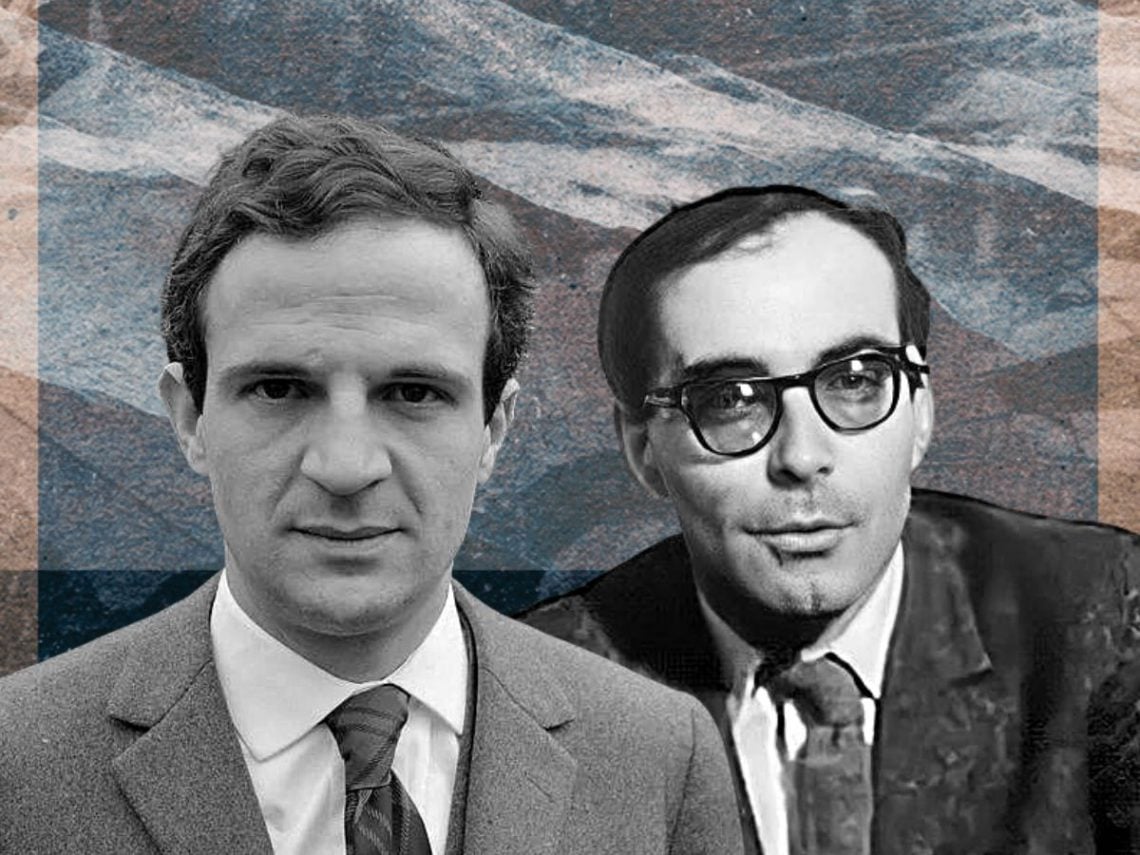
The infamous dispute between French New Wave icons Jean-Luc Godard and Francois Truffaut

Jean-Luc Godard and Francois Truffaut were pioneers of French New Wave cinema. The pair met during the 1940s in a Parisian cinema club before becoming co-workers as film critics for Cahiers du cinema. Before too long, the duo started making movies, co-directing a short together called The Story of Water. However, Truffaut made a name for himself when he released The 400 Blows in 1959, a beautiful coming-of-age story inspired by his childhood.
The following year, Truffaut provided the story for Godard’s debut feature, Breathless, highlighting the rising dominance of a new wave of young filmmakers. Both The 400 Blows and Breathless experimented with exciting new formal techniques. The directors took an informal approach to filmmaking, shooting on location away from the restrictions of studios, improvising dialogue, and using handheld cameras.
Following their respective directorial debuts’ success, Godard and Truffaut had illustrious careers as filmmakers, heralded as some of the most influential directors of all time. Truffaut passed away in 1984 from a brain tumour, just 52 years old. Godard long outlived his contemporary, passing away just a few weeks ago on September 13th, 2022, via assisted suicide.
The pair’s close friendship began to weaken during the late 1960s. Godard became increasingly political, transitioning into a period of ‘militant’ filmmaking. He formed the Dziga Vertov Group with director Jean-Pierre Gorin, which saw them create ‘revolutionary’ films inspired by Brechtian form and Marxist ideology. This era in Godard’s career came shortly after the incidents of May 1968. Inspired by civil unrest in France, Godard and Truffaut led protests that urged the cancellation of the Cannes Film Festival in solidarity with worker and student protests.
Despite Truffuat’s involvement in the cause, his passions weren’t as intense as Godard’s. Whilst the former called for the cancellation of the festival, Godard had become intensely critical of cinema in general. In June 1968, the pair argued over taking student protests to the Avignon Theatre Festival. Godard’s wife at the time, Anne Wiazemsky, recalled that Truffaut told his friend “I will never be on the side of the sons of the bourgeoisie” since police offers were mainly working-class. Wiazemsky states that Godard “really got angry: ‘I thought you were a brother—you are a traitor.’ That was their breakup.”
A few months later, Godard asked Truffaut to help him fund the “anti-boss films” he wanted to make before saying: “I have nothing to add, either about you, or about myself, and the others. We no longer agree about anything.”
However, the release of Day for Night, Truffaut’s successful, Oscar-winning 1973 film, really rubbed Godard the wrong way. The director sent Truffaut a four-page letter, including a note addressed to Jean-Pierre Leaud, the film’s co-star who had starred in Godard’s La Chinoise. The letter begins with the words, “Yesterday I saw Day for Night. Probably no one else will call you a liar, so I will.”
Godard includes some biting remarks such as “One wonders why the director is the only one who doesn’t screw in Day for Night,” a reference to Truffaut’s affair with the film’s star Jacqueline Bisset. He even requested money from his old friend, stating: “Given Day for Night, you should help me so that viewers don’t think that films are only made your way.”
Truffaut wrote the hilarious lines in response: “I am returning your letter to Jean-Pierre Léaud: I have read it and find it disgusting. It is because of this that I feel that the time has come to tell you, at length, that in my view, you are behaving like a shit.”
He fired insults back at Godard, condemning him for sharing the recipe for a Molotov cocktail in one of his films, not turning up to certain events, and referring to him as “both jealous and envious”. Detailing further, Truffaut continued: “You have never succeeded in loving anyone or in helping anyone, other than by shoving a few banknotes at them. […] Between your interest in the masses and your own narcissism, there’s no room for anything or anyone else.”
Their feud continued until Truffaut died. In 1978, Godard was quoted saying: “I think that François absolutely doesn’t know how to make films. He made one that truly corresponded to him, and then it stopped there: afterwards, he only told stories…Truffaut is a crook who passes himself off as an honest man, which is the worst thing.”
Not long before Truffaut died, the pair bumped into each other in New York, but Godard refused to shake hands. A letter was sent to Godard by Truffaut that advised him to make an autobiographical film called A Shit is A Shit.
The directors never reconciled, and it’s widely acknowledged that Truffaut “won” the feud. However, in 1988, Godard explained: “If we tore each other apart, little by little, it was for fear of being the first to be eaten alive.”
