


The inevitable collapse of Coachella Festival

Weekend one of Coachella Festival was hardly riotous. As ever, the gathering in the desert garnered expansive coverage on social media, but much of this was tied to maddeningly innocuous moments like Sabrina Carpenter waving at Barry Keoghan in the crowd—moments that made you question the sensibilities of humanity more so than serve as a celebration of great music at its connective best.
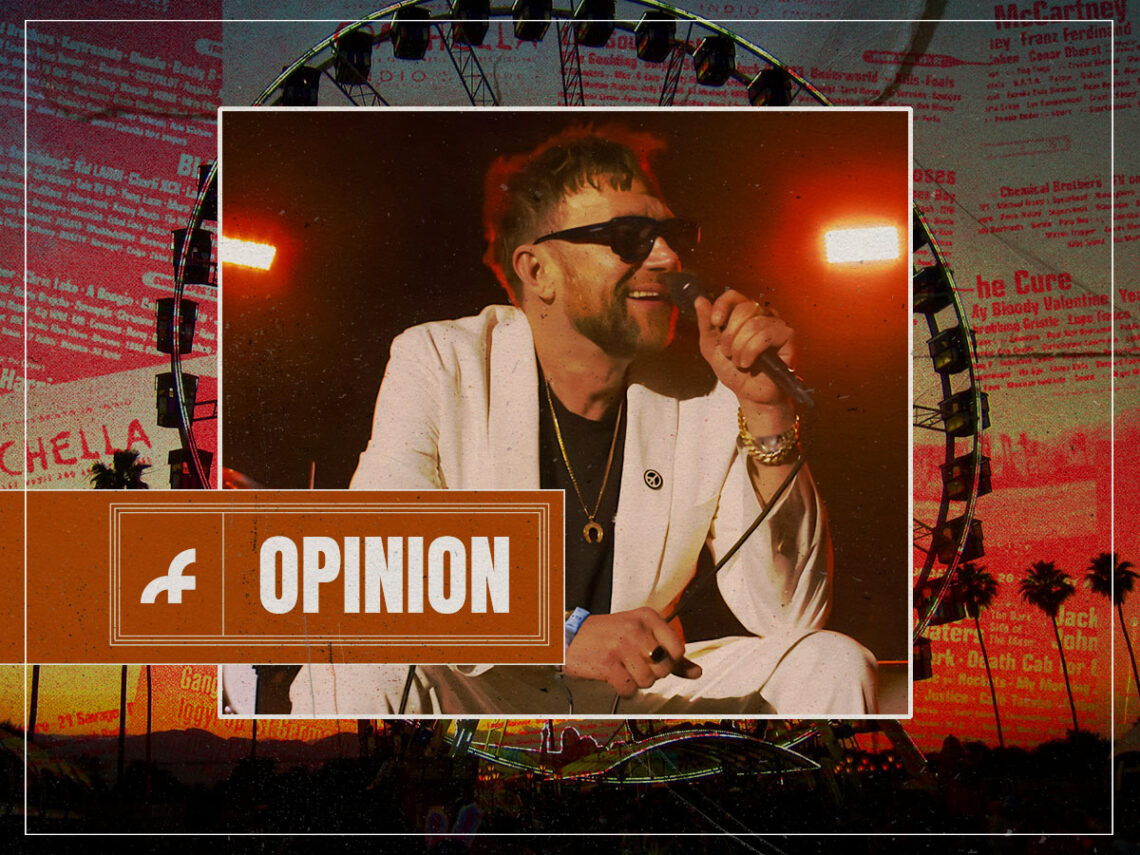
This point was rammed home by one of the main acts as Damon Albarn from Blur appeared to take umbrage with the fact that their crowd seemingly couldn’t care less. “You’ll never see us again,” he yelled to the swathe of uninterested onlookers. While that could, in theory, be chalked up to a bad set from the Britpop legends, the folks we spoke to at the festival corroborated that the masses being disengaged from what was unfurling on stage was rather commonplace throughout, sparing the blushes of Blur, but signalling a troubled time for Coachella.
Scorching conditions no doubt played their part, but the damp squib served up over the weekend came with an air of inevitability—this inevitability seems to extend towards the potential demise of the festival itself in the not-too-distant future. On the one hand, it is not entirely the fault of Coachella that its position seems perilous, as it failed to sell out in 2024. It is simply the case that curating a weekend of live music that satisfies a profitable mass is becoming increasingly difficult.
If you were to ask the average music fan to curate a hypothetical ideal line-up for the inaugural two-day event in 1999, then most people would likely chalk up a similar list of alternative names. Ask the same set of fans to do that imaginary task for the three-day event in 2025, and you’d likely be met with a far more divergent spread of acts. This is simply indicative of how music has changed over that period. The last 20 years have given rise to the birth of the age of micro-genres, and no set sound rules the roost.
In the 1960s, there was the dominant counterculture movement, which made managing the list of rock ‘n’ roll names at Woodstock a piece of cake. Thereafter, prevalent trends in pop culture have been self-evident. Then the internet came along and blurred everything into a macrocosm with infinite offshoots. Fads and cliques like indie were ruling genres by virtue of social construct, whereby you would bond with your peers over bands, and the dive bars you attended on the weekend would spin largely homogenous setlists. Now, this pool of peers is spread over the entire world, so genres are becoming more and more niche.
For a festival, that makes it harder to book names. Blur are an iconic act with almost 12million monthly listeners on Spotify. Meanwhile, Ice Spice is a rising star with 20m, and the beloved Tyler, The Creator gathers up 29.8m; so it would seem that all three are worth booking from a commercial standpoint, but, in reality, there is no saying whether any single person among the 100,000 in attendance each weekend is a fan of all three. So, it stands to reason that if you’re stood in the scorching desert – largely sober thanks to Coachella’s strict designated drinking areas – and enduring a set you don’t enjoy simply because you don’t want to lose your space, then enthusiasm is likely to wane.
So, while the difficulties faced are undoubted, perhaps where Coachella has gone wrong is trying too hard to play into too many places for the sake of marketing. As the British culture photographer Raph Pour-Hashemi, who has been to just about every major festival in the world, told us regarding his experiences at Coachella: “I don’t think there’s any real soul to it. It just chases the next demographic, and from what I’ve seen, it’s just getting worse for that.” Chasing the next demographic is getting harder, and in doing so, you risk alienating the one you had previously built up and muddying your legacy.
Did Coachella sell-out?
Since its punk-like beginnings, changes and chases at Coachella have been wholesale. For a while, that was paying dividends, but it did seem unsustainable. This year, it only sold roughly 80% of the 250,000 tickets available over the course of the two weekends. This is reported as a 14-17% decrease from last year. Why? Is it because the lineup hasn’t been deemed as strong by paying punters? Or is it because the festival has lost its original ethos of a get-together in the desert aimed at kicking back and enjoying an array of the finest alternative acts and instead pitched itself towards social media clout, which is always subject to the next shiny, new, big thing?
Blur’s disgruntlement may have caught the eye, but you could have seen it coming. From a booking standpoint, having a legendary British band fresh from the impetus of a comeback to throw on the bill between some contemporary names is a promising proposition and opens the line-up up to a wider crowd, adding credibility in the process. But that’s how posters work rather than orchestrated musical enjoyment. In reality, you would never really back 30-year-old Britpop songs about British landed gentry to go down a storm after the pre-amble of sets by Jaqck Glam, Santa Fe Klan and Sublime.
Now, Coachella is trapped in an awkward halfway house of diminishing returns. Its origins all but abandoned, getting by on Instagramable waves by pretty pop stars to A-list boyfriends, while also clinging to the credibility of a clutch of alternative names in fear of the fact that all it takes is an influencer to say, ‘Coachella is sooooo 2024, the next big thing is [insert the name of giant commercial cash-in funded by Red Bull masquerading as a chic alternative to Burning Man]’. Soon, they will be waving ba-bye to the barely musical marketing menagerie they’ve spent the last seven or eight years milking.
