


“The Anti-Glastonbury”: What is it actually like at Coachella Festival?

At 6am there is a dreaminess to Coachella as the desert sun peaks over the distant mountains. The very British culture photographer Raph Pour-Hashemi is still in his hotel car park a few miles away at this stage. The gathering warmth and dramatic scenery fill him with a sense of wonder as the music of the Talking Heads blares out of his hire car stereo. ‘Perhaps this manicured spot 133 miles from Los Angeles in the realm of Palm Springs is the perfect place for a festival after all’, he thinks to himself, regaining some of the enthusiasm that endless hours of travelling have steadily eroded.
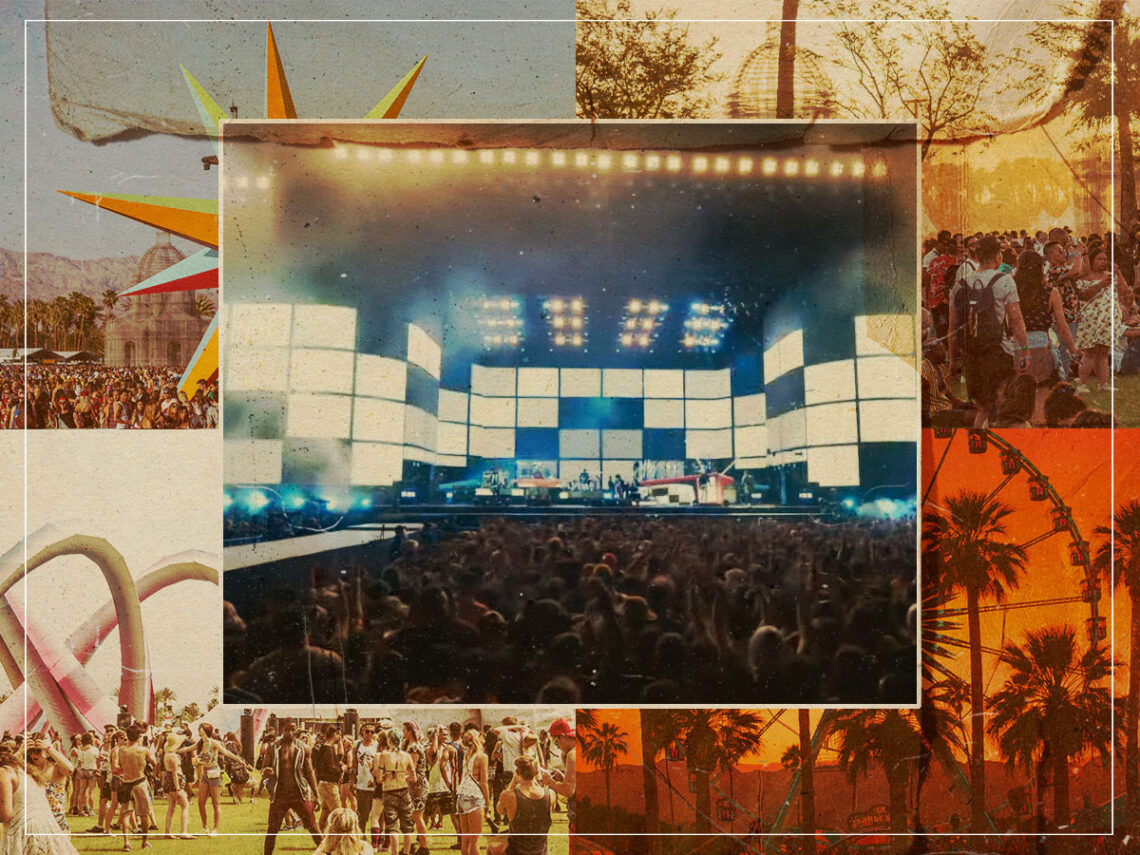
In his career, Raph has been to “just about every music festival in the world”, which makes him well-placed to put to bed the quandary of where the cultural oddity of the Coachella Festival sits among the summer music calendar. When he arrived at the influencer hot spot for the first time, he was struck by its pristine beauty. The sun was now rising higher, casting everything in a golden hue. The usual festival fodder of mud, wellies and a mountain of discarded lager cans were nowhere to be seen. In their place was a pristine lawn, a giant spaceman sculpture, and an ever-lengthening queue for the showers.
Barring the queue of campers, things looked idyllic, unusually so for a festival. Raph grew suspicious. “It’s so unfestival-like you almost feel like it’s a sham or a film set,” he says. Soon, his suspicions were confirmed. It didn’t take long for the promise of that early morning sun to amount to an unbearable 45°C. When he inquired about the nearest bar, he was pointed towards one of the designated drinking areas. ‘So you can’t just drink on the festival grounds?’ he asked a kindly American security guard. ‘Most certainly not, sir’. Things had been too idyllic after all.
The spray of hurled beer over a packed crowd had been an ever-present at every single other festival Raph had ever been at, but now that was forgone. As too were the packed crowds. “I wouldn’t be surprised if you told me there were 65,000 people there,” he says. The actual figure usually floats at around 125,000 daily attendees. This leads to the even greater oddity of the music at Coachella. While it started as a chance for Pearl Jam’s promoter to put on some alt-rock reverie in the desert, it has steadily headed down a more commercial, mainstream route since. However, year-on-year, it still books some of the finest and biggest names in alternative music.
Raph ventured over the trimmed lawns to watch one of these names in action. He had been excited about seeing the legendary David Byrne for months. He arrived at the tent where the former Talking Heads frontman was just about to start. And he just kept on walking. “I was literally able to watch him with my hand on the front row guard rail without having to brush shoulders with a single other person,” he explains. “Most people aren’t there for the music,” he muses, seemingly confirming that the Jimmy Kimmel sketches, whereby reporters ask punters if they’re excited to see fake bands and get enthused responses from people in tribal headwear, aren’t really that satirical. “They’re there for the pictures and, well… I’m not sure,” Raph muses.

“Put it this way,” he adds, “I think it’s the anti-Glastonbury in so many ways,” and while he can’t quite expand on the specifics, the sentiment of the statement says enough. “I saw The War on Drugs, St Vincent and Jean-Michel Jarre, all without losing my spot on the front row, and I was able to leave and come back at will. There were maybe a few hundred people there that were interested.” This creates a strange duality. Of course, it’s quite nice not to have to jostle in the baking sun for a spot half a mile away from one of your favourite acts, but the flip side of a purely pleasantly appreciative crowd somewhat undermines the typical enthusiasm you get when an iconic artist takes to the stage.
“Anyone who goes to Coachella with that Instagram-type lifestyle would get murdered alive at Glastonbury. It’s just like a breezy day in the desert where most people aren’t really there for the music. It’s just an extended day out for them,” he adds. Later encapsulating the experience with a single vignette: “I walked past a young girl, she was maybe 20, and she was posing for an Instagram picture that her security guard was taking.”
While the mind might boggle at such a cartoonish 21st-century image, I can’t help but feel struck by the asserted notion that many of these people “would get murdered alive at Glastonbury”. That seems quite extreme. Alas, they wouldn’t be alone. Many of the world’s premiere festivals are brutal affairs. I’ve covered a great deal of them in my time, and they ain’t no holiday. So, the counterpoint of sparse crowds who don’t stink, no threat of floods, and rather more luxurious hospitality has its own appeal. Even Raph somewhat agrees. “It is nice to have a completely different vibe,” he adds. “It is unlike any other festival I have ever been to. But then again, I think that’s because it isn’t really a music festival. The music is just like a background.”
“The dance and DJ tents are the ones that are becoming more and more popular, and the alternative acts are steadily being pushed further out of the festival,” he believes. They are now largely just names to put in bold on the poster. They are legacy acts to spread the marketing to a broader demographic. Many of the alternative acts who have played it agree, and yet they’d also go back in a heartbeat. In part, this is because of the lucrative fees it pays out. But there is also the chance to showcase yourself to a wider, affluent audience and the “breezy” holiday nature of it to enjoy to boot.
Once again, it seems even for the artists the music is almost secondary. As are many of the tickets—another oddity of this strange, sought-after, yet easy-to-attend affair. “Another element that runs counter to nearly every other festival is the fact that there’s a whole secondary ticket culture. Most festivals don’t allow ticket touts,” Raph explains. “Coachella has its own booth where you can buy them, so there are always people just rocking up to the festival continually. For one of the most famous festivals in the world, getting a ticket is easy.” That is to say, it’s easy if you can afford the $499+ entry fee, $15 beers, and $32 for a burrito and coffee combo (a combo that at least surely boasts that the toilet situation is fairly solid).
The crux is that if you can comfortably afford that and your favourite act is headlining, then you may well adore the festival. It’s a dreamy, spacious wonderland beneath stunning desert hills and offers blistering heat, golden sunsets, and usually some prime artists too. Raph says he saw plenty of Beyoncé fans looking like they loved their time in the desert sun a few years back, the asterisk being that they were literally camped out facing away from the main stage until she came on. That’s Coachella in a nutshell, it is like how you imagine it, but nobody there imagines it quite how you imagine it except for the acts themselves.
“It does look beautiful,” Raph concludes. “But I don’t think there’s any real soul to it. It just chases the next demographic, and from what I’ve seen, it’s just getting worse for that.” Alas, it seems there is nowhere on Earth so focused on a filtered image-free utopia and yet, in reality, so close to a comic dystopia as the beautiful farce of the Coachella Festival.
