


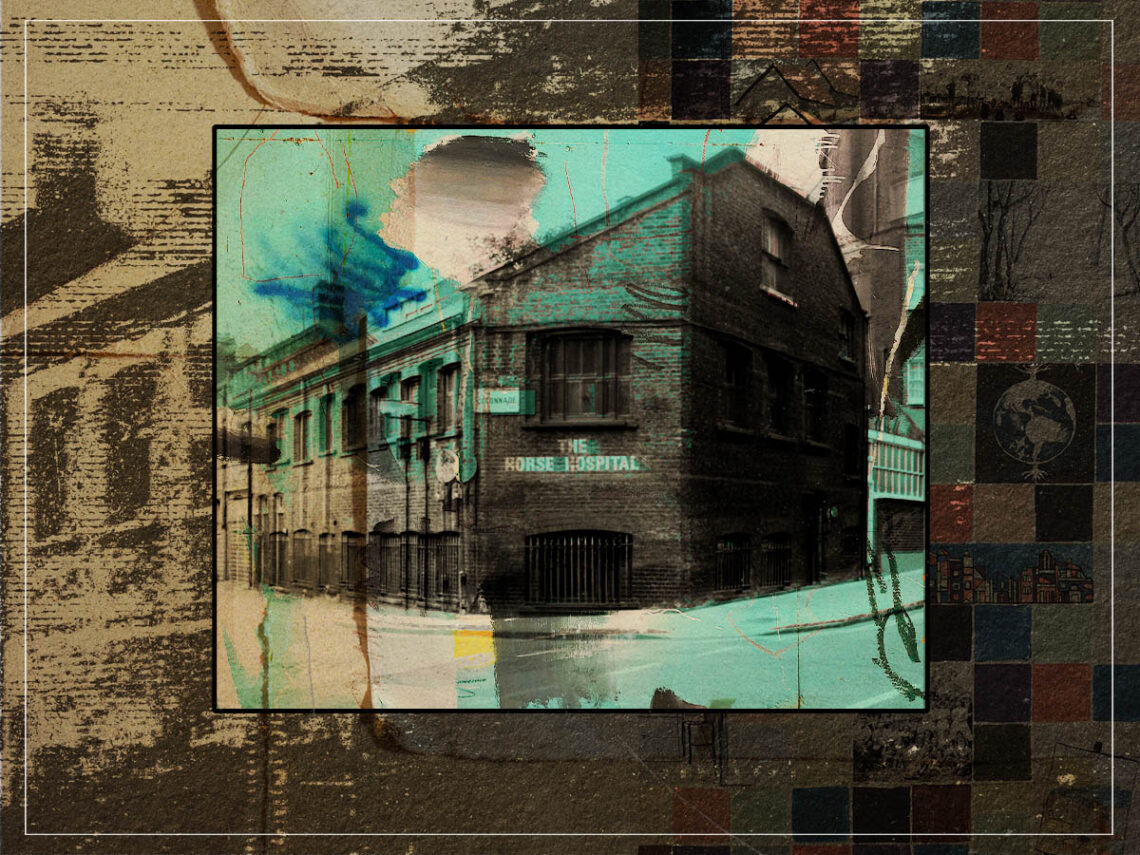
The Horse Hospital: London’s most overlooked cultural space

As one of Europe’s most sprawling urban conurbations, London has many venues and locations of immense cultural consequence. From the likes of the Brixton Windmill to places such as The Marquee Club that are no longer there, for decades, the city has had a flourishing subculture, and these places have provided incubators for creativity and safe spaces for intersectional artistic transgression.
London is so giant and has such a long and famous cultural history that some venues that are crucial to its development often get overlooked. While Brixton Windmill is probably the most prominent at the minute due to the likes of the recently defunct Black Midi, The Last Dinner Party, Shame, Fat White Family and others that it has fostered coming to national prominence, it is just one in a long line of independent venues propping up the capital’s deep pool of artistic talent.
One of the most forward-thinking, subversive, intriguing, and strangely overlooked independent venues is The Horse Hospital. With a name as bizarre as some of the exhibits it’s housed, it’s a Grade II listed not-for-profit arts venue at Colonnade, Bloomsbury, in central London. With a curatorial focus on countercultural history, subcultures and outsider artists, it’s been home to film screenings, exhibitions, musical performances, book talks and more. For those wondering about the name, the famous architect James Burton built the building in 1797 as a stable for sick horses of cab drivers.
The Horse Hospital, while promoting some of the most obscure, niche elements of London’s artistic counterculture and subcultures, has a strong connection to the city’s past. It was founded in 1992 by Roger K. Burton. A creative entrepreneur, in 1978, he designed PX, the formative New Romantic clothing store for Stephane Raynor and Helen Robinson, and the following year, helped punk pioneers Vivienne Westwood and her husband, former Sex Pistoles manager Malcolm McLaren, change their iconic fashion store Sex into Worlds End. In 1981, he designed Nostalgia of Mud for the pair.
There’s no wonder, then, that The Horse Hospital is so dedicated to independent culture and an array of different boundary-pushing formats; it’s a spiritual continuation of punk’s provocative, countercultural spirit. Fittingly, the venue opened in 1993 with Vive Le Punk!, a retrospective of Westwood’s designs. Since then, it’s hosted work by Anita Pallenberg, Alejandro Jodorowsky, Crass, Mark Leckey, Lydia Lunch, and Jamie Reid.
Elsewhere, exhibitions exploring the work of Tai Shani, Stu Mead, and Detroit noise outfit Destroy All Monsters have been held. Even Tony Foutz’s incomplete science fiction film, Saturation 70, starring Michelle Phillips, Gram Parsons and Rolling Stones member Brian Jones’s son, Julian Brian, was examined in an eye-opening 2014 exhibition that housed the remains of the project.
As with every independent venue, no matter how culturally significant, The Horse Hospital is always threatened with closure. In 2020, esteemed author Alan Moore, a fan of the avant-garde and defender of British countercultural traditions, perfectly defined the venue and why it should be fought for in an age of alternatives to the norm being systematically removed.
“The roster of talents associated with the place is an essential résumé of counterculture, both English and global, with all this surmounted by the most exciting archive of modern street-fashion anywhere in London,” he wrote. “Boiling everything electrifying in the city’s subterranean culture down to an exquisite bouillon, the Horse Hospital is an enormously important strand in the artistic fabric of our current century that must not be cut short, a redbrick Pegasus for which the knacker’s yard must surely be unthinkable.”
Moore was right. In an age where creative venues at large, not just independent ones, are at threat due to the rising cost of living, unscrupulous developers and the arts being constantly chipped away at by clueless policymakers, places like The Horse Hospital have never been so vital. They are some of our last bastions of pure countercultural expression. It’s well worth adding to your list of favourite London venues.

Never Miss A Beat
The Far Out Punk Newsletter
All the latest Punk content from the independent voice of culture.
Straight to your inbox.