


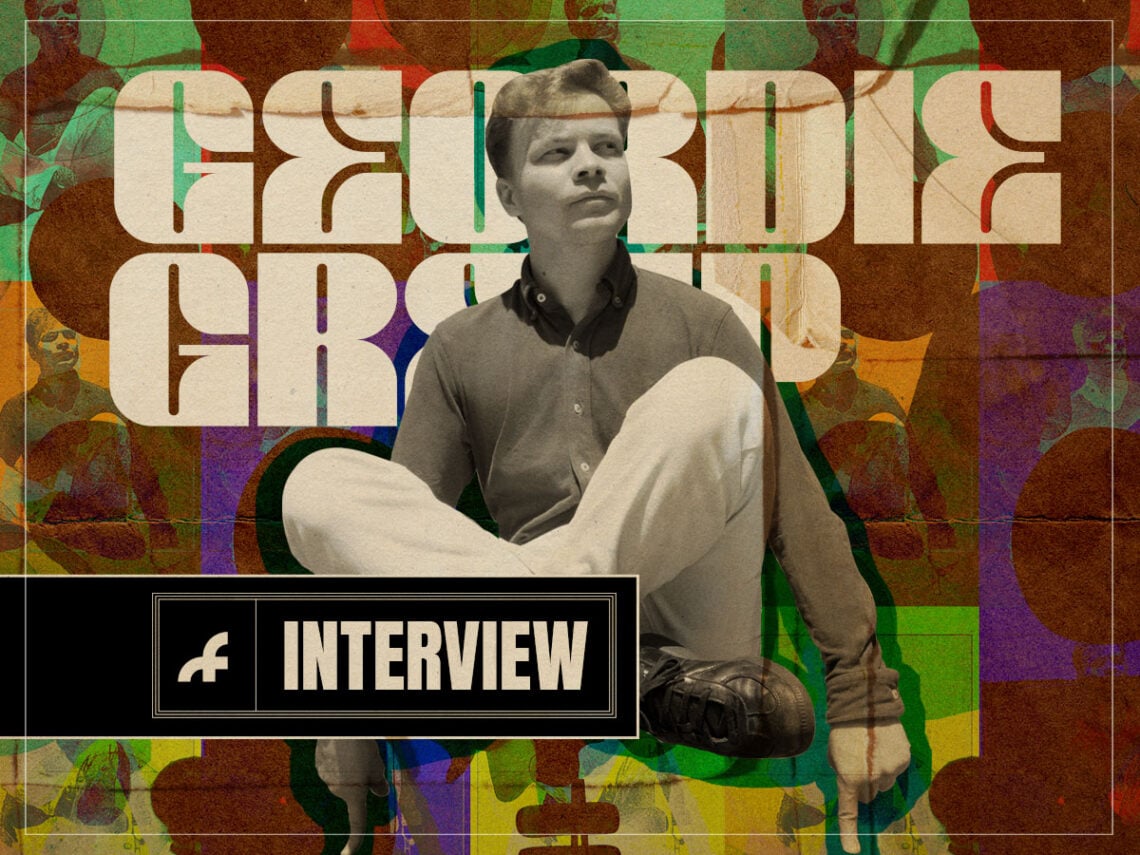
Geordie Greep reflects on ‘The New Sound’ and the end of Black Midi: “Your friends do all change”

Former glories can often be a musician’s undoing, as expectations and inevitable comparisons to past successes frequently overshadow new endeavours. This challenge is especially daunting in a world that remains fixated on what came before. However, on his solo album The New Sound, former Black Midi frontman Geordie Greep skillfully escapes the constraints of his recent history, boldly ushering in a new era and redefining his artistic identity.
Releasing a debut solo album within weeks of the news of the lauded London outfit splitting would always be a risk, given that they have droves of diehard followers across the globe. However, Greep knew what was happening long before the world outside of Black Midi did. Fittingly, The New Sound is a remarkably accomplished effort, which sees him work with former Black Midi touring member Seth ‘Shank’ Evans – who produced the record – and an array of veteran session musicians in Sao Paulo to stretch the limits of his formula and create something that sounds more like himself than anything before it.
While touching on familiar subjects, the album is highly descriptive but fictional, surreal and blackly comic, with the music visionary borrowing from a wild array of inspirations throughout. It flits from prog rock-leaning twists to Latin and jazz influences. As a testament to the songwriter’s clear awareness, some moments will appeal to fans of his old band, and plenty of others clearly show that he is unchained and more comfortable now as the scope is expanded and the sense of daring ramped up.
I caught up with Greep before The New Sound arrived, and the 25-year-old was in relaxed spirits, emitting a sense of creative satisfaction with how the songs had turned out. After completing his August residency at MAP in London, and a sprinkling of other shows, the signs were there: people were enjoying his latest project.
“It’s just going further in each direction, there’s more to chew on,” he comments.
While the latest record was written the same as he’d approach any other song, Greep did get to a point where he thought to himself, “If you want to do these songs properly, they probably warrant a different approach than working just in a band”. Out of nowhere, Greep maintained that if he wanted it to sound as refined as ‘Billie Jean’, he needed to hire the right musicians so they could get it done swiftly.

Greep asserts that “in the band, they were great musicians as well, amazing musicians”, but he needed hardened session performers for this project. Opening The New Sound up to more expansive horizons than he was previously used to, having different players across the tracks naturally increased its range due to the individual styles present and years of experience gained. The former Black Midi frontman agrees it’s a similar approach to the late Steely Dan era, when Walter Becker and Donald Fagen only worked with hired hands.
It’s certainly an intriguing approach, especially in a time when few artists choose to take such risks, which highlights Greep’s technical proficiency and deep understanding of music. He explains that the current state of music reflects that of cinema, noting that “everything is done so that you can have options.” This mindset underscores his innovative approach to creating music in a saturated industry.
If you choose to create an album with numerous session musicians and record it live, you must have complete confidence that everything will come together from the outset. There are no second chances; the takes are final. In contrast, many modern artists prefer to record their music individually and over an extended period, allowing for overdubs and adjustments as their perspectives on different elements evolve throughout the process. Wisely, he notes: “It’s the same in movies, where you shoot a scene with four or five cameras and have options, and by the time you edit it, it’s a bit bland looking because there’s no clear vision.”
Unsurprisingly, the Londoner is big into his films, and used to visit the cinema almost daily, which accounts for a portion of the profoundly visual nature of Black Midi and The New Sound. On the new record, the lyrics are so descriptive in parts, particularly on the madcap lead single ‘Holy, Holy’, that you could make a movie out of it, albeit one that would prompt much shock among today’s highly offendable audiences.
Again, it’s all a matter of perspective when creating. After discussing the 1970s vibe that’s always lived in his music from the outset to now, Greep says: “I think it’s just the ambition, you know. It’s like the one thing about stuff from the ’70s. Music, movies, all of that, it was very ambitious; there was less of this ironic, detached, or overly subtle kind of thing.”
Delving into the sharp intellect behind The New Sound, he continues: “It was like, ‘If we’re gonna do it, let’s go, let’s make a huge album, Close to the Edge, and all that kind of stuff. It was the era when the director could just do whatever they wanted, this auteur thing. It ended up with stuff like Heaven’s Gate, but it’s quite different from how things are now.”
While the title, The New Sound, might feel a little on the nose, like Greep is telling us that this is the real him in a new era, it’s more straightforward than that. “It’s not serious,” he levels, smiling. “To be honest, it’s just a title I had for ages and wanted to use for something”. Initially, he and Shank were going to write the album together and call the duo The New Sound, but as things wore on, Greep had written nearly a dozen songs and Shank just a couple. They settled on doing this as a Greep record. But make no mistake, this is a new era.

Regarding the somewhat chaotic announcement of Black Midi’s split, which was confirmed by Greep on Instagram Live and prompted surprised X posts from bassist Cameron Picton, who said the band had all agreed not to say anything about “breaking up” and felt blindsided, Greep set a few things straight. He maintains that he’d said ample ridiculous things on livestream before that had never made a splash.
However, there was more to it this time. The band met up about a year prior and agreed it was “probably the end” but didn’t feel the need to say anything because, after a few months, the noise would surely dissipate. This wasn’t the case, though. Their diehard fanbase kept asking about the group’s silence, and during that stream, Greep felt it was finally time to answer.
“It was probably the wrong thing to do, but in this moment, I thought, ‘Who cares? It’s finished,’ just because I felt bad, I didn’t wanna string all these guys along, give anyone false hope or be weird about it. It’s just clean,” he states. “It’s better just to say because, yeah, the reality is that it’s probably going to be a long time before there’s any other gigs or whatever, who knows. Mainly just for the fact that it just wasn’t going anywhere for a long time.”
For roughly two years, he recalls, there “wasn’t that much progress in the band”. They created Cavalcade and Hellfire close to each other. For him, the process started to become formulaic, with everything from writing to recording and even listening to the finished product losing the great sense of satisfaction it once held. He wanted more creatively and understood that from that moment, the end was nigh, or as he put it rather bleakly, “The days were numbered”.
It’s like being in a relationship: when you think like that, you’re already halfway out the door. “It’s exactly right,” Greep confirms. “If you think when you’re 15-16, and then you get to 25, your friends do all change. It’s not like a conscious thing. It’s not even that deep or anything, it just happens.”
Black Midi achieved much for a band that was so young, regardless of the minutiae of their split. They released three acclaimed albums and toured the world. “That’s like an old school vibe, you know, Velvet Underground, even The Beatles weren’t together that long, really,” their former frontman concludes. “It’s better than churning out whatever, and every time you put out a bad album, your ranking goes down. You don’t want to do that.”
Calling it a day isn’t the end of the road for Geordie Greep, but more like the start of a new one after turning off at a junction signposted The New Sound. Who knows what this one has in store?
