


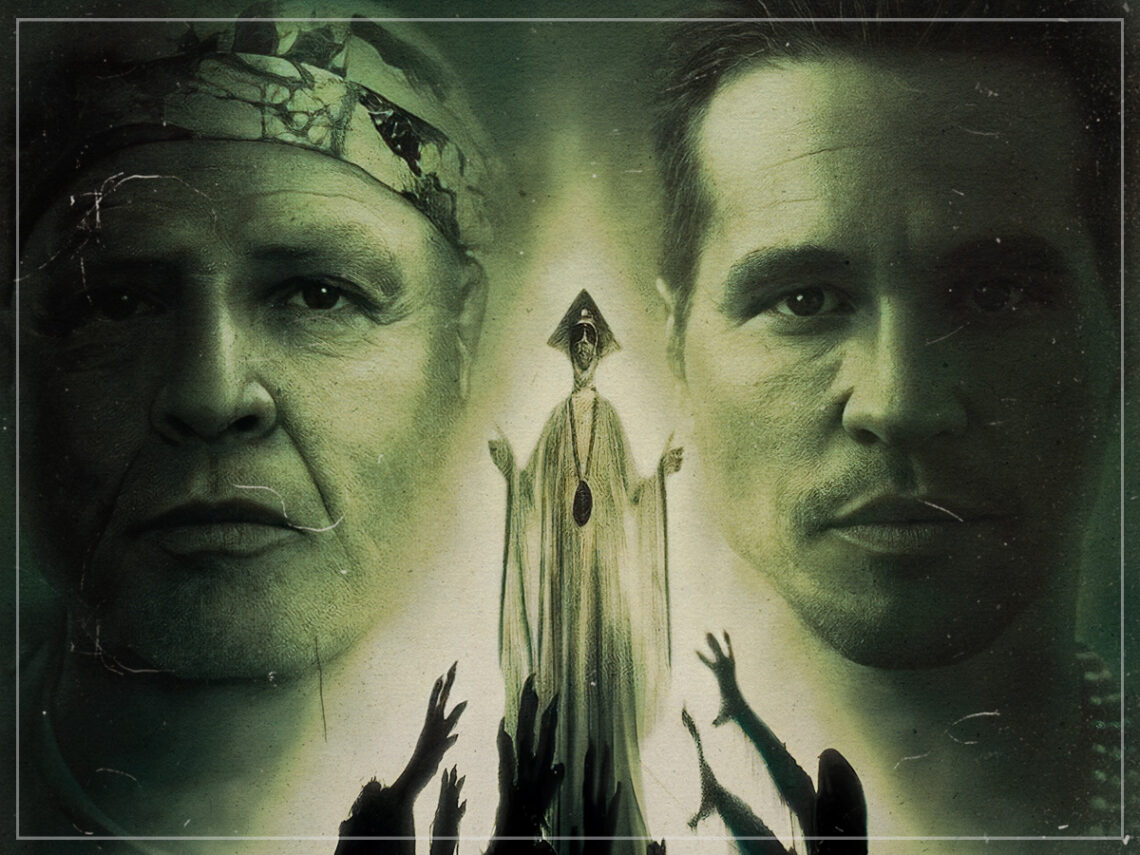
The horror of making ‘The Island of Dr. Moreau’

It’s all too often that we can perceive a cinematic work without actually considering the kind of production that went into making it a success. After all, while some movies enjoy a relatively pain-free production, others are beleaguered by several behind-the-scenes problems; just take Francis Ford Coppola’s Apocalypse Now, for example, or another Marlon Brando film, The Island of Dr. Moreau.
The 1996 science fiction horror film was directed by John Frankenheimer and is based on the 1896 novel of the same name by H.G. Wells, marking the third time that the novel was adapted for the big screen, following the release of 1932’s Island of Lost Souls and Don Taylor’s 1977 movie The Island of Dr. Moreau.
Starring Marlon Brando, Val Kilmer, David Thewlis and Fairuza Balk, tells the story of a United Nations negotiator, Edward Douglas, who survives a plane crash in the Java Sea. He is rescued and taken to a strange island where he discovers the inhabitants are experimental animals that have been turned into odd-looking humans.
The film has gone down in history as being one of the most troubled productions of all time. It began with director Richard Stanley, who’d long wanted to make a version, but at one point, producers New Line went behind his back and offered the job to Roman Polanski. A conversation between Stanley and the recently hired Marlon Brando eventually got Stanley back in the director’s chair.
Bruce Willis was brought in to star in the lead role, but just as principal photography was about to begin, the actor withdrew amid his ongoing divorce from Demi Moore. Val Kilmer was brought in as a replacement but demanded that he could only be on set to shoot for nearly half of what Willis had originally agreed to. Kilmer was then moved to a supporting role, which subsequently meant that James Woods was forced to depart the production.
Things were not made better when Brando’s daughter Cheyenne committed suicide, prompting the actor to retreat into private seclusion with the cast and crew not knowing if he would ever turn up to shoot. Within the first few days of filming, tensions between the producers and Stanley, which had already been brewing, reached a boiling point.
Brando was nowhere to be seen. Kilmer turned up two days late, and when he did, he is said to have behaved obnoxiously in the hostile manner of a playground bully. New Line looked to blame Stanley for not being able to control Kilmer and fired him on the third day of filming. With the production in crisis, John Frankenheimer, one of Hollywood’s old guards, was brought in to finish the production.
However, Frankenheimer’s old-school approach meant that he alienated many of the cast and crew. When shooting resumed, Brando, who’d finally joined proceedings, would spend most of the time in his trailer, and tensions between him and Kilmer began to bubble up, with both refusing to come onto the set before the other.
Frankenheimer, David Thewlis, Brando and Kilmer all fired shots at one another throughout the remainder of the shoot, and the atmosphere on set was described as “poisonous”. Unsurprisingly, perhaps, the film received negative reviews and was a box office failure and worst of all, the relationships between those involved were forever severed.
Check out the trailer for the film below.
