


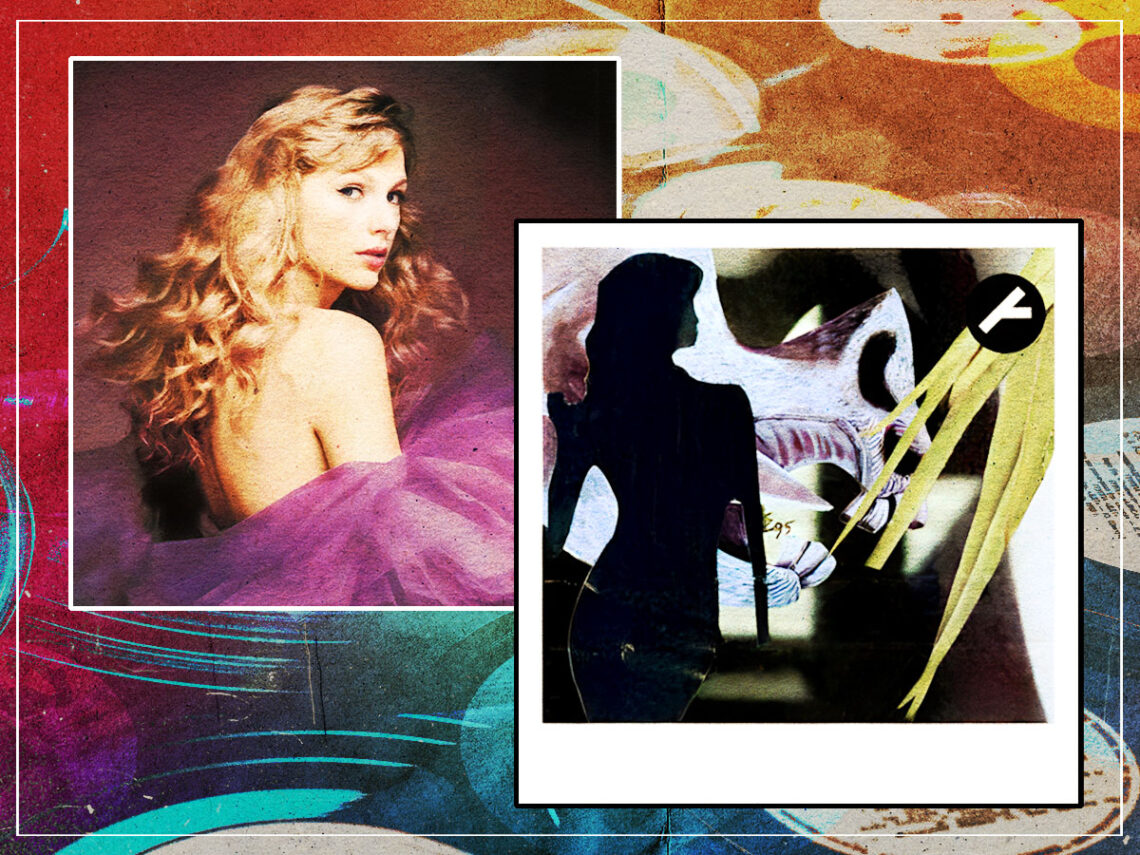
The happy accident of Cabaret Voltaire: How the misprint of Taylor Swift’s vinyl is changing music

Kids these days, huh? With their dance trends, TikTok crazes, Taylor Swift and social media obsessions… and penchants for Dadaist industrial music. It is dichotomies like these that have made the zeitgeist an unknowable beast for adults isolated from the online world of modern youth culture. For aeons, the arts were largely in the order of the bourgeoisie, then pop culture came along as a curveball and the powers that be briefly lost hold of the arts and their strong arm over the in-vogue discourse. Sadly, they have since adjusted to this and ushered things towards a commercially manageable direction once more.
But every now and again, a curveball comes along. Recently, when visiting friends with a teenage daughter, I got to uncover an intervention of fate in the diegesis of culture first-hand. While we conversed downstairs, a strange sound was emanating from the teenager’s room. It was the unmistakable hum of England’s underground pioneers of guitar-less darkness, Cabaret Voltaire. This was a world away from the musical tastes I had heard from that room at previous dinner parties. What had caused this sudden conversion to danceable absurdist abstractions, I wondered.
As it transpired, a happy accident had dramatically catalysed the teenager’s musical journey. Presently, there is an ardency to Taylor Swift fandom that is comparable only to Beatlemania. These ‘Swifties’ pore over every element related to their favourite artist. They have a community—a refreshing thing in the polarised modern age. In July, that community was rocked by a strange occurrence.
A post went viral on TikTok asking fellow Taylor Swift fans: “Does anyone else’s ‘Speak Now’ vinyl not have Taylor Swift on it?” A handful of people agreed and posted evidence of this peculiarity. Then Universal Music Group broke their silence on the matter and admitted that somehow – pending investigation – an “extremely limited” number of copies of Speak Now had been pressed with Cabaret Voltaire’s track ‘Soul Vine (70 Billion People)’ in place of ‘Taylor’s Version’.
Although the actual number of misprints might have exposed all of about 20 Swifties to the singular ways of Sheffield’s underground arty anarchists, the amplifying effect of the internet and its appetite for an enigma spread Cabaret Voltaire throughout the fandom. And a lot of them, it seems, quite liked what they heard. Thus, for the first time since 1978, or perhaps even more so, Cabaret Voltaire is being talked about with a buzz in playgrounds around the world.
The band themselves were formed in the early 1970s, but their avant-garde nature meant that they weren’t signed to a major label until Rough Trade nabbed them in ‘78. Perhaps the most fitting motif to explain their style comes from the fact that their name derives from the cafe in Zurich where the Dadaist movement began in 1916. The structureless absurdity of that scene prompted Cabaret Voltaire to deploy a similar footloose smorgasbord amid the backdrop of the Cold War, with sound collage being a defining element of their work.
The band then honed their style, welcoming in the electronic notion of futurism tempered by industrial despair as melodic soundscapes are chequered with abrasive percussion. To promote this pioneering new sound, they would simply elusively leave copies of their work on pub tables and pelt it out from a stereo system mounted on the roof of a friend’s van during a slow drive around town. In the process, they illuminated the electronic possibilities of an Ian Curtis-less future for Joy Division / New Order, made Bauhaus feel like they were not alone, and proved instrumental in the musical development of Trent Reznor.
Now, they are once again flexing an influence thanks to a quirk of fate (or perhaps a rogue fan somewhere in the pipework at Universal). And this is all potentially shifting the zeitgeist towards a more avant-garde future. TikTok itself is a medium that has encouraged weirdness to trend with David Bowie’s favourite clown, Nomi, recently reaching millions of youngsters in a microdose of madness.
If either Nomi or Cabaret Voltaire were presented in full, then they may well have been shot down and sequestered as too strange, but when revealed to youngsters in this come hither capacity, the lure of their originality is more manageable. Thus, you have a generation being assimilated towards avant-garde music in a paradoxically more natural fashion, and it is catching on by virtue of its inherent interest. As I was reliably informed, ‘You know, I just thought, this Cabaret Voltaire track is pretty cool actually’.
