


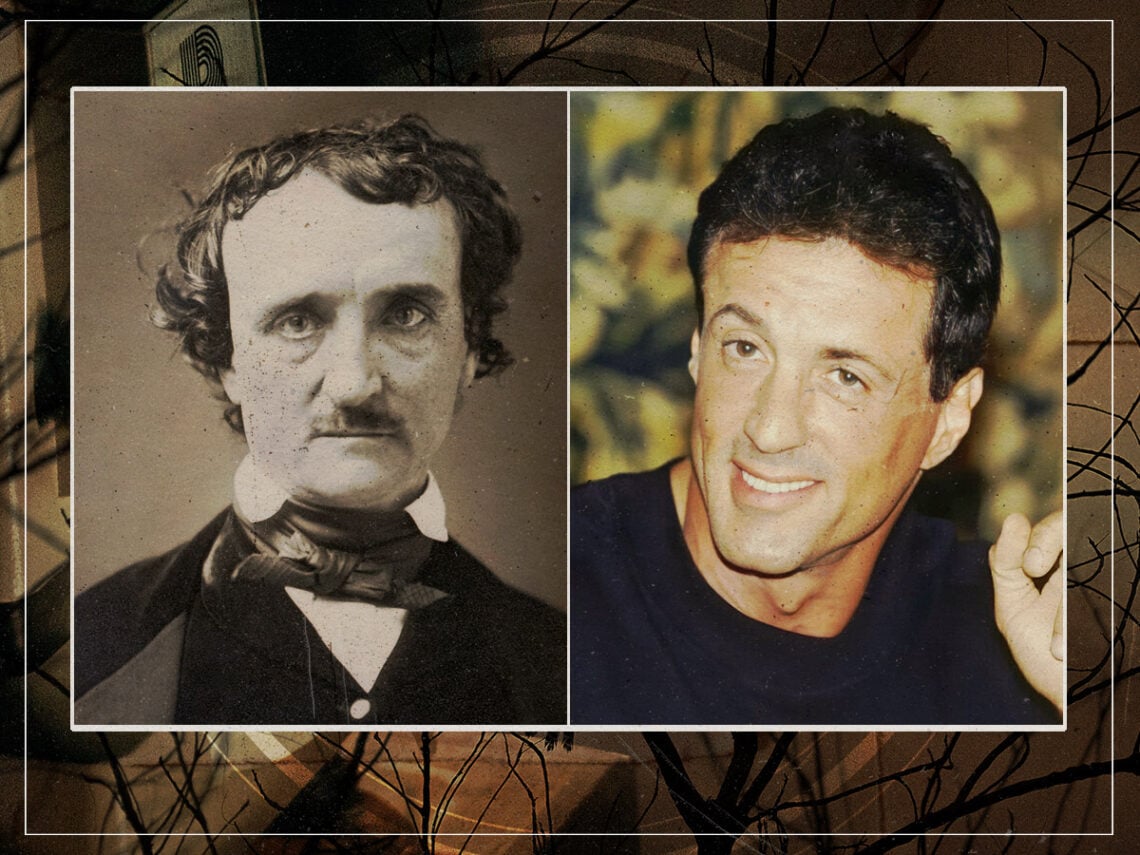
The greatest movies never made: Sylvester Stallone’s ‘Poe’

Even though he’s embraced the fact his career will always be defined by Rocky Balboa, John Rambo, and his seismic contributions to the action genre, it feels as if Sylvester Stallone has always been on the hunt for that movie that would truly establish him as a respected director.
He’s helmed eight features, but none of them are exactly reflective of an auteur. Stallone’s filmography from behind the camera only extends to four of the Rocky sequels, the fourth Rambo flick, the first instalment in The Expendables franchise, the risible Saturday Night Fever sequel Staying Alive, and his debut sports drama Paradise Alley.
Hardly the back catalogue of a filmmaker ready to prove themself to the world as a force to be reckoned with, which is exactly what made his Edgar Allan Poe biopic such an enticing prospect. It was completely out of left field, unlike anything Stallone had ever made as either an actor, writer, producer, or director, and could have single-handedly altered the perception of his directorial reputation.
On the other side of the coin, it could have been an unmitigated disaster, but that only strengthens its position as the one that got away. Poe was going to be a huge swing for the fences, and whether it missed by miles or hit the target dead-on, it’s a project that should have been given a chance to exist just so audiences could find out which way the dominoes ended up falling.
Often characterised as a musclebound meathead, it’s easy to overlook the fact Stallone has two Academy Award nominations for acting and one for writing, with the story of how Rocky came to be entering Hollywood folklore. It shouldn’t go unmentioned that he’s made an incredible number of shitty films, either, but none of them were intense, brooding, gothic period pieces focusing on a pivotal figure in American literature.
He wrote the first draft of the screenplay in 1979, when he was intending to play the lead role himself. For whatever reason, nobody seemed willing to take a punt on the shredded, gun-toting hero of Reagan-era action cinema toning things down to such a drastic extent, but he persevered with the project for longer than Poe was alive for reasons that were close to his heart.
“What fascinates me about Poe is that he was such an iconoclast,” he explained. “It’s a story for every young man or woman who sees themselves as a bit outside the box, or has been ostracized during their life as an oddball or too eccentric. It didn’t work for him either. His work was too hip for the room but he developed the modern mystery story. He was also one of the great cryptologists; there were very few codes he couldn’t crack. He was just an extraordinary guy.”
Ironically, Stallone’s reputation worked against him when he was trying to get it off the ground. “I keep telling my producer Avi Lerner, ‘Make Edgar Allan Poe!’,” he recalled. “He says, ‘Does he have a gun?’. ‘No, he doesn’t have a gun’. ‘Can he throw a knife?’. I say, ‘No, he writes poetry!'” That’s not the type of Stallone flick people were interested in funding, but he nonetheless held on to rewrite his screenplay with Robert Downey Jr. in mind.
No offence to Sly, but that’s a much better and more inspired casting choice, not that it came to pass anyway. He even admitted that “it’s never going to live up to the hype,” going so far as to say that “no matter what I do it’s going to bomb, totally.” That lack of self-confidence helps explain why everyone in Tinseltown was so reluctant, but that doesn’t mean it wouldn’t have been a sight to see.
Regardless of whether it justified his decades-long endeavour or ended up as one of the worst movies in history, the world deserved to see Poe for the express purpose of giving viewers the chance to witness whether Stallone would sink or swim heading further out of his wheelhouse than ever before.
