


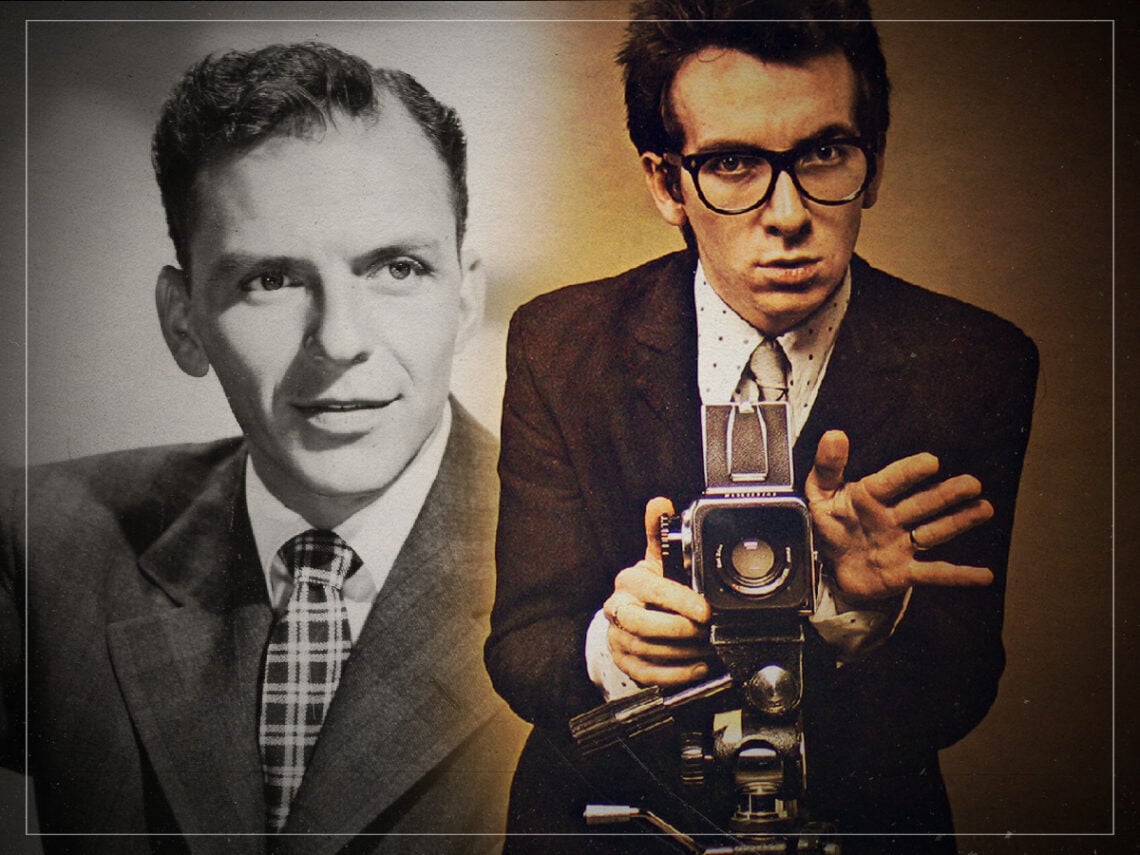
The greatest Frank Sinatra song, according to Elvis Costello

Elvis Costello and Frank Sinatra may have been active in different eras, but they share a rare distinction of having earned the admiration of Bob Dylan, who once described Costello as “light years better” than his contemporaries, while Sinatra, he said, was “the mountain you have to climb”.
In 1992, Costello appeared on the iconic BBC radio show Desert Island Discs, a stage that has seen castaways from Maya Angelou to Simon Cowell wrestle with a deceptively simple question: if stranded on a desert island, which eight records would you take? It’s a concept this writer has used to pass many a long traffic jam.
Guests also pick one book, one luxury item, and, by default, receive the complete works of Shakespeare and the Bible; the format is brilliant in its simplicity, peeling back the material trappings of celebrities to reveal the soul beneath.
Unsurprisingly, it’s also a place where politicians attempting to reclaim cool points have spectacularly flopped, or revealed perhaps more than they intended. For instance, Tony Blair picking Bruce Springsteen’s 4th of July exposed a man with a near-obsessive fascination with Americana, while Boris Johnson claiming he loved The Clash is a window into a man desperate to convince the world he was ‘just Boris’, not Alexander Boris de Pfeffel Johnson (in retrospect, it would have been far better to have left him marooned).
Costello, though, leaned into the format with characteristic ingenuity, with his book choice being a collection of works by James Thurber, the American cartoonist and writer best known for his illustrations and short stories, published primarily in The New Yorker and collected in his numerous publications, and his luxury item of choice, an upright piano, accompanied by Botticelli’s Saint Barnabas Altarpiece.
In terms of the songs, Sinatra’s ‘I’ve Got You Under My Skin’ was his second pick of the day after Beethoven’s ‘String Quartet No 16 in F major, Op 135’, noting of it, “This is probably the first song that I can remember, although really I think my memory has been prompted slightly by my mother, who tells me that I requested it before I could talk properly. I got the word ‘skin’ and insisted on it being played.”
Costello then reminisced about once being at a party following some recent success in pop music, and being asked by an “art student type” to quote a song, “I think he imagined that I would give him something by the Sex Pistols or something. It was in America, and they imagined that we had the secret to everything. I quoted the bridge of ‘I’ve Got You Under My Skin’, you know, ‘Wake up to reality, use your mentality’, and he wouldn’t believe me […] I also think, from a music point of view, that the note that Sinatra hits on ‘don’t’ in ‘Don’t you know, little fool’, the second time he comes in, is supernatural.”
In a 1998 article for Mojo magazine, Costello said that being exposed to Sinatra by his parents sparked a lifelong admiration and influence upon his own music, and he even bought a lapel badge from a junk shop as a child that read: “It’s Sinatra’s world. We just live in it”. In the piece, he also hailed Sinatra’s ability to deliver performances of plain, raw anguish, while his contemporaries were unwilling to disobey romantic conventions, “closing the door before things really got messy”, as Costello put it.
It was of this he considered Sinatra a true master of, with the latter’s work profoundly shaping his approach to storytelling and vocal performance, particularly in his sadder or more bitter songs, where his phrasing, timing, and emotional nuance echo the great American songbook that Sinatra perfected.
