


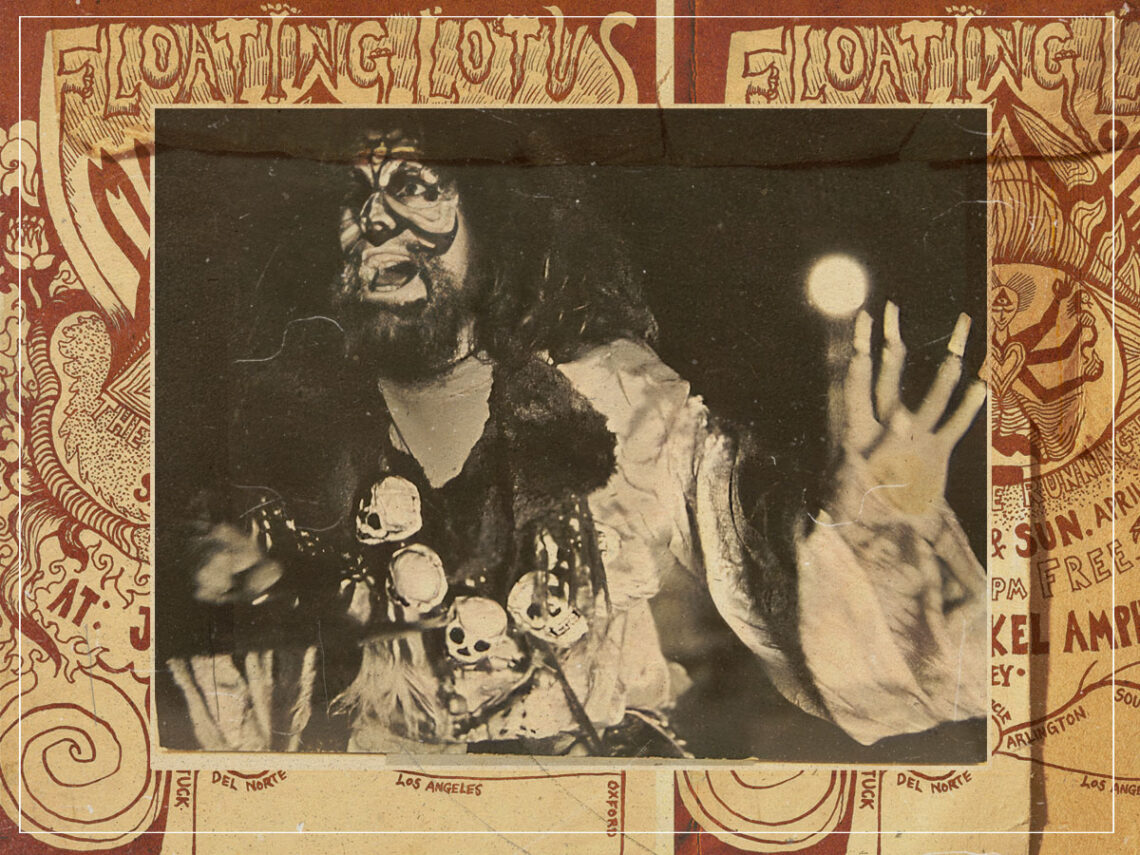
The Floating Lotus Magic Opera Company: when the counterculture stepped one toke over the line

While the counterculture is primarily remembered for the tremendous artistic innovations it produced, the movement was also a period of ample weirdness. Due to the confluence of wild imaginations, excessive LSD taking, and a fascination with the complex spiritual world, an array of bizarro exhibits emerged during this era. One of the most peculiar was The Floating Lotus Magic Opera Company.
Roughly lasting from about 1967 to 1970, with the exact dates understandably fuzzy for all those involved, the theatre troupe was based in North Berkeley, California, the epicentre of the period’s fervent student activism, nestled on the eastern shore of San Francisco Bay. Drawing on the mystical aspects of the counterculture, its productions were configured as sacred dramas with a deeply expressionistic folk style underpinned by the teachings of Zen Buddhism.
This constantly evolving band of artists and believers was led by the shaggy-haired poet Daniel Moore. It has been reported in the years since that he strived to make the theatrical form of opera a collective product, which involved group meditation before and after shows. To forge such a bond, he also lived closely with the actors who formed the troupe.
It was clear that if the audience was willing to forego traditional opera and fully give themselves up to Moore’s out-there creations. The objective was total catharsis, to let go of societal ills and the dark manifestations of the Cold War, such as the bloody conflict in Vietnam. Accordingly, one of the group’s operas featured a danced battle between the representatives of good and evil, with each combatant armed with a single cymbal.
In another part of one opera, the music in the background was freakout psychedelia, with the dancers dynamically working their way through several religious and cultural traditions, such as a Zen master dodging a weary Wanderer’s queries about life and suffering. In the spirit of the day, stirring coloured lights, bare-breasted dancers waving grain stalks, silver face paint, and silk sheets used to symbolise the River of Life were also commonplace in The Floating Lotus shows.
Besides Moore, the mysterious woman known as Zilla was also a driving force of The Floating Lotus. She had been with the group from the beginning and was so central to the design and choreography of shows that she also played Kali in one of their operas. Zilla is also said to have embodied every facet of their style, from the striking intensity to the unflinching calm.
In an incredibly hippie way, Moore, Zilla and others from the Floating Lotus spent most of their time together, with some partners or neighbours and connecting in other communal ways expected of the counterculture. As artists, the central figures of the group were fans of painting, poetry, Sufism – the mystical form of Islam – and most telling of all, the work of Armenian mystic George Gurdjieff, the man who popularised the idea of life being a “waking sleep”.
A multi-disciplinary group of artists, The Floating Lotus wasn’t only amateurish and attracted several notable musicians to join the ranks of its celebration of Berkeley’s “tribal consciousness”. At different points, the orchestra featured original Velvet Underground drummer Angus MacLise – a professed occultist – poet and musician Louise Landes Levi, light artist and musical whizz Daniel Conrad, and Marc Allen. Reflecting his school’s inextricable link to the counterculture, the pioneering minimalist composer Terry Riley would play his erhu with The Company from time to time and even provide a touch of musical direction. The great Ramón Sender also lent his talents to them once upon a time.
In their short life, The Floating Lotus performed two operas, The Walls are Running Blood and Bliss Apocalypse. They had even written the final part of the trilogy, Sun Rose, but at that point, their neighbours in North Berkeley had had enough after two years of their wailing and crashing racket and forced them to leave for new pastures. As the times were changing at the end of the decade, and the countercultural dream was quickly fading away into something much darker than the utopia its adherent had hoped for, things also drew to a close for the troupe.
After leaving their former sanctuary of Williams College in North Berkley, this unlikely band of believers migrated to an abandoned Lumber Mill near Palo Alto, which a friend lent them. However, after a few months of communally “living on the land”, they disbanded.
