


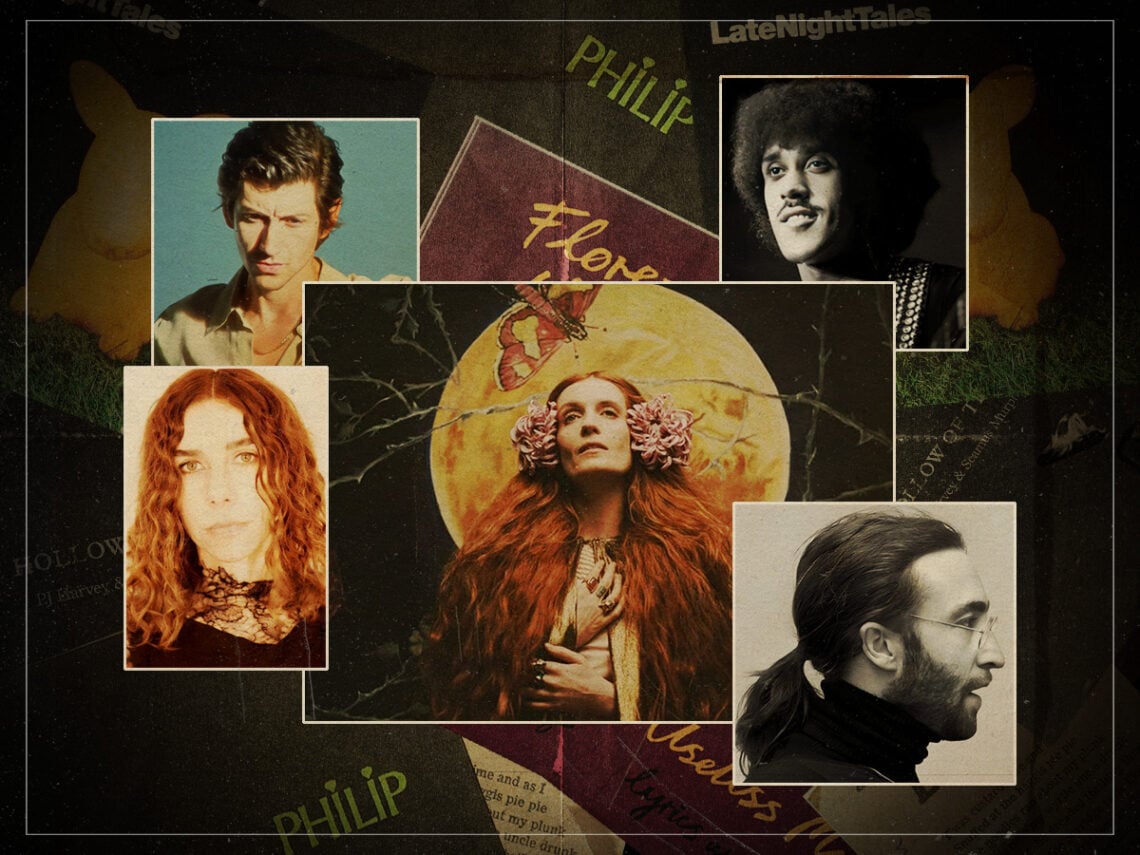
The five best poems written by musicians

Without trying to expose myself as an absolute geek here, the real reason I fell in love so much with writing about music was the poems that appear within it. The English graduate heart of mine sings whenever a good metaphor or piece of symbolism crops up in a tune’s lyrics, and I have an odd fascination with tracing the storylines and plots that drive sonic narratives, as a combined force between melody and prose.
You can imagine my delight, then, each time I discover that an artist has taken a leap into the literary world, putting their songwriting talents on the line to bridge into poetry. Admittedly, some attempts are not as successful as others – not naming anyone in particular – but when you come across a poem that works, there’s nothing more insightful than trying to connect the dots to that musician’s sonic output.
While you can’t exactly put musicians on a parallel with the next William Shakespeare, WB Yeats, or even Sylvia Plath, a huge part of the enthral of a sonic poetry collection is the realisation of how literature is bridging its way into modern art forms, as well as how it is being opened up to become more accessible to various diverse audiences. There are plenty of debates to be had on the path to this being achieved, but artists and lyricists are absolutely a driving force in the contemporary poetry canon, and that rightly deserves to be celebrated.
Poets, musicians, and playwrights are often clubbed together in their own artsy league, but the instances when their works actually do cross over make for the most fascinating reading. Poems are, of course, just as integral a study of lyrics as anything else out there, so if you’re looking for a deep dive into your favourite musicians, find out if they’ve ever penned any poetry. Chances are, you’ll find some gems.
Five of the best poems penned by music artists:
‘Monster’ – Florence Welch

Perhaps one of the most prolific wordsmiths of the modern era is Florence Welch, who has always possessed a magical way of weaving lyrics and sound into ethereal masterpieces. But topping the charts is only one piece of the puzzle, as words and poetry are just as important – if not more essential – to forming an accurate portrait of the songstress’s artistry; her muse on which she paints her thoughts before she brings them to life in tune.
Welch uncovered this aspect of her process most overtly in her 2018 book Useless Magic, displaying a mixture of song lyrics and poetry that has circled her mind throughout her career. One of the most stark examples was within the poem ‘Monster’, exploring the very bones of songwriting and fame, and the moral effects of selling one’s soul for sonic rapture. She may be fairy-like in her presence, but there’s no denying that Welch’s heart is truly grounded in reality.

‘The Land of Lunapots’ – John Lennon

Everyone associates The Beatles and John Lennon’s songbook largely with the psychedelia synonymous with the 1960s, but early evidence indicates that this crazed way of thinking may have flowed through the songwriter’s veins all his life. One particular poem, ‘The Land of Lunapots’ – published in 1964 but written as far back as when Lennon was around 15 years old, demonstrates that songs like ‘I Am the Walrus’ and ‘Lucy in the Sky with Diamonds’ were not just surrealist epiphanies, but rooted in his everyday psyche.
The gibberish word choices throughout the poem, including the line: “The inkles were pulling at my plunk/ Which made my zinkle tinkle dunk,” may not make much sense on the surface, but they were evidently inspired by the fantastical literary worlds of Lewis Carroll. There’s a direct connection between the tone of ‘The Land of Lunapots’ and the latter’s famous poem ‘Jabberwocky’ – and thus, it’s no longer nonsensical, but literary genius.

‘The Guest Room’ – PJ Harvey

PJ Harvey is one of those artists I look at in awe, as I really don’t know how she does it. Being an eclectic, experimental sonic visionary for your time is one thing, but doing it while also establishing yourself as a prolific poet at the same time is a whole different ballpark. Through it all, Harvey maintains an acerbic, caustic, and equally devastating eye on the world, never more so evident than in her 2014 poem, ‘The Guest Room’.
The thing that sets great literature apart is its ability to transcend time and space. ‘The Guest Room’ may now be 11 years old, but its haunting hallows, depicting a child wandering through a war-torn landscape with no home to return to, are as resonant to the tragic conflicts of today just as it has been at any other point in history.

‘A Choice of Three’ – Alex Turner

Without naming any songs specifically, Alex Turner has been responsible for some lyrical abominations in his time. If you’re able to put those to the back of your mind, however, his poem ‘A Choice of Three’ stands out as a cut above the rest. The deliberations of love and lust, all while travelling on a train from Loughborough, don’t immediately jump out as the most inspiring literary muse, but as Turner has proved countless times before, he can truly spin words from anything.
“The trouble was, if I looked at your reflection in the left window I missed the actual image of you and your reflection in the right. And if I looked in the right I had the same problem but the other way around,” he muses in one of the opening verses of prose, creating a web of illusions and dreams in his midst. ‘A Choice of Three’ is equally mundane and magical, making the ultimate case for Turner as an oft-misguided artist.

‘Angel from the Coast’ – Phil Lynott

Perhaps to a greater degree than any other rock star of his time, Phil Lynott was more in touch with his poetic side than anyone else. Thin Lizzy were all about the thrashing guitars and the electric sonics, yes, but behind it all was a prolific way with words that Lynott helmed, and could rarely ever be replicated.
Proving this, the Irishman released two poetry collections in his time – Songs for While I’m Away in 1974, followed by Philip in 1977. These largely contained the lyrics of what would later become Thin Lizzy tunes, exemplified by ‘Angel from the Coast’, which transformed into a track on the band’s iconic album Jailbreak. Depicting the moral turbulence in the relationship between religion and addiction, the poem painted a painful parallel to the circumstances of Lynott’s own life, but nevertheless, still stood as the strongest testament to the sonic and lyrical odysseys that orbited his mind.

