


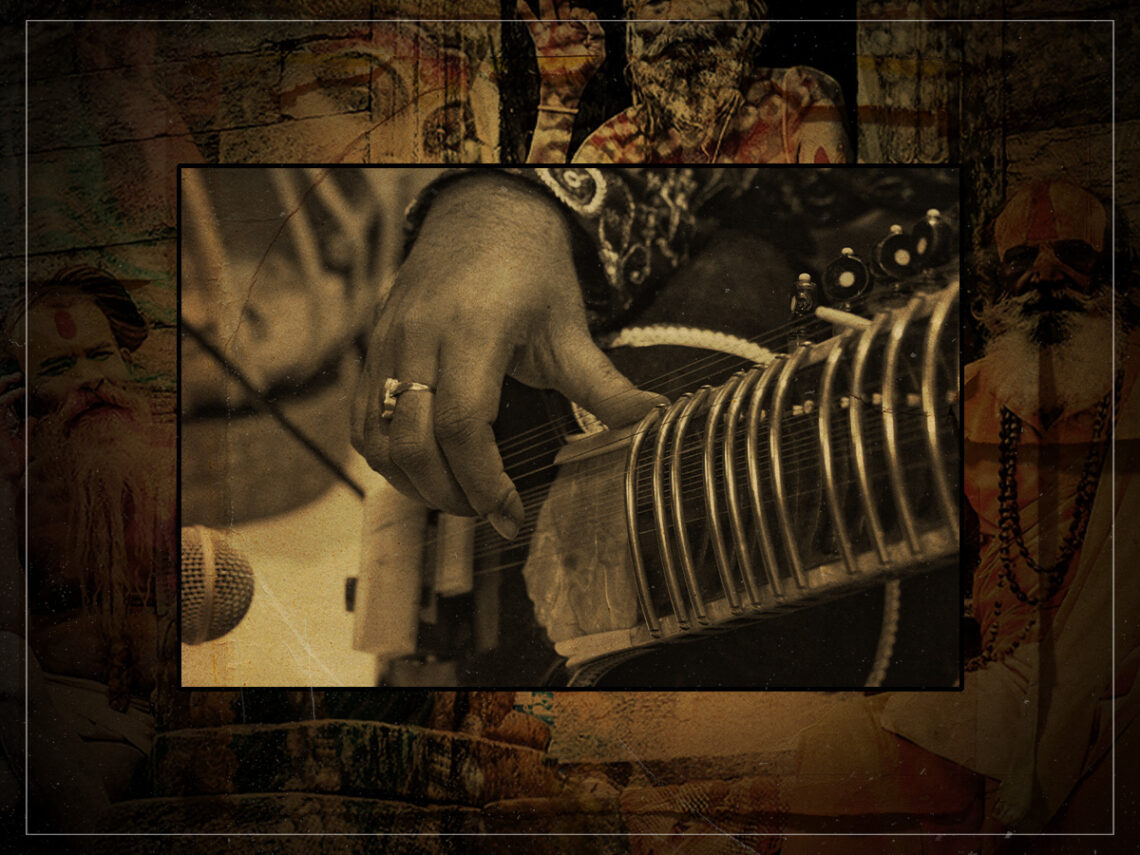
Uncovering a Countercultural Cornerstone: What was the first rock song to feature the sitar?

When the Suli inventor and poet, Amir Khusrow, got carried away with a length of teak and made the first sitar in an ancient Indian village over 400 years ago, there is no way that he could have envisioned the serpentine path that it would weave through musical history to become one of the most influential instruments of all time. Out of nowhere, the cumbersome beast became a cornerstone and symbol of counterculture.
The hefty instrument typically has 18 strings and 20 movable frets, which allows for an amorphous melodic sound. The shifting frets create a sonorous humming undercurrent, while the strings can produce a harp-like topline. When listened to live in isolation, it is easy to see how George Harrison and the likes were seduced into the oeuvre of its mystic come hither.
There is undoubtedly a spiritual depth to the sound, which was the main factor that endeared it to the mindful milieu of the era. It also helps that it’s got the look – you don’t casually yield a sitar if you’re not plugged into the ether, dude. Perhaps above all, it also provided a point of difference – a textural and aesthetic mark of innovation in an age that was racing towards the future in a whirling blur.
Initially, the sitar was confined to the realm of Hindustani music. Then, inspired to wander the world aimlessly in search of nothing in particular by beat literature, beatniks, hippies and the occasional recently divorced Geography teacher, waved a middle finger to the suburbs and clambered aboard a spiritual bandwagon weaving a path to the answer-chocked lands of the past in Nepal and India. This was the start of the sitar’s rise.
However, it wasn’t until 1965 that it crash-landed from the celestial realm of shrouded history to make its seismic mark amid the fuzz-pedalled kaleidoscope of the 1960s, where it quickly became a firm favourite thing to strum among musicians with severe incense addictions.
In April of 1965, the tale goes that The Beatles were filming Help! and an Indian band played background music in a groovy restaurant scene that set George Harrison agog. In casual conversation with Roger McGuinn of the Byrds, Harrison would mention this mind-bending moment, and McGuinn would fatefully slip the Quiet Beatle a copy of a Ravi Shankar record. But how had McGuinn heard it?
What was the first rock song to feature a sitar?
Well, a lot of the West had actually heard the sitar long before its consideration in rock. After all, Shankar was a virtuoso sitarist, and he found himself employed as the music director of All India Radio. This made him a very prominent figure in Indian music, and with large diasporic British communities in India at the time, there were plenty of Western ears attuned to what he was playing. In turn, he would tour the US and Europe in the 1950s, helping to fuel the West’s newfound spiritual obsession with Asia in the Kerouacian age.
However, genre-blending was not particularly prevalent, so while the sitar might have been heard in certain circles, nobody had thought of putting it into rock music until Ray Davies of The Kinks enjoyed a brief stopover in India during a 1965 tour of Asia. With the rising influence of ‘the other’ and a sense that alternatives were, indeed, possible, he bent his ear to the sound of locals playing folk music.

He was simply enjoying a stroll when the resonant drone of fishermen strumming traditional songs enchanted him. The world was looking for something different, and he had found it. The next time that The Kinks found themselves in a studio, Davies decided to try to mimic the drone with a guitar. The resultant song, ‘See My Friends’, provides us with rock’s first imitation of the sitar.
Shortly after, as word was spreading around the close-knit creative community of the day, the Yardbirds hired a local sitar player to perform on their track ‘Heart Full of Soul’, but jitters kicked in, and this demo was later shelved. The Beatles, however, had absolutely no bones about taking risks and as soon as Harrison heard the instrument, he became determined to make it ‘his thing’.
So, enthused by the sheer sense of ‘the alternative’ that the instrument provided, Harrison created the first rock song to contain a sitar with ‘Norwegian Wood (This Bird Has Flown)’. John Lennon’s introspective, Bob Dylan-inspired lyrics were graced with a great otherworldly wonder thanks to Harrison’s curious and vital innovation.
What impact did the sitar have on Western culture?
World music is now an outdated term. Why should Korean folk be clubbed in with West African griot music when all they share in common is a sense of the exotic to a Western ear? But when George Harrison called Ravi Shankar “the godfather of world music”, it carried a little more veracity. It was Shankar’s subsequent influence that led us to a point where we could recognise that the moniker the Beatles gave him was a misnomer.
After the Fab Four heard the sounds of Indian sitarist, music really did become a globalised art. “George Harrison, on his own, opened up India to England,” XTC guitarist Andy Partridge explains. “The man brings back a sitar and flirts with sitar lessons, and all of a sudden, India means things to people […] Single-handily, George Harrison brought India to English consciousness. In a non-colonial and non-judgemental kind of way.”
Cultures from around the world were suddenly appreciated and appraised on a global scale and woven into the counterculture of the day. From the sitar of India to the siku of Peru, suddenly, everyone from The Byrds, The Bee Gees and The Zombies were making musical stews infused with a planetary pantry. And at the start of that advancement was Shankar and the way he transformed The Beatles’ sound.
“The first person who ever impressed me in my life was Ravi Shankar, and he was the only person who didn’t try to impress me,” Harrison expressed. He went on to explain that he was the person who influenced his life the most. John, Paul and Ringo got on board with the band, expanding their sound into a wailing revolution of awakening.

Never Miss A Beat
The Far Out Beatles Newsletter
All the latest stories about The Beatles from the independent voice of culture.
Straight to your inbox.