


Bring back the banana boots: The fight to save Glasgow’s People’s Palace, in the words of the people

Art is essential. Art is universal. Art is for everyone. They are the manifesto points drummed into the heart of every creative, and even understood by those outside it. But in Glasgow, that very ethos seems to be slipping away, as the masses fight to save their People’s Palace.
For a long time, that mantra of art’s inherent accessibility has been the beating pulse of what keeps the city alive, expressed in cones on the top of statues or the massive and expansive mural trail which adorns many of its walls. Whether it’s in music, film, art or anywhere else, the idea is always to invert an insular world and put it straight in the hands of the everyday person.
It’s a deeply commendable motto, and one that every Glaswegian is fiercely proud of, no matter their walk of life. Yet in terms of maintaining and providing space for the exhibits of society that tell their stories, they are in the middle of one hell of a fight – being led by the march of one pair of banana boots.
Of course, Glasgow has a number of famous museums within its walls, but arguably none are more historically significant, nor as important to the population’s pride, as the People’s Palace. Opening in 1898, it deliberately turned its back on prized pieces of art or exorbitant displays. Instead, it exhibited the artefacts of its own community.
Over the years, decades, and centuries, this has evolved into a physical cultural space, located right in the heart of Glasgow Green, that wins the affection of any Scottish city dweller who has ever set foot in it. There’s no airs and graces, because it’s their stories – whether being able to sit in the corrugated metal air raid shelters used in World War Two, or reminiscing on the iconic Glasgow’s Miles Better campaign of the 1980s.

The emblematic mecca of it all, however, is a pair of banana boots that sit at the very centre, once worn and frolicked in by the Glaswegian god himself, Billy Connolly. Ask anyone of any age – they will tell you about those boots, sitting in their glass casing, as the absolute epitome of a place which both celebrates its people, but also simultaneously lets them step into those shoes of history.
Even in a brief introduction, it is impossible to overstate the importance of the People’s Palace to Glasgow’s cultural identity, let alone Scotland’s. It provides a space for stories that have often struggled to be heard, celebrating the community on its own terms and presenting its history honestly, flaws and all.
But there’s a problem. Despite various rounds of closures and refurbishments over the past 30-plus years, the People’s Palace has found its doors shut again. It doesn’t make for pleasant sights – the adjoining historical greenhouse, the Winter Garden, has been closed since 2018. The museum itself has been shut since 2024.
The people of Glasgow were told the Palace would reopen to them in 2027, only for that hope to be cruelly stripped away. Due to timelines, rising costs, and a whole host of uncertainties, the worst fact of all emerged in February that the museum is now closed “indefinitely”, with the shadows of doubt being cast ever longer as to whether it will ever reopen at all.
A statement released by a supporters group, Friends of the People’s Palace (FPP), said at the time that progress on the renovations had come to a halt due to a “substantial shortfall of approximately £12million” out of the total £35.9m estimated to be needed for the refurbishment project.
To this end, The Glasgow Bell reported that Glasgow Life, the arms-length organisation responsible for the museum, disputed that fact and said the £12m in question was a “fundraising target and not a ‘shortfall’,” with a similar approach being used for the refurbishment of other similar cultural sites across the city, including the Kelvingrove and Riverside Museums.

While all of this stands to reason, it does, however, seem to obscure the true heart of what all of this is really about – the people want not just their museum, but their history back. If you were to approach any stranger in Glasgow and ask them about the subject, you would be met with a range of annoyance to total abject outrage. To them, it really is a matter of artistic life and death.
During the time that its doors were open, Alasdair Gray was an unstoppable force whose contributions were essential to the very fabric of the People’s Palace. To many, he was the incisive author of works like Poor Things and Lanark, but beyond that immediate muse, his career as an artist was vital to depicting the scenes of everyday life that were integral to the displays of the museum.
Because of this, he was hired in 1977 by Elspeth King, the curator of the People’s Palace, to be the ‘artist recorder’ – where he had a studio on-site to create works as they came to him, and opened The Continuous Glasgow Show in 1978, which invited working-class audiences into the space, with over 30 of his pieces on display.
Gray passed away in 2019, sadly followed by King late last year, but the legacy of the former lives on through The Alasdair Gray Archive, a local charity set up to explore his work and continue his ethos in society. Subsequently, when speaking to Far Out, the archive emphasised just how vital Gray’s connection to the People’s Palace was.
“In a setting like the People’s Palace – a museum explicitly dedicated to the social history of Glasgow – Gray’s work likely had a powerful validating effect,” they said. “His art doesn’t ‘translate’ working-class life for outsiders; it reflects it back to those who recognise it. That creates a sense of ownership and recognition.”
From an audience perspective, “Drawing on Elspeth King’s approach, which emphasised accessibility and participation, Gray’s pieces would have helped visitors see their own histories as worthy of artistic representation. For many viewers, especially those from similar backgrounds, this kind of representation can be quietly radical: it says that their lives are not peripheral but central to Scotland’s cultural story,” they added.
Yet the reality is that in 2026, many of the younger generations would not have been around to view Gray’s stint at the museum. Indeed, they’re probably more used to seeing the Glasgow Green landmark in the state of unfinished disarray that it is now. It doesn’t stop their anger at the situation, though – it may not be their lives directly, but it’s their parents, grandparents, and ancestors. It’s a piece of connection being carelessly lost.
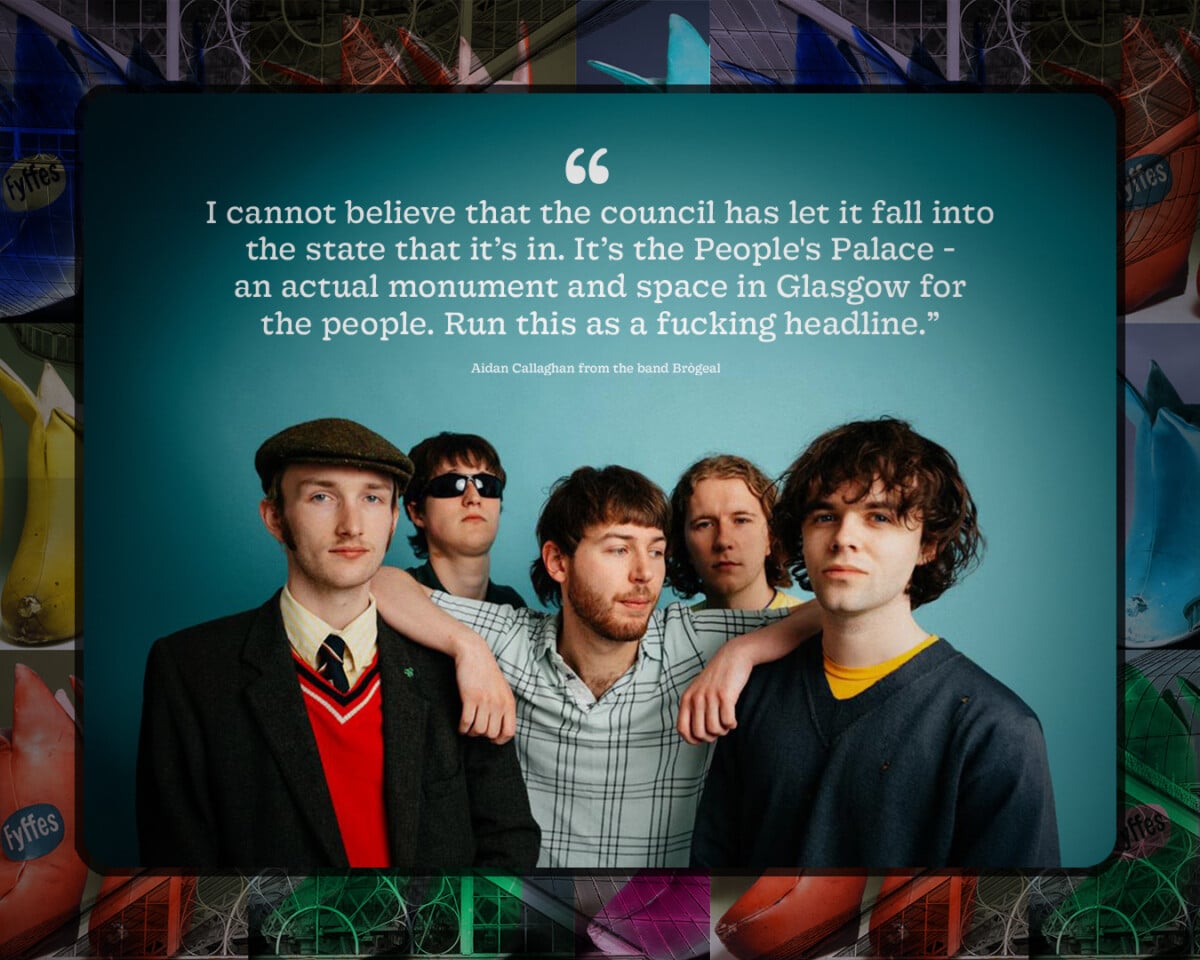
One of those who feels that sense keenly is Aidan Callaghan from the band Brògeal, who, in their own musical right, are on a mission to bring that same working-class pride ethos to the modern day. Their recent double bill of shows in Glasgow even saw them selling merchandise bearing Connolly’s “big banana feet”, showing just how ingrained that iconography is to their identity.
“I cannot believe that the council has let it fall into the state that it’s in,” Callaghan said when Far Out recently spoke to him. “It’s the People’s Palace – an actual monument and space in Glasgow for the people. Run this as a fucking headline,” he joked.
Callaghan’s stance may be particularly outspoken, but it’s one that’s not uncommon in the slightest across the course of the city. People are justifiably angry about the way such an integral landmark has been seemingly allowed to waste away. The banjoist decried the state of the Winter Gardens in particular, with pictures of the current disrepair regularly circling social media.
Of course, many will at least have some level of understanding of the fact that cities and councils don’t just have a never-ending pot of money to dip into, especially in the midst of a cost-of-living crisis that seems to be worse than ever. But from the perspective of the people, the communities whose lives the contents of the museum are built on, this is probably one of the worthiest investments anyone can make.
Not only does art and representation demonstrably open doors to opportunities and social mobility in a place like Glasgow, but there’s an argument to be heard that the museum and its displays actually belong to the people who once inhabited some of the artefacts, or contributed significantly to the stories being told.

“The closure of the People’s Palace represents more than the loss of a museum – it’s the temporary disappearance of one of the few civic spaces dedicated specifically to working-class history,” the Alasdair Gray Archive said. “In a city like Glasgow, where identity is closely tied to community, labour, and migration, that absence is significant.”
They added that without the museum, it creates a version of society in which there is “a gap in how stories of ordinary Glaswegians are publicly shared and preserved. This risks reinforcing a broader cultural imbalance, where institutional memory becomes less representative of working-class experience.”
In that capacity, their endorsement is searingly clear. “Working-class stories are not optional extras – they are foundational to Glasgow’s cultural life. Reopening and properly supporting the museum is not just about heritage preservation, but about cultural justice, representation, and the city’s future.”
There may be anger, but there is also undeniably hope: the people of Glasgow are tenacious, and they will not see their history go down without a fight. Certain decisions may technically be out of their hands for now, but their voices raise high and loud above the trenches of bureaucracy: the People’s Palace must be saved, no ifs or buts about it.
Far Out contacted Glasgow Life, the arms-length organisation responsible for running the People’s Palace, who said in a statement: “The People’s Palace is undergoing a multi-million pound, once-in-a-generation transformation. As is common with large capital investment projects involving Category A-listed heritage structures, our reopening timeline continues to evolve as more detailed technical and design information becomes available and as funding discussions progress.”
They added: “This also reflects our commitment to getting the project right; ensuring it delivers lasting value for local communities and secures the long-term future of this much-loved cultural space as an inclusive, accessible and modern museum. We look forward to being able to announce an exciting reopening programme and will confirm a date for this publicly as soon as we can.”
