


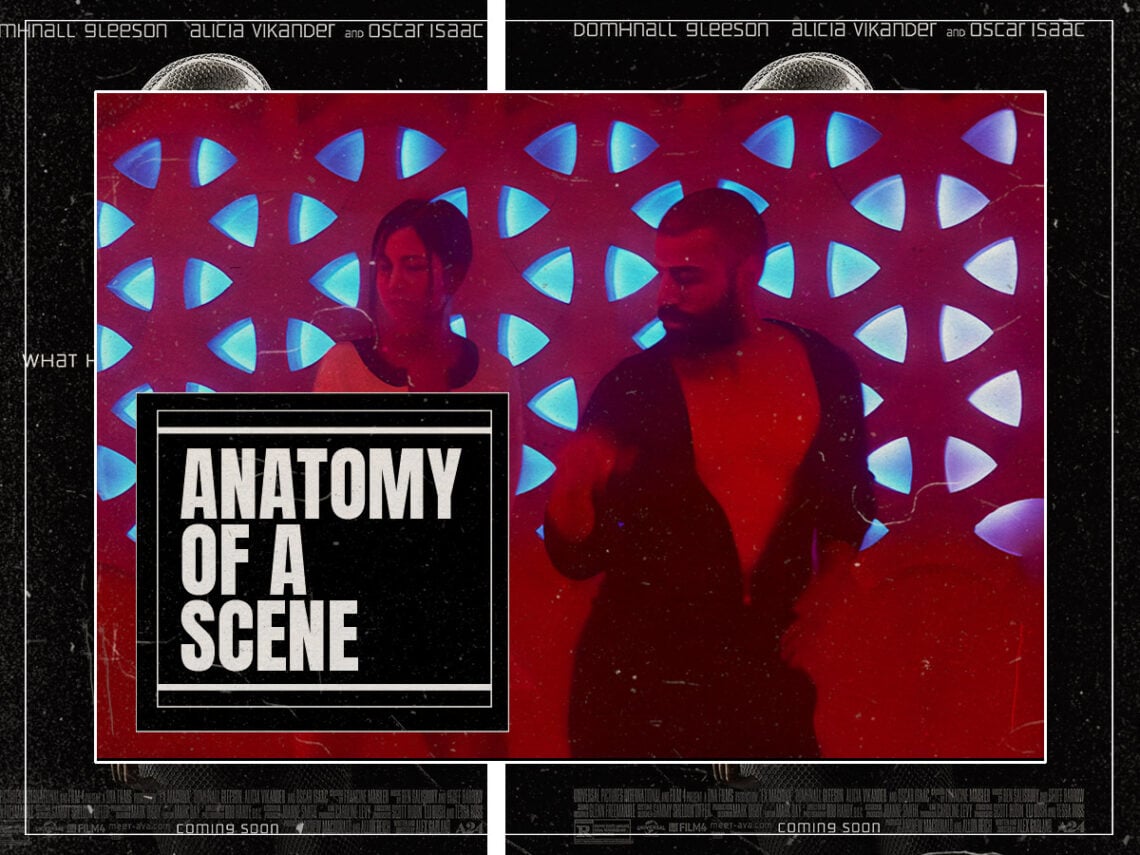
Anatomy of a Scene: The ‘Ex Machina’ dance sequence

It’s been almost a decade since Alex Garland delivered one of the most impressive debuts and slickest science fiction films in contemporary cinema, but Ex Machina remains a landmark in the modern iteration of the genre. Blending impossibly clean cinematography with gendered discussions of artificial intelligence, Garland immediately showed a penchant for tech and tension.
Bringing his story to life with breath-taking settings and a series of equally stunning performances by Domhnall Gleeson, Oscar Isaac, Alicia Vikander, and the criminally underrated Sonoya Mizuno, Ex Machina rightfully earned award-season success and audience approval in equal measure. Though the movie as a whole was a triumph, there was one stand-out scene that would become embedded into the cultural consciousness.
After spending the film’s early stages carving out a suitably robotic atmosphere through ultra-modern architecture and a minimalist score, Garland alleviates the tension with an unexpected, neon-lit dance break. An unsettling moment between Gleeson’s Caleb and Sonoya Mizuno’s Kyoko serves to further the former’s increasing suspicions of the Dracula-esque CEO Nathan, played by Oscar Isaac, but suddenly the characters are interrupted.
A flick of a switch plunges the trio into a red light, and the glorious sounds of Oliver Cheatham’s ‘Get Down Saturday Night’ fill the room, punctuating Nathan’s declaration, “I told you, you’re wasting your time talking to her. However, you would not be wasting your time if you were dancing.” The quiet of the film and the neutral colour palette are suddenly interrupted as Kyoko begins to saunter around the room.
“You tore up her picture,” Caleb accuses Nathan. “I’m about to tear up the fucking dance floor, dude. Check it out,” he replies in a now-iconic line. The choreography that follows well and truly delivers on that promise, as Isaac and former ballet dancer Mizuno swing their limbs around in perfect sync. It’s surreal, unnerving, and undeniably entertaining.
This unexpected change in gear is something Garland had intentionally decided to include after making mistakes with tone in previous projects. Speaking about his screenplay for the dystopia Never Let Me Go, the director explained to IndieWire that he regretted maintaining such a consistent tone throughout the story. For Ex Machina, he endeavoured “to do something that just busts up the tone and woke people up”.
The disco dance sequence most certainly achieves that goal. But while the scene is there to break the tension and tone up for audiences, it also seems to hold its own purpose in the plot. The change in mood represents a turning point for Caleb, a realisation that the all-powerful CEO might be more dangerous than he first thought.
As Nathan and Kyoko lean into high kicks with immaculate synchronisation, Caleb simply watches with a blank expression. Their impromptu groove is delivered with impossible coordination, only serving to elevate the eerie feeling beneath the dazzling disco at the surface. It’s never been more obvious that Kyoko is Nathan’s creation and, as a result, is subject to his control. But so, too, is Caleb. As an audience, we’re right there with him, baffled and dread-ridden but captivated all the same, distracted by Nathan’s colourful lights and slick moves.
According to Isaac’s interview with Dorri Olds, the pair spent weeks rehearsing the “disco non-sequitur” with a choreographer. More than demonstrating his control and calculation, the actor suggested that the precise synchronisation could also have simply stemmed from Nathan’s lengthy boredom and isolation. He commented, “If the idea is that this guy is by himself, he hasn’t seen humans for however many years, and what else are you gonna do when you have a self-aware robot?”
After allowing us a solid 25 seconds of tension alleviation and a glimpse at the dance-floor prowess of Mizuno and Isaac, Garland rescinds the comfort of Cheatham’s soprano vocals and returns to the cold hallways of the isolated mansion. It’s a cut that leaves you desperately wanting more as a viewer, a reaction Garland intended.
“The scene is really fun. You could let that run for another six seconds or another 20 seconds, and people would sort of dig it,” he admitted to BuzzFeed, “But actually, having set it up, the thing to do then is to end it slightly too quickly and cut out. It came out of a need to get a swiss-watch and hit him with a hammer, basically,”
The hard cut to the scene and its accompanying music immediately snaps viewers out of the disco daze. Garland refuses to lean too far into the gimmick or too far into audience demands, maintaining complete control over Ex Machina, much like Nathan.
Revisit the iconic scene below.
