


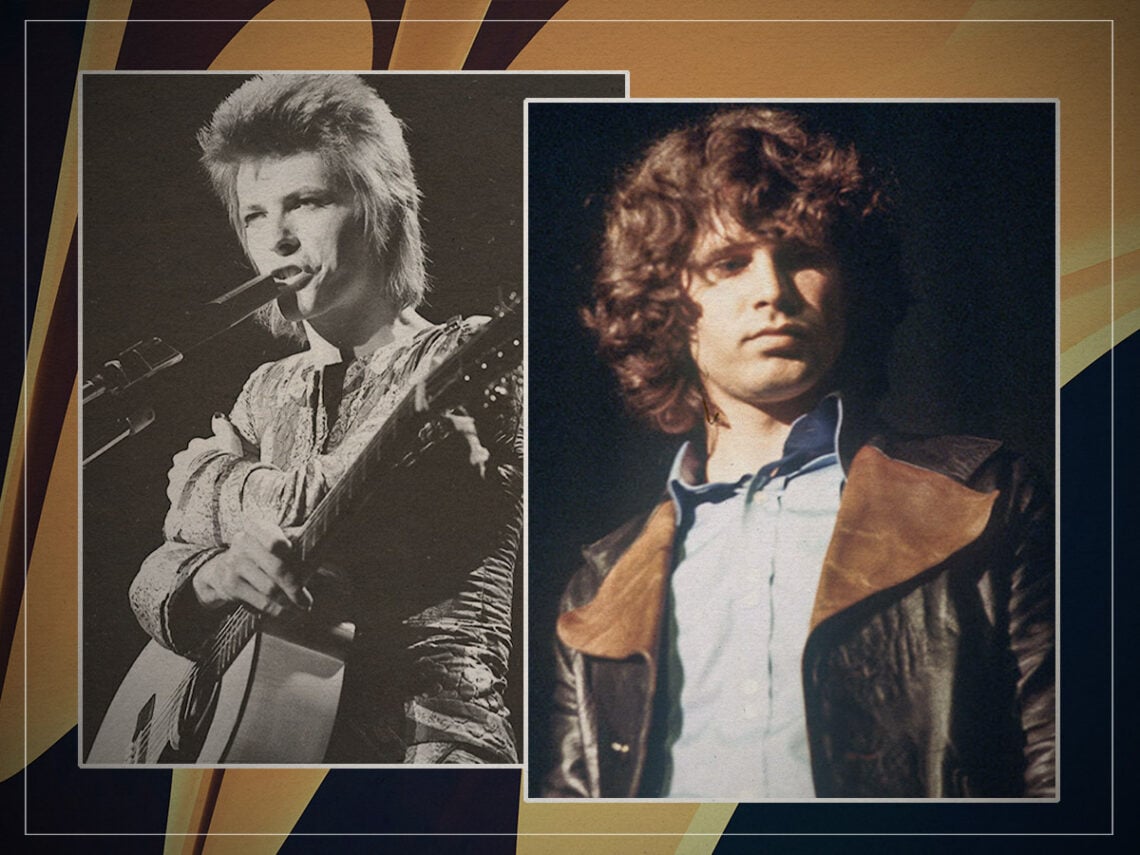
The David Bowie song inspired by Jim Morrison: “I adore that track”

A conversation circulated around the Far Out offices recently about the underwhelming quality of David Bowie’s album covers. For an artist perennially at the edge of innovation, some of them gave a relatively unfair representation of their content.
While that’s ultimately a discussion for another day, it spoke to something wider within Bowie’s work. A question of how far the line of genius can be pushed before it gets questioned? Because Bowie was perennially at the edge, and if he wasn’t praised for his efforts in the present tense, it would almost always be retrospectively viewed for its seismic impact on culture.
In the 1970s, everything he touched turned to gold, and his mercuriality allowed him to seamlessly switch genres. During that decade, he was largely a trendsetter, opposed to a trend follower and created a blueprint of influence from which the following decade launched. To do this, Bowie always soaked up the work of his contemporaries like a sponge, but in the 1990s, the pace shifted to a point where it felt like he was chasing the pack.
It was a decade that saw him embrace a more industrial sonic world and in doing so, Nine Inch Nails became somewhat of a creative north star. As a decade, the 1990s teetered on the edge of revolution, with one foot in the antiquated purity of yesteryear, and the other facing forwards, into a more dystopic and technologically led future.
To Bowie, Reznor and his band were soundtracking a world that mirrored a new alternative reality. In 2005, Bowie wrote about their album The Immortals for Rolling Stone and their list of the 100 greatest rock & roll artists of all time stating, “In making The Downward Spiral, Reznor encouraged the computer to misconstrue input, willed it to spew out bloated, misshapen shards of sound that pierced and lacerated the listener.”
The band left a remarkable impact on Bowie, who, with his 1995 album Outside, sought to create an album that could reverberate through the metal walls of this new industrial landscape. However, in keeping with the transitional nature of the decade and Bowie’s position as a bridge between the two, he kept one eye on a traditional mode of influence when recording the song.
He said, “I adore that track. In my mind, it was like Jim Morrison meets industrial. When I heard it back, I thought, ‘F**k me. It’s like metal Doors.’ It’s an extraordinary sound.”
The track was subject to more genre bending when Pet Shop Boys released a remixed version a year later that added a disco edge to the track as well as added lyrics sung by Neil Tennant.
While Bowie is certainly an open-minded artist, he was initially unsure about the collaboration and had to be convinced by Tennant. But in a rather bizarre pitch, Tennant told Bowie: “It’s like Major Tom is in one of those Russian spaceships they can’t afford to bring down.”
The sell worked on Bowie who reportedly replied: “Oh wow, is that where he is?” before agreeing to the remix.
