


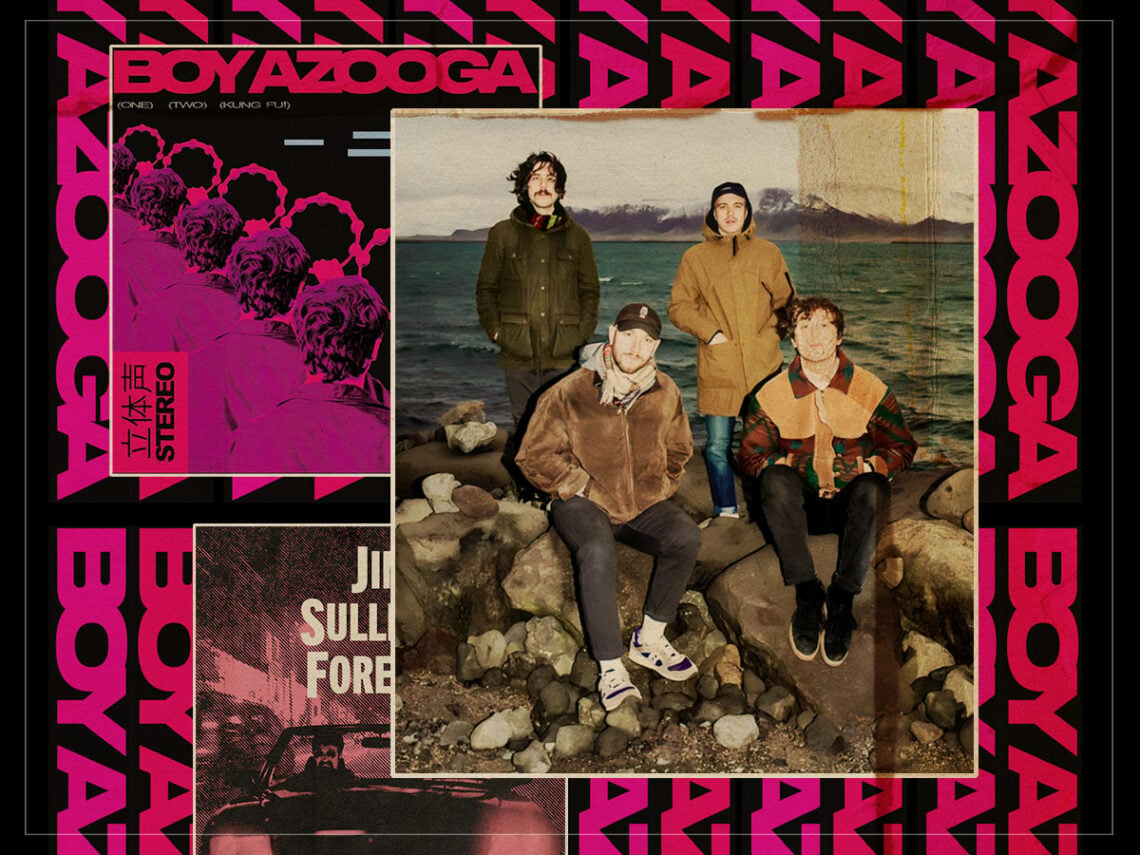
The curious case of Boy Azooga

Everything is ironic today, isn’t it? A parody of something that was once cool. To call a community of fans and the musicians that represent them a “scene” is deemed obnoxious if not delivered with inverted commas. However, something in the essence of that idea still feels important to me. And maybe it still exists? But in place of decadent parties and conversations over record crates, “scenes” now flourish in the online space, somewhere between the cracks of hate and misinformation, are communities built on the safety of anonymity.
But as I cut my teeth as a music journalist in the bustling Cardiff gig community during the late 2010s, I started to find myself in the centre of a healthy scene that boasted all of the qualities I seemed to romanticise from days past. At the forefront was an undeniable talent pool ranging from post-punk, Americana and hip-hop – with the Welsh language performances of those being the most compelling. And within all of those genres were people who genuinely cared for the authentic expression of one another’s art; at the front of every gig would be the face of a fellow artist, clutching a pint and singing the words as they supported the endeavours of their contemporaries.
But as I bounced between Clwb Ifor Bach and The City Arms, fuelled on a diet of pork scratchings, Guinness and wide-eyed excitement, there seemed to be a commonality within the sounds that drew me into each venue door. A psychedelic undertone ran through the city’s best bands, whether it was exercised in blues, noise-rock or punk.
While the development of most communities fights for light beneath the shadows of their classic rock forefathers—The Beatles, Oasis, The Clash—the psychedelic trends I began to notice in Cardiff were rooted in something completely fresh. And it was one record in particular, Boy Azooga’s 1, 2 Kung Fu!, that decided to step forth from the shadows and thrust Cardiff into the creative sunlight.
It was a landmark record in the city and gave way to the genesis of alumni of bands who now proudly represent the scene. One of which were Panic Shack, a punk tour-de-force, who, in the years that followed, marked a fresh sonic chapter for the city. When I asked them about Newington’s influence, they spoke to me about what it meant for the entire attitude of the city’s burgeoning artists.

Explaining, “Boy Azooga were the first band we knew of in Cardiff ‘doing the thing’ like we’d go and see them live around the city, in our local,s but then also hear them on the radio. Which was massive but also showed us that it was achievable, and that’s so important for new artists!… The album is still on repeat for us and loads of other friends. I hum ‘Walking Thompsons Park’ to myself every time I walk past/through it. The record is truly a Cardiff artefact.”
Released on Heavenly Records in 2018, Cardiff’s Davey Newington, otherwise known as Boy Azooga, introduced the world to his sonic masterpiece, 1, 2, Kung Fu!. A dazzling display of concept rock that intertwines monster riffs, dazzling harmonies, and puzzling psychedelia, it was a record that seemingly marked the dawn of a fresh new day in modern indie rock.
The lead single ‘Loner Boogie’ introduces you to a narrative protagonist who weaves his way through a party with outward insecurity while playing host to a sort of complex confidence that would exude through the rest of the record. Whether it was on the full-hearted ‘Jerry’ or spiral-eyed ‘Taxi To Your Head’, it was an album bursting with ideas yet grounded in a warm sense of humanity. As debut albums go, it was a defiant start that wet the whistle of fans aching to hear the various facets of Davey Newington’s creativity.
Soon after, Newington was booked onto support slots with Liam Gallagher, Neil Young and Bob Dylan, exposing the album to 6Music dads far and wide in a move that would seemingly cement his status as one of alternative music’s most important acts to come. But seven years after Newington’s masterful record, I find myself alone at the barricade, waiting for an encore that may never come. Without any real explanation, he has never followed up on the record, and 1, 2, Kung Fu! stands alone as his only body of work to date.
Since its release, Newington has contributed to the production of Cardiff records and pitched in as a session musician. Perhaps more notable is his contribution to Katy J Pearson’s latest record, Someday, Now, both in the studio and on stage. And while this reality seems like an understated sequel to a stunning debut, the ripples of influence his album has had on Cardiff’s output perhaps supersedes the release of one more album.
In the halls of pubs and venues across the city were fresh interpretations of Boy Azooga’s sonic blueprint. One such band I remember seeing live for the first time in 2022 in the iconic and sadly no longer running Porters. They were called The Family Battenberg, and in an electrifying set that felt 20 minutes too short, the impact of Newington’s innovation on the future makers of the scene felt plainly apparent. Not only were the band expanding on the sonic architecture he built, but they were putting their own sense of expression at the forefront of it.
So when I subsequently became a fan of The Family Battenberg and got to know them a little better, it came as no surprise that Newington’s work was heralded as a key influence. When I asked vocalist Eliot Jones about the record more specifically, he said: “1, 2, Kung Fu! was the record that forever changed my brain chemistry. Davey’s songwriting and arrangement is creatively unparalleled. Al-Shakarchi’s engineering and production on the record is a total masterclass.”
Adding, “I was living in the Valleys when it released, and it cemented in my mind that Cardiff was where the music was. I bought a tambourine because I thought it looked cool on the cover. It was my favourite record then and it’s my favourite record now.”
Whether it’s Eliot and The Family Battenberg, twisting the psychedelic foundation set out by Newington in their own raucous and esoteric discography, or CVC riding the groove with hazy-eyed vocal takes, the influence of Newington’s work on a city bursting at the seams with creativity is plain to see.
But the greatest strength of 1, 2, Kung Fu! isn’t its individual components of musicality, but rather the feeling created by the sum of its parts. It’s a record that oozes out of the speakers with complete naturality and feels like the most coherent example of an artist finding his voice. In achieving that, Newington kicked down a door of creative freedom and subsequently fostered a scene that celebrates an odd sense of unified diversity.
I can’t say I wanted him to drop one album and drive off into the sunset, but if it meant leaving one of my favourite eras of music any city has created in his wake, then I have no complaints.

Never Miss A Tale
The Far Out Bob Dylan Newsletter
All the latest stories about Bob Dylan from the independent voice of culture.
Straight to your inbox.