


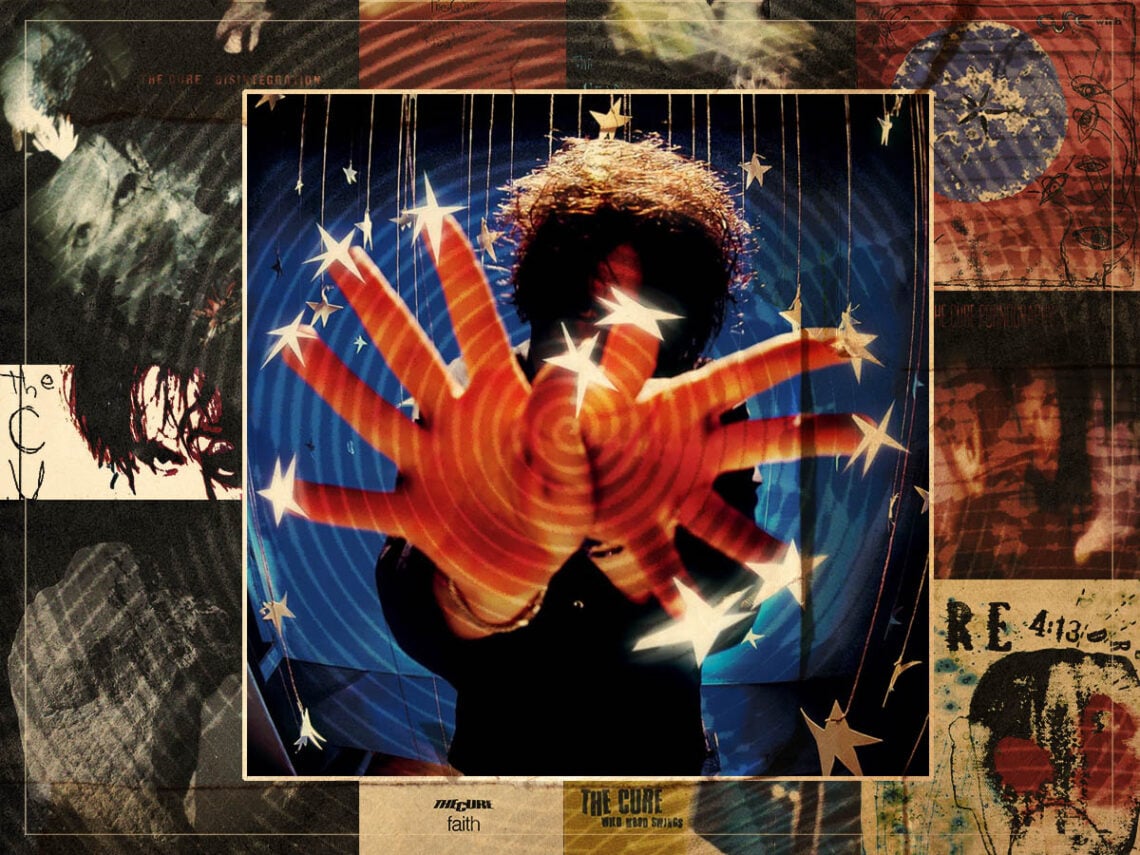
Every album by The Cure ranked from worst to best

The Cure are undeniably one of the most distinctive bands to emerge from the creative wave of the 1980s. Formed in the late ’70s amidst the post-punk explosion, their sound has transformed from raw and edgy to something moodier, gloomier, and, paradoxically, brighter. This evolution has solidified The Cure as one of the most influential groups in Britain’s rich rock history, even giving them a strong claim to having pioneered an entire genre.
That said, The Cure are a lot more than goth poster boys. The group have developed a trademark sound that continues to play tricks on itself, forever masking the dark and morose within candy-pop flavours while sugar is drenched in the sweat and tears of gloomy goth rock. It’s a juxtaposing combination that has made The Cure quite possibly the ultimate cult band.
Famously, The Cure arrived out of Crawley, Sussex, with their debut 1979 album, Three Imaginary Boys; little did they know that in the 21st century, the clamour for their latest album would be an insanely loud roar and one that was answered in 2024 with the long-awaited release of Songs Of A Lost World, an exquisite unveiling of impending finality.
While a whole new best today, the band’s sound initially drew on the riff-heavy energy of punk before quickly evolving in the ’80s, solidifying their status as the quintessential band of their own making. This shift inspired countless others to adopt a darker outlook and moodier expression. By the decade’s close, The Cure’s sound had transformed once again, infusing their sombre lyrics with a sugary pop twist, creating an ideal blend of the bitter and the sweet.
Their evolution continued throughout their psychedelic jangly phase and back into their more gloomy sound. It’s been a career arc that shows no sign of ending anytime soon, as their latest release exemplifies.
If you’re not sure where to start with the impressive discography of The Cure and are unsure which of the band’s 14 albums you should begin with, then below, we’ve got you covered as we rank the albums in order of greatness.
The Cure’s albums ranked from worst to best:
13. 4:13 Dream (2008)
4:13 Dream, released in 2008, is the group’s thirteenth studio album and arguably why there has been such a desire for more music—albeit not for the reasons Robert Smith would want to hear. There’s no other way to go about it; this one was a letdown.
Arriving after a four-year stint away, 4:13 Dream The Cure returns with a blend of darkly introspective tracks and more upbeat, melodic numbers that marked a divergence from the consistently melancholy tone of earlier works. The record, it goes without saying, was one of the most pop-infused releases from the band and suggested perhaps they had become tired of their own signature sound.
It was undoubtedly a disappointment for those who had waited so long for a new album, but it still has some classic Cure sensibilities. 4:13 Dream may have talked the talk and hinted that The Cure’s pop side was once again out and proud, but it failed to ever truly walk the walk, let alone stage a march.
12. The Cure (2004)
Sometimes, the pursuit of evolution can lead the band astray, and their self-titled LP from 2004 is certainly one of their missteps. Employing nu-metal producer Ross Robinson may have been seen as an adventurous step in music-making, but he ended up picturing the band as a pastiche of their former selves.
There are certainly some hits on the record; ‘Taking Off’ is a perfectly welcomed jangle-pop tune, while the epic closing song ‘The Promise’ is simply marvellous. Otherwise, the rest of the album falls comparatively flat. It is fine when it arrives as a morsel of the group for their starving fans, but now it rarely gets a spin on the record player.
In retrospect, The Cure represents a moment of creative risk for the band, an exploration of darker, more abrasive sounds that highlights the versatility and emotional range of Smith and his bandmates.
11. The Top (1984)
As The Cure grew out of their somewhat bleak post-punk period, they grew into some fairly uncomfortable guises. While the non-album singles like ‘Let’s Go To Bed’ and ‘Love Cats’ had seen some chart success, the vision of the band’s future was blurry at best.
With the ring of pop stardom calling them closer to the cliff edge, the band produced their most saccharine record to date.
The real blurry vision, however, came from the band themselves. Almost composed entirely by Robert Smith as the different group members squabbled, it’s a reminder that having good co-workers always produces better material. However, we will say that the jaunty skiffle rhythm of ‘The Caterpillar’ is still capable of drawing a smile whenever we hear it.
10. Wild Mood Swings (1996)
When you’re trying to follow an album like Wish with something a little bit more left-field, chances are you’re always going to fall short.
That can certainly be said of 1996’s effort, Wild Mood Swings. With a shift in personnel as Boris Williams quit and Jason Cooper and Roger O’Donnell joined, the album is caught between two styles and perhaps landed at the wrong time.
Released in the summer of ’96 as England was brimming with football and lad culture, The Cure’s attempts to satisfy everyone with their varying sounds as they paint by numbers and attempt to deliver a meal everyone can enjoy. Sadly, despite some big wins, not everybody leaves the table satisfied.
9. Faith (1981)
Here’s the first time we may upset some Cure fans. If you’re a diehard fan, then the release of The Cure’s 1981 album Faith will likely remind you of a time when The Cure became a fully realised band.
Away from their searing post-punk debut and further pursuit of the new sound on Seventeen Seconds, the band had begun to cultivate a brand new sonic landscape that would dominate their style for the decade to come.
‘Primary’ and ‘The Funeral Party’ are two standout numbers from an album that showed that The Cure were about to become real icons of the music world. It’s a sign of just how good the band’s discography is that an album of this calibre is so low down on the list.
8. Bloodflowers (2000)
Robert Smith described Bloodflowers as part of the trilogy, which also includes the behemoth albums Pornography and Disintegration as being ‘definitive Cure LPs’. The reason being that the sonic landscape of the record is melancholy yet wistful and welcoming; it saw Smith paint with a far broader brush than ever before.
That’s because Smith essentially brings the album out of the theatre and, instead, grounds it in the reality of the modern, now-21st-century world. The songs are big and beaming but largely intimate with songs such as ‘Where The Birds Always Sing’ being the pick of the bunch. It’s still regarded as one of Smith’s finest pieces of lyrical writing.
8. Songs Of A Lost World (2024)
“I’m outside in the dark, wondering how I got so old,” The Cure band leader Smith sings on the closing track to Songs Of A Lost World. His usual gloomy conviction rings on, presenting a reminder that this is precisely where The Cure will always be—lurking, shadowy, in a haze of ominous questions without answers.
In Songs Of A Lost World, the exquisite guitar work and meticulously produced rhythmic cadences complement all the unspoken words, revealing a more immersive side to The Cure, where the haunt of a perturbed mind lingers in the subtleties. Ambience is a prominent force in modern music, and here, its vagueness is anything but background.
7. Wish (1992)
Following the release of Disintegration and with a swell of new fans and a growing group of critics now applauding the band’s every move, the group’s ninth album topped the UK chart. It even climbed to number two on the Billboard chart, proving that The Cure had truly gone global. Of course, a line-up change was employed as the group’s sound only grew.
The band were quickly becoming headline acts and stadium-sized acts at that. It meant that they needed to flesh out their sound, and, on Wish, they certainly did that.
The band leaned into their baroque pop image and delivered some of their most obviously pop-adjacent songs ever. As well as ‘Friday, I’m In Love’, there was also ‘High’, a song dripping in romantic euphoria. But, for our money, ‘From The Edge of the Deep Green Sea’ is our favourite from the LP.
6. Three Imaginary Boys (1979)
Often, a band’s debut album is determined as the most expressive of the group’s career. It stands to reason, too.
After all, many groups have worked years and years to get that elusive first record deal and so have a large body of work to draw from, never mind the energy and enthusiasm to see the vision through. The same can’t quite be said of The Cure’s debut, mainly because it provided such a jumping-off point for the band.
The Cure were still growing into themselves when they released their searing post-punk debut, Three Imaginary Boys. An album brimming with malicious intent was also drenched in melancholy and melodrama. While we will quickly move on from their covers of ‘Foxy Lady’ by Jimi Hendrix, songs like ‘10.15 Saturday Night’, ‘Accuracy’ and ‘Object’ all land with some serious weight. It hinted at a bright future.
5. Seventeen Seconds (1980)
Dreaded second album syndrome didn’t strike The Cure as they delivered one of their finest records straight off the back of their debut. Seventeen Seconds was released in 1980 and suggested that The Cure were about to become one of the music scene’s major players. Smith had a new vocal whine, and the band’s music was suddenly lightened up and brightened to perfection.
Though the songs were still full of grim motifs and their signature aesthetic was beginning to pierce through, Smith demonstrated that his growing ability to craft left-field pop hits was coming to the fore.
‘Play For Today’ is a brilliant number, but the immense ‘A Forest’ is still widely regarded as one of the band’s finest-ever songs. There’s a heavy dose of nightlife angst and underworld glimmers, but overall, the album lands as the first stepping stone to their stardom.
4. The Head on the Door (1985)
As Pearl Thompson became a part of The Cure’s recording band and their touring group, they brought with them a collection of jangle pop riffs that cemented The Cure as pure pop stars, if only for an album. Their sixth LP, The Head on the Door, was also shaped, perhaps most prominently, by MTV’s advent.
As the network began to dominate the airwaves and determine the charts, the need to make music that would appeal to the core audience was evermore present.
With this record, The Cure became chart-toppers and had escaped the past’s gloomy sounds to explore a shuffling and joyful pop sound that captivated an audience. ‘In Between Days’ and ‘Close To Me’ are the perfect examples of that theory coming to fruition.
3. Pornography (1982)
In 1982, The Cure were still establishing their sound, and with this album, Pornography, the group did a great job at rounding it all out. If you wanted a quick summary of exactly what the band were all about in ‘82, then you need only hear one of the first lines of the album: “It doesn’t matter if we all die…”
That song, ‘One Hundred Years’, is one of many songs highlighting The Cure’s new direction and purpose. Having followed a similar path to Siouxsie and The Banshees (emerging from punk to find a new artistic channel), the group use their post-punk sensibilities to capture the intense feeling of the band’s regeneration.
The album is only eight tracks wrong, but every aspect of gothic rock is covered. There are the themes of sex through the track ‘Siamese Twins’, drugs on ‘A Short Term Effect’ and the impending dread of death in pretty much every song. The group brings their single-minded vision to record and prove that they were a band capable of defining whatever scene they drifted into.
It just so happens that they’re happiest when sad.
2. Kiss Me, Kiss Me, Kiss Me (1987)
When 1987 rolled around, The Cure had not only been post-punk pioneers but had also branded themselves with their own specially crafted goth iron. They returned to jangle-pop, shoegaze, and spangly joy on their 1987 record, and it became the first album to break the top 40 in the US.
Recorded amid the growing tensions between Smith and Lol Tolhurst, there’s a confidence to this album that makes it better than most of their catalogue.
Purists will likely see the inclusion of the album so high up on our list as an act of war but the beguiling nature of the record means that it has had us entranced ever since the needle first dropped.
Whether it was the burning brass of ‘Why Can’t I Be You’ or the piano-driven beauty of ‘Just Like Heaven’, the LP cracked the lucrative American market and announced The Cure as a serious contender for the decade’s ultimate musical icons.
1. Disintegration (1989)
If there’s one album to distil The Cure’s feverish attitude, then it has to be 1989’s Disintegration. There’s something greatly grotesque about taking a burgeoning pop career and metaphorically wiping your arse with it. It is this delightful image that is conjured up whenever you listen to The Cure’s album. If it isn’t, it should be.
The Cure had, by 1989, a serious career under their belts. They had emerged from punk as one of the artistic new auteurs of alternative rock music, and their sound had even gone as far as to develop the group into pop stars. A series of pop records that charted well and saw some commercial success could easily have swayed Robert Smith and the band to follow the money trail to middle-of-the-road obliteration. Instead, they revolted with this album.
The band use the 12 tracks of the album to create landscapes that feel moodier and more menacing than ever before. In fact, ‘Landscapes’ is likely too bright an expression; the Cure were digging wells on Disintegration and were happy to throw us all down there in a bucket. Smith’s delicate state of mind is explored and expressed on every track, with some particular favourites being ‘Plainsong’ and ‘Pictures of You’.
If The Cure’s music is all about seeing the beauty in the darkness of humanity, then there is perhaps no better expression than that of Disintegration.
