


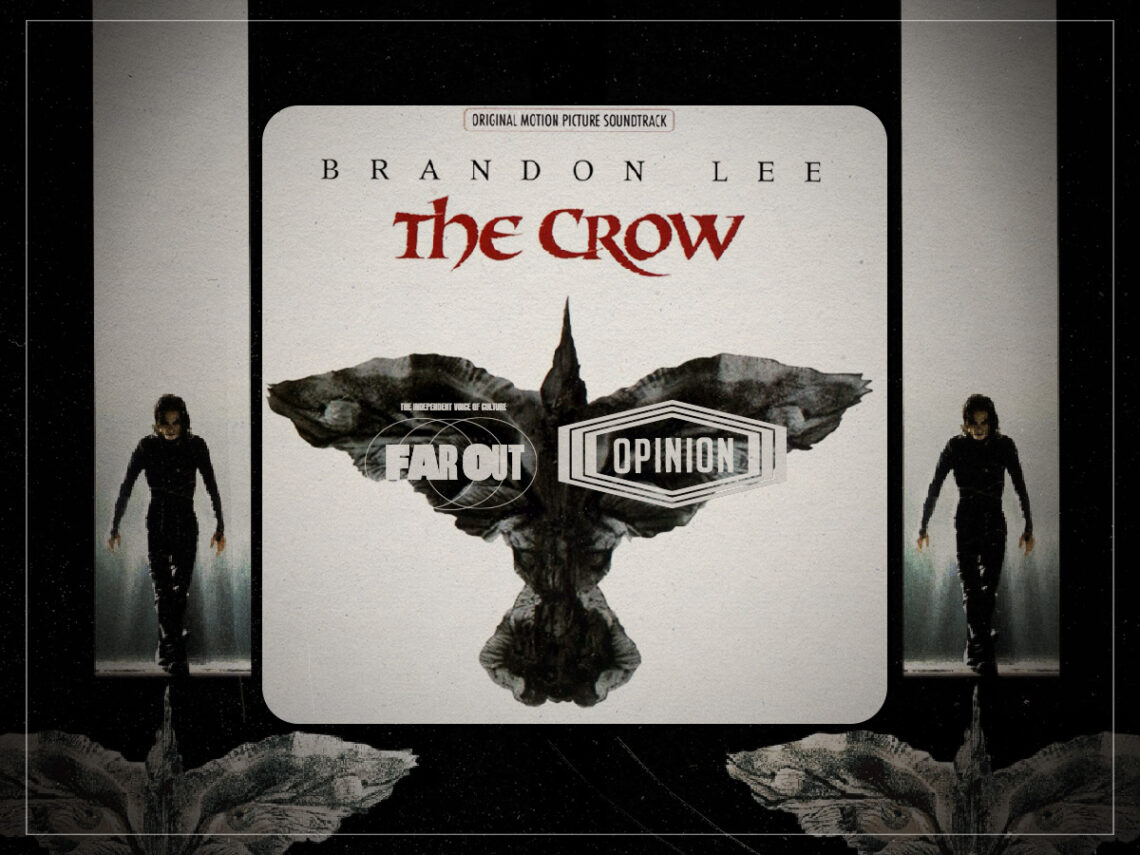
Hear Me Out: ‘The Crow’ soundtrack is still gothic perfection

When artist James O’Barr was drawing the pages of the comic that would become The Crow, two bands remained central to bringing the story to life: The Cure and Joy Division.
On one entire page, O’Barr reprinted the lyrics to The Cure’s ‘The Hanging Garden’, the sole single from their fourth album, 1982’s Pornography. Chapters of the comic book are named after Joy Division songs, including ‘Atmosphere’ and ‘Atrocity Exhibition’, and a lyric from ‘Disorder’ is adapted as dialogue for the protagonist, Eric Draven. Music became intrinsic to the conception of The Crow, inherently rooting the story in the Gothic and post-punk while establishing its mood, centred on tragedy, mourning and vengeful reckoning.
First published in 1989, The Crow comic series was crafted as a result of O’Barr’s own grief over the murder of his fiancée by a drunk driver, as he expounded the anger that he felt into his artwork. The story centres on Eric, who, with his fiancée Shelly, is attacked by a gang; he is forced to witness her being brutally assaulted, and both are murdered. Later, Eric is resurrected by a crow to seek revenge on the murderers, carrying out their demise one by one.
The 1994 film adaptation by director Alex Proyas sets the story in a crime-stricken Detroit, with Eric as a rock musician portrayed by the late Brandon Lee, who was tragically murdered during the making of the film, fatally wounded by a prop gun.
Dedicated to the memory of Brandon Lee, The Crow’s soundtrack is the perfect companion to the film’s sombre tone, compiling some of the greatest goddamn voices across metal and alternative – in a lighter twist, The Cure contributed an original song to the soundtrack, a full-circle moment for O’Barr. Initially, ‘The Hanging Garden’ was to be featured in the film, but Robert Smith took such a liking to the comic that he wrote and recorded an original song alongside The Cure’s then-drummer, Boris Williams.
Together, they created ‘Burn’, which became the film’s main theme, as the lurking bassline and tumbling drums carry Smith’s tale of relentless devotion: “But every night I burn / Every night I call your name.” In the film, the song plays as Eric transforms himself with black-and-white face paint and all-black clothing, post-resurrection.

The industrial rock band machines of Loving Grace also recorded an original song for the soundtrack, ‘Golgotha Tenement Blues’, written after the band read the film’s screenplay. The Jesus and Mary Chain did the same, contributing their noise-pop tune ‘Snakedriver’ which first appeared on their compilation 1992’s The Sound of Speed, before the release of The Crow soundtrack. “[The producers] had asked us for a song, and we went into our studio, messed around with a couple possible ideas,” singer Jim Reid explained on MTV’s Alternative Nation in 1993. “This one worked out best.”
A highlight of The Crow soundtrack is Stone Temple Pilots’ ‘Big Empty’, which appears on their 1994 album, Purple. They had intended to offer a song called ‘Only Dying’, an early demo that would not be released until 2017, for their debut album Core’s 25th anniversary. In light of Lee’s death during production, the band chose ‘Big Empty’ in its place, a song that flows from an acoustic drawl to a thrashing chorus, all of which captures the feeling of loneliness.
Rage Against the Machine also offered a song from their discography, re-recording a song known as ‘Darkness of Greed’ from a 1991 demo tape, and in turn, contributing to ‘Darkness’. The song dates back to frontman Zack de la Rocha’s previous hardcore-punk band Inside Out, written for an album to be titled Rage Against the Machine, before their breakup in 1991. Helmet contributed an alternate version of their own song, too, in the form of ‘Milktoast’ (a new version of ‘Milquetoast’), recorded with producer Butch Vig, while the electronic-industrial band My Life with the Thrill Kill Kult not only revamped their song ‘After the Flesh’ for The Crow, but then featured it in a cameo in the film, performing at a Gothic rave in an abandoned cement factory.
A number of covers also feature on The Crow soundtrack: Rollins Band contributed their rendition of proto-punk duo Suicide’s ‘Ghost Rider’, Pantera chose to cover the hardcore-punk band Poison Idea’s ‘The Badge’, and, perhaps most well-known, Nine Inch Nails covered Joy Division’s ‘Dead Souls’. In a 2013 interview, bassist Peter Hook revealed that New Order were approached to contribute their version of ‘Love Will Tear Us Apart’, in honour of Joy Division. While this never came to fruition, the band did give their blessing to have Trent Reznor & co give their rendition of ‘Dead Souls’ to the soundtrack.
The song’s haunting lyricism, invoking imagery of being plagued by dreams and morbid voices that insist on the repeated, “They keep calling me,” Nine Inch Nails’ rendition mirrors Joy Division’s performance – the song plays in a key moment during the film, just after The Cure’s ‘Burn’, as Eric follows his crow, running across rooftops that lead him on his vengeful path.
Now, nearly 32 years after its release, The Crow stands as a poignant meditation on grief, leaning into an intrinsic darkness and violence, and its soundtrack captures these emotions, becoming a capsule of an era that remains brilliantly evocative.
