


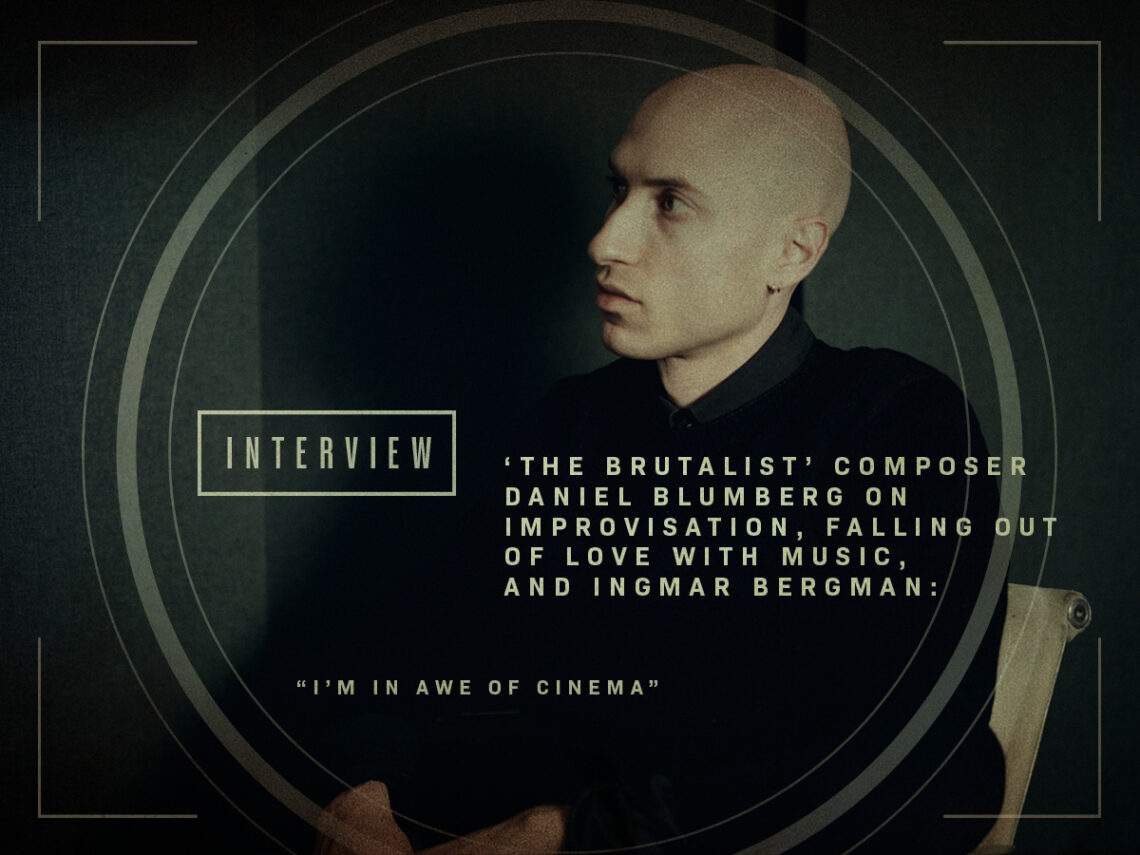
‘The Brutalist’ composer Daniel Blumberg on improvisation, falling out of love with music, and Ingmar Bergman

When Daniel Blumberg appears on the Zoom call, he’s wearing a black leather jacket and begins to roll a cigarette. In his mid-thirties, he’s one of the youngest composers to be nominated for ‘Best Original Score’ at the Oscars, but he has already been an acclaimed artist for more than two decades. As a teenager, he was the frontman of London-based indie band Cajun Dance Party before becoming a founding member of the indie group Yuck. Now, he’s put all that behind him and, by the sounds of it, has found his calling.
“I came to film when I was about 17,” he says. “I discovered film, and it was immediately this – I was watching more films than I would listen to records… I became a professional musician when I was 15, just immediately, as soon as I started making work, and that process immediately became demystified. So when I listen to music, sometimes I’m thinking about how it’s been recorded and all sorts of things, how it’s been constructed, rather than experiencing it. But with film, it was completely magical because I didn’t know how films were made.”
At one point in our conversation, Blumberg stands up from his desk and carries his laptop over to a bookcase crammed with DVDs to find a particular Ingmar Bergman film he loves. “This one’s amazing,” he says, brandishing his copy of the 1969 drama The Rite. “Structurally, it’s really interesting,” he continues, chuckling over the discrepancy in running time between Bergman’s 74-minute film and the nearly three-and-a-half-hour film for which he’s been nominated.
In the score for Brady Corbet’s awards frontrunner The Brutalist, Blumberg created a sweeping palate of sound, from large-scale brass orchestrations to quietly lyrical piano to 1980s synthpop and jazz. The film follows Adrien Brody’s László Tóth, a fictional Hungarian architect who moves to the United States after the ravages of the Holocaust to chase the American dream. Blumberg worked with world-class musicians from around the UK and Europe, many of whom specialise in improvisation.
Improv has played a key role in his journey as a musician. It even brought him back from a period where he had stopped making music altogether. “I came to improvise music when I was about 22,” he says. “I was disillusioned with music in general, and my friend took me to a concert where someone was improvising, and I just hadn’t been exposed to that before in music.” Again, it was cinema that led the way for him. He had religiously watched the movies of John Cassavetes and Mike Leigh and particularly remembered the moment when he watched Andrei Tarkovsky’s hallucinatory science fiction dreamscape, Stalker.

“I remember watching Stalker in this flat about 14 years ago and just having an experience,” he says. “Something was happening. I was there; I was somewhere. And it’s – for the same reason why I’m struggling to create sentences – But it’s beyond language, and it’s this access to people’s feelings and emotions that is beyond language.”
When his friend took him to see improvised music, it set him on a new path. “For years, all I did musically was improvise and not even record,” he reveals, saying that when he was asked to start making film scores, he had to find a way to reconcile his love for improvisation and the strictures of being one piece of a much larger project. He found himself asking the same question when he went back to songwriting: “What are you trying to achieve?”
“It was like, ‘What are you trying to achieve by bringing these limitations to the process, which is supposed to be unlimited?'” he said. “So, with songs, are you bringing a structure? Are you bringing words? With a film, there is a structure to the narrative. Do I bring that to the recording session? And all of these questions are good because it can create something that has attention or feels a bit dangerous, and I think when it’s successful, it’s got that same feeling where something is happening… And that’s really great to see when you’re… watching something unravel.”
The Brutalist is Blumberg’s second feature score following his work on Mona Fastvold’s The World to Come in 2020 (Fastvold co-wrote The Brutalist). He opted to blend improvisation and structure, allowing each musician and ensemble to interpret themes to make them their own. Nowhere is this more apparent than in the intermission. Blumberg and Corbet had discussed that section of the film from the beginning and decided to enlist the talents of avant-garde improvisational pianist John Tilbury. Blumberg travelled to the musician’s garden studio with his recording equipment and captured hours of improvisation. One piece, which was about 13 minutes long, jumped out at him when he was going back through the recordings.
“I brought him ‘Erzsébet’s Theme’, which is introduced in the second half of the film when László meets his wife after all these years,” he says, “And the piece of music for the intermission is John sort of working that out. Working ways of playing it out… But he also had this idea that he wanted to introduce klezmer, the Jewish music, into his playing.”

Blumberg wanted to bring in another layer of improvisation to the piece – the ambient sounds of the studio and the outdoors. “[Tilbury] stops, and he writes notes, and you can hear his hands on the piano, and you can hear his stool creaking,” Blumberg says, “And there’s also these silences, this space… you can hear the birds walking on the studio roof. And then, at one point, he talks to me.” It gives that somewhat antiquated element of the film, the intermission, a sense of intimacy and life that flies in the face of the formal, overbearing orchestrations that used to accompany Old Hollywood intervals.
More than anything, however, Blumberg wanted to adhere to Corbet’s vision with his score. “My aim is to make music that’s completely contextualised by the screenplay,” he explains. “And the earliest thing was finding these sounds that just felt like the world of the film.” His first instinct was to use prepared piano. “The process is sort of humorously connected to construction, as in, you’re putting screws in the strings of the piano, and the hammers are banging the strings,” he says. “There’s the tools of architecture.”
Beyond that, however, was the range of sound that the instrument could provide. “The piano has this sonic potential because of its vastness, because of its space,” he explains. “If you put a microphone in, you can get very different sounds depending on where you put microphones on a piano, even disregarding the room that you’re recording in. Within the piano, you can find huge reverbs. Someone can play one string, or you could play 30 strings at the same time, like a whole orchestra. And that relates to the sort of Brutalist approach.”
In the film, we see Tóth designing and constructing vast and minimalist rooms and buildings. In one key scene, he transforms a stuffy, dimly lit library into a breathtaking, expansive reading room that filters in natural light and capitalises on the space of its high ceilings.
Ultimately, Blumberg judges the success or failure of his score on how seamlessly it fits with the film. “When I saw it in Venice, I thought [the score] was successfully not distracting,” he says, “Because that would be awful if it was distracting because it should be part of Brady’s story, and what Brady’s trying to say, rather than being its own entity.”
“I’m in awe of cinema and directors,” he adds, “And that means that that’s sort of the priority, even when I’m mixing and stuff, it’s all secondary.”
The fact that many viewers and the Academy (and Bafta voters, who handed him the award last month) would disagree about his score being obscured by the rest of the film is to Blumberg’s credit. His compositions swell with emotion, modulating from the intimacy of birds’ feet on a metal roof and the gentle notes of a piano to the breathtaking grandeur of the four-note progression that recurs throughout the film. It’s a remarkable feat for a relatively new film composer and hints at a promising career to come.
