


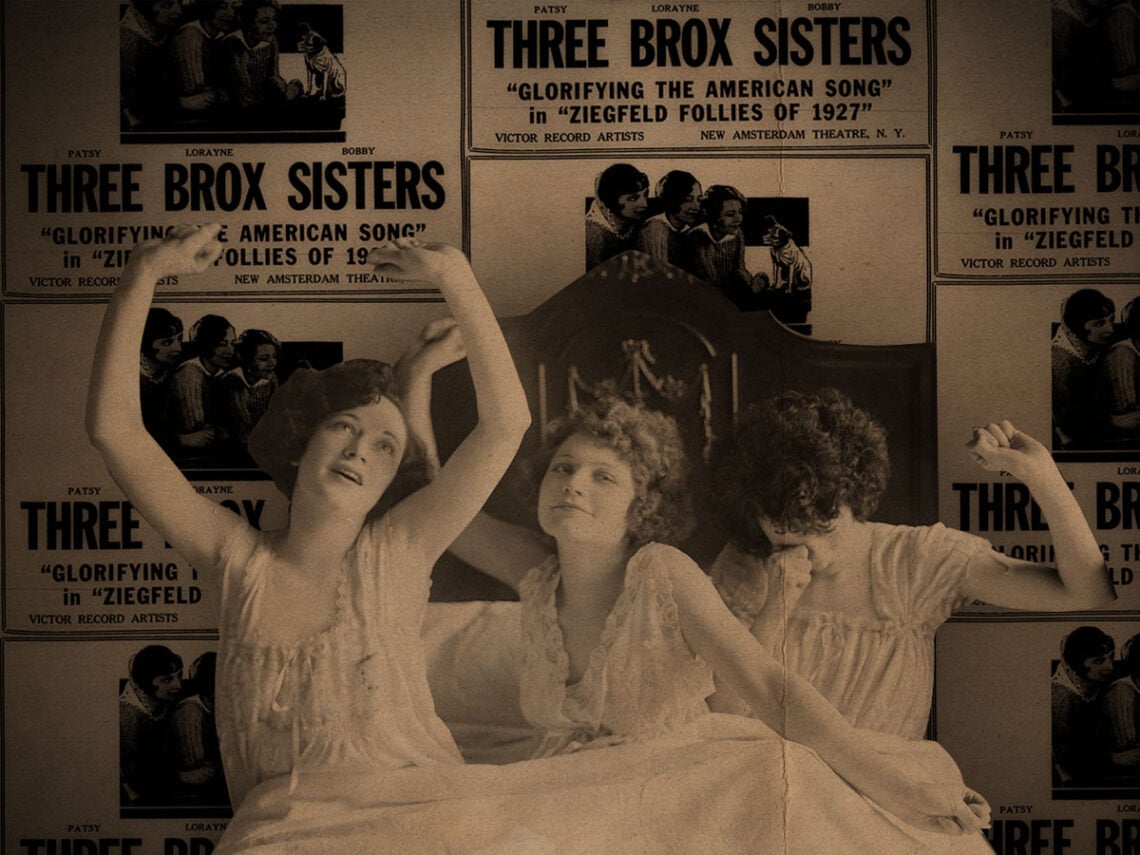
The Brox Sisters: Broadway-bound pioneers of the ‘girl group’

Before the “Golden Age” of girl groups from the mid-1950s, and even the earliest all-women groups that emerged from and within Vaudeville, like The Three X Sisters and The Boswell Sisters, another sister trio named The Brox Sisters were the earliest, making a name for themselves from the 1910s.
Lorayne (born Eunice, 1901), Dagmar (born Josephine, 1902; and later went by Bobbe) and Patricia (born Kathleen, 1904) were born in Iowa and Indiana, and grew up in Alberta, Canada and Tennessee. It was while living in Canada that the sisters began singing together as a trio, performing as kids in Mother Lang’s Children’s Show in Vancouver. The sisters began making a name for themselves within the Vaudeville circuit in the 1910s, situated among their fellow singers, dancers, comedians and various eccentric on-stage personas with their signature harmonies.
Transitioning into larger theatre roles, the sisters stuck together as they travelled from Canada to New York, changing their birth names and surname in the process. They went from “Brock” to “Brox”, at the suggestion of a producer, who believed “Brox” would look better on a marquee.
On stage at the New York Theatre, the Brox Sisters found fame starring in the Music Box Revue, a series of four musical theatre revues by Irving Berlin that ran from 1921 to 1924 (the sisters appeared for three years, except 1922). Where Berlin wrote the book, music and lyrics to all four revues, he wrote the song ‘Everybody Step’ just for the Brox Sisters, who debuted the tune, as well, in 1921 – later recorded by the likes of Bing Crosby and Ella Fitzgerald (with Chick Webb and His Orchestra). Other recordings of Berlin compositions from the sisters followed, including ‘Bring on the Pepper’ and ‘Lazy’ (later recorded by Marilyn Monroe, among others).
In both 1925 and 1926, the Brox Sisters debuted in the musical comedy The Cocoanuts during its Broadway run, starring alongside the Marx Brothers comedy troupe. Once again with music from Berlin, the sisters sang a number titled ‘Monkey-Doodle-Doo’. The following year, they emerged as part of the Ziegfeld Follies, the Parisian-inspired elaborate theatre revues that, among hosting various entertainers, became iconic for their Ziegfeld Girls, chorus girls appearing in ornate costumes. The Brox Sisters did not appear as one of the girls, but they shared an act with Eddie Cantor, an all-around entertainer across comedy, singing and dancing.

While the sisters made history as music’s first girl group, they transitioned into the film world as their talents in the theatre began to translate on-screen. Crucially, they performed in the midst of the transition from silent films to “talkies”, and where many silent film actors and actresses’ careers did not sustain as well in the interim, the Brox Sisters were prominent artists who helped usher the transition forward. They appeared in three Warner Brothers’ Vitaphone sound shorts in the late 1920s: Glorifying the American Song and Down South (both 1928) and a six-minute short, Down South (1929).
While these films are considered “lost” (Down South only exists in camera negative at the Library of Congress, and a disc is potentially being restored), the Brox Sisters’ appearances in them solidified them in popular culture and signalled Hollywood’s eye towards Broadway stars as a viable source of entertainment in the film world. Where the tangible evidence may be lost, the sisters’ influence persists in the trajectory of film history, as they eased the change that shocked the industry, while bringing in a new way for music to be immortalised on film, as well.
In something of a combination of these two art forms – and perhaps most famously – the Brox Sisters appeared in the Broadway show The Hollywood Revue of 1929, which saw them perform a finale number, ‘Strike Up the Band’, and ‘Singin’ in the Rain’; for the latter, they appeared bundled under one raincoat as they harmonised alongside Cliff Edwards.
The song became foundational in cinema history as one of the pivotal marks of the shift to film “talkies,” and it would later serve as the basis for the musical film of the same name in 1952, which, of course, needs no introduction. But, before Gene Kelly sauntered across puddles of rain, the Brox Sisters brought the tune to life.
Where the 1920s saw the sisters record numerous radio broadcasts and phonograph records for Brunswick, Victor and Columbia Records, respectively, the 1930s saw their careers in film expand. In Spring Is Here (1930), the Brox Sisters appear in matching curled hairdos and glittering gowns, performing the song ‘Crying for the Carolines’ with an elegant poise. King of Jazz (also 1930) sees them sing ‘A Bench in the Park’ with musicians Joe Venuti and Eddie Lang, and The Rhythm Boys, before Bing Crosby launched his solo career. Their final film credit came in 1932 in Hollywood on Parade, where they performed ‘Falling in Love Again’, later sung by The Beatles.
After the early 1930s, the Brox Sisters disbanded, each venturing into their own personal lives away from the spotlight and thus, their work as a trio largely faded into music and film history. Patricia, the youngest sister, passed away in 1988, followed by the oldest, Lorayne, in 1993. The last surviving sister, then known as Bobbe Brox, passed away in 1999, at the age of 98. Despite their relative unknown in the history books, the sisters opened a door for girl groups after them to enter.
